

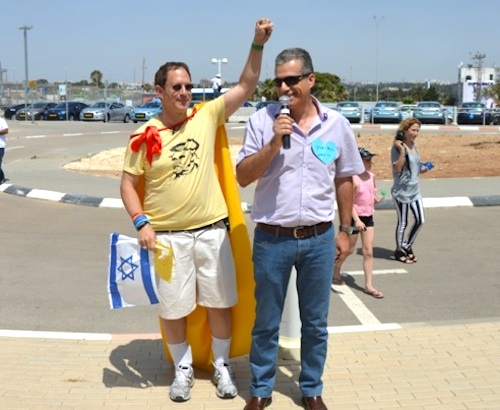
 The Better Place electric vehicle network was always an ambitious dream, and now it doesn’t have to die thanks to the man known as Captain Sunshine.
The company declared bankruptcy in May, but today an Israeli court awarded the liquidation of its Israel-based assets and Swiss-based intellectual property to Yosef Abramowitz and a union of Better Place car owners, who are determined to continue building an open, national technology and serve platform for all current and future electric vehicles.
Better Place founder Shai Agassi had a great vision when he set out to bring both electric vehicles and state of the art battery charging systems to Israel.
He raised an extraordinary amount of money to realize his vision, which culminated in the construction of 37 charging stations, 2,000 curbside charging stands, and 1,000 electric vehicles driving around.
But it was expensive to build what is currently the world’s largest network of EV battery switching stations. Each cost $500,000, such that by the time the company called it quits, they had lost $800 million, according to the Times of Israel.
Plus the management team had lost site of its own vision and nobody, nobody being government officials, was willing to work with them.
Abramowitz, who founded Arava Power and Energiya Global in order to spread good will and solar energy as far and wide as possible, explained to the paper that Shai Agassi was trying to build a monopoly, instead of a national network that would benefit as many EV owners and developers as possible.
And with the country’s richest man, Idan Ofer, at the helm, the government was unwilling to offer any tax breaks. So they failed.
First Agassi was fired from the company he started, and then Better Place officially declared bankruptcy in May, after which the court swiftly appointed a liquidator to find a buyer for the company’s assets.
In the meantime, the 900 or so EV owners who had purchased a $44,000 Electric Renault Fluence from the company were very happy with their purchase and decided to form a lobby or union just before the company’s fall in order to protect not just their financial interests, but also the company’s original ideology.
If they are eventually charged with energy produced by the renewable energy, which is what Abramowitz proposed when Shai Agassi first got started, EV’s could go a long way to reversing some of the environmental damage we have done with gas guzzling cars.
“We are committed to maintaining the 2,000 charging spots and basic battery swap services for all current and future EV drivers in Israel,” said Efi Shahak, Chairman of the EV Drivers Association. “We thank the Court and liquidators for giving Israel a second chance to get it right.”
Whereas Agassi seemed to hoard his idea, Captain Sunshine and Shahak want to bust it open so that it functions as a cooperative that benefits not only Better Place cars, but all electric vehicles that will inevitably enter the country.
“Our vision is to transform the charging network into an open, national technology and service platform for all current and future EVs,” said Abramowitz.
“We look forward to Israelis soon driving and charging Teslas and other EVs that will save money for both drivers and government, fight climate change and keep our air clean.”
They have inherited a broken system, but they have also inherited a lot of intellectual property and investors have already committed to giving them 25 percent of the funds they will need to keep the company running for the next two years.
But they will need more.
“The Company is currently seeking new investment of up to $36 million (USD) by offering both equity and convertible debt participation. We are saving a dream here, so the valuation and terms will be investor-friendly,” said Abramowitz, who will co-chair the Company along with Shahak.
Already so well connected with government officials with whom he has cooperated to get his solar energy projects off the ground, Abramowitz is keen to help build a system that aims to do good, instead of a system whose main goal is to make money.
They expect to break even within 24 months.
Read more about Better Place:
A Better Place Owner on Tesla’s Battery Swap Tech
Uncertain Future for Better Place ZE Owners
Better Place Bankruptcy is a Sad Day for Electric Car Industry




[…] Read the full story here. […]
Is this a sob story? Don’t blame the government. Don’t tell a backwards story about some type of economic discrimination. Focus on the relationship that they had with the consumers; that’s the real story.
the management team had lost SIGHT, not site, of its own vision
Thanks, fair comment! I’ll fix that immediately.
Thanks, Tafline. I think your sentence in the article, “,,, the management team had lost site of its own vision and nobody, nobody being government officials, was willing to work with them,” definitely hits the mark. But I think that Abromowitz’s claim that Shai Agassi was trying to build a monopoly misses the mark. Mr. Agassi always said that he welcomed competition, but asked only that the electric plug used by his competitors be to international standard. Of course, it goes without saying that to use battery-exchange stations, the battery would have to be suspended under the vehicle, not under the hood or otherwise permanently attached to the car.
I re-viewed a number of Shai Agassi’s video lectures on YouTube and found that Mr. Agassi had always envisioned Better Place as a support network for ALL electric cars. The battery swap stations, according to him, could handle a range of batteries from the vertical type in the Fluence ZE to the flat type in the Tesla Model S. The government helped Better Place to some extent by ruling that electric car owners could not simply plug in their cars to their home’s electric outlets. But this break was, I believe, less due to Better Place lobbying, attempted monopoly or other influence and more because the power companies did not want their loads spiking when EV owners plugged in at home or at work. Better Place offered a computer-controlled network that could smooth the power load by not charging all cars from the moment they are plugged in. Shai Agassi acknowledged that car owners could plug into their home outlets, but warned that, if that practice ruined the battery, Better Place would hold the car owner liable.
Also, when Shai Agassi was asked where additional electric power would come from, he said, on numerous, occasions, that he wanted it to come from clean sources such as solar (Israel) or wind (Denmark).
Many of Mr. Agassi’s solutions have been criticized, but it is hard to know whether the critics are correct or whether they have not thought the problem through as thoroughly and systematically as he has.
I spoke with Abromovich yesterday, who with car owner partners and investors, has taken over the company: the problem with the original model seems to be that the Israeli government didn’t want to give “breaks” to Idan Ofer, an oligarch. That and the company didn’t really connect with the “people” in Israel. I will be writing about our conversation soon. Stay posted.
Wrong about Agassi.
In 2010 they went to the government, asking for regulations on EV charging (there were none). They ended up essentially writing these regulations for the clueless government. And what an overreach it was. They excluded any charging except by a company with a centralized control room. In other words, anyone except Better Place.
This was leaked by Haaretz and caused serious PR headaches. So the government loosened the regulations somewhat, and issued some PR junk brochures in English to get people off their backs.
But to this day, the official Israeli regulations still outlaw simple trickle-charging of EVs from the home plug. This is how we charge our Nissan Leaf. Fortunately, we are expatriate Israelis, otherwise we’d be breaking the law every night. This outlawing, unheard of anywhere else, was clearly tailored to ward off competition from non-switchable EVs such as the Leaf, and even more so from easier solutions such as the plug-in Prius.
So yes, Better Place has built its entire business model upon monopoly and upon captivating the individual consumer (they catered mainly to company fleets who buy the employee’s cars for them; but they failed). No need to try and put lipstick on that pig. They deserved to fail. It’s the 900 Fluence ZE drivers who don’t deserve to be stranded, and we should be thankful to Abramowitz for stepping in. If in the process he sends some hints in Agassi’s direction (hints that are very polite in Israeli terms), he’s fully earned that right and Agassi has earned far worse than that.
Oh, and by the way: trickle-charging on a 220V plug takes up some 6-7 amps. Less than a toaster.
“Spiking the grid” my foot. It’s the Better Place reps who raised this bogey-man to clueless electric-company and government officials. They acted like the fox in the henhouse, and ended up shafted. No tears over that.
As to Agassi “analyzing thoroughly” the situation more than anyone else: this “thorough analysis” apparently led him to introduce a brand-new variation on the brand-new concept of EVs, to a society and economy totally unprepared for it.
Also, I wonder what kind of “thorough analysis” leads someone to build the entire national infrastructure before any serious cash inflow has been generated. Speaking of which: simple arithmetic, as well as some admissions published in the Israeli press, suggest that the actual per-station costs of Better Place were upwards of $2 million a pop, rather than the formally quoted half-million.
The stations that cost $500,000 apiece are not “charging stations.”. They are battery exchange stations Please correct this error. Thanks.