

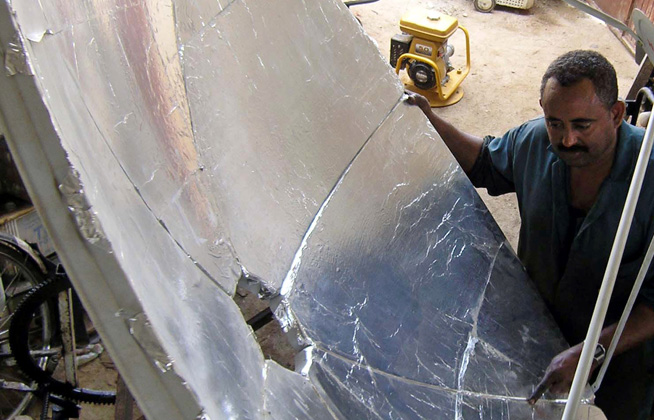
The Middle East and North Africa have faced a number of hurdles in getting what experts believe could be the greatest solar power grid in the world off the ground. From Morocco to Egypt to the United Arab Emirates (UAE), obstacles have continued to stand in the way of creating a grand solar project. Until now.
According to the Climate Investments Funds (CIF), this week they are prepared to deliver $7.6 billion to Algeria, Egypt, Jordan, Libya, Tunisia and Morocco that would enable the go-ahead to create “an unprecedented 1,120 megawatts (MW) of energy from Concentrated Solar Power (CSP) for the region.”
CIF said it is expected to leverage some $5 billion from donors in addition to $660 million to finance the ambitious project.
It comes as Morocco, home to Desertec – the largest solar power project in the world – faced controversy late last year after European donors failed to show up at an investment meeting aimed to get funding for the project.
In the two years since the beginning of the Arab Spring, CIF says the project has undergone numerous changes to mold itself to the current political and economic environment.
“The revised plan accepted today by the CIF governing body provides a realignment of projects in the pipeline based on each country’s reassessed needs; focuses on well-performing projects as a stronger measure of the plan’s positive impact; and expands the plan’s horizons to also include Concentrated Solar Photovoltaic (CPV) technologies and business models including public sector, public-private partnerships (PPPs), and independent power producers (IPPs),” it said.
The original plan projected a total of 895 MW of power, but with the revision the region now expects to achieve 1.12 GW, making it the most ambitious CSP program in the world. The countries have also agreed to request a smaller funding envelope from the original US $750 million to US $660 million including currently funded projects.
“The changes suggested by the countries in the plan make it a more viable and flexible plan which takes into account the realities each of these countries face,” stated Mafalda Duarte, AfDB coordinator for the Bank’s CIF program.
“We can all look to this revised plan as both a signal of hope for the forward economic and social movement in the region built on renewable energy, and a more realistic blueprint for the evolution of renewables as a potent engine of power globally.”
Experts hope that the new funding won’t find itself struggling like Desertec in Morocco. It saw a number of pull-outs late last year, which Green Prophet reported, including the future of the project as a whole.
Both Bosch and Siemens pulled out, further fanning skepticism. But All Africa reports that despite setbacks, solar energy is safe in Morocco, where the Moroccan Agency for Solar Energy (Masen) has secured $380 million for a 160MW CSP plant planned for the same region set aside for the Ourzazate plant.
With few fossil fuel reserves to call their own, Morocco has long demonstrated its commitment to generating renewable energy.
In 2009 the government unveiled a plan to spend $9 billion on a total of 2 GW of solar energy by 2020, in addition to wind and biofuel projects.
Then in June, 2011, the Desertec Industrial Initiative (Dii) signed a cooperation agreement with Masen to start working on projects that would allow Europe to benefit from Morocco’s solar. This agreement would have allowed Morocco to lean on Dii’s networking prowess for help with its own plans.
Given this history, it’s not so surprising that the media panicked when the Desertec initiative took a tumble, but it was premature to underestimate Morocco’s ability to sidestep obstacles in order to meet the country’s rising energy demand.
Now, with the new funding, solar power can finally, or hopefully, be the future that the MENA region believed it would be many years ago.


[…] Read the full article here […]