
Suntech Launches New Research Centre In Arava – INTERVIEW

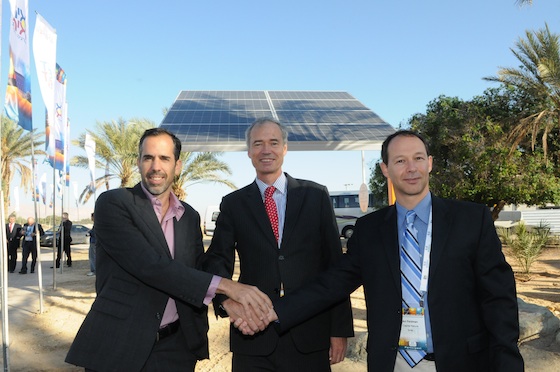
suntech arava solar isrealFollowing the inauguration of Suntech’s new research centre in Arava, we speak to their Chief Technology Officer (pictured centre) about the future of renewables in the Middle East

As one of the largest producers of solar panels, Suntech is undoubtedly a world player. In Israel alone, out of a total of 220 solar megawatts produced, 100 megawatts are harvested by Suntech’s panels. Suntech panels were also used on the Ketura Sun field, the first commercial solar field in Israel. As such, the company’s decision to open a new research centre in the Arava region didn’t come as a huge surprise. Green Prophet caught up with Suntech’s Chief Technology Officer, Dr. Stuart Wenham to talk about their solar plans for the Middle East region.

According to the Clean Energy Business Council, there are more than 150 renewable-energy projects under way right now in the Middle East and North Africa. For a region which is known mostly for its oil and fossil fuels that is very impressive. Indeed, the region is gained something of a reputation for its increasing interest in renewables and particularly solar. Suntech, which recently opened its research centre in Arava, is in Israel with the hopes of doubling its power production from 100 to 200 megawatts. I spoke to Dr. Stuart Wenham about opportunities in Jordan and Saudi Arabia and the major restrictions they face in Israel.

GreenProphet: China has become world famous for its solar technologies and research. Why did you want to establish a research centre in Arava, Israel?

Dr. Stuart Wenham: Suntech is committed to technological innovation. Our investment in a testing facility is twofold; first to test our most cutting edge technology in some of the harshest conditions on earth, in the Arava desert. Secondly, to invest in a facility where we can work with other local companies to develop and test new technologies that can work to improve the efficiency of our cells and increase the output of our panels.

What restrictions are you facing in Israel and what can the government do to help encourage renewable technologies?

Israel is a land full of sun and harnessing the power of Israel’s most abundant natural resource is something that should be important for all players. Regulatory barriers, layers of bureaucracy and sudden changes in renewable energy policy all present substantial challenges to the sustainability of the market.

Do you hope to further expand your reach in the Middle East/North Africa region? Do you see it as an exciting market?

Yes, this is certainly a promising market. Saudi Arabia plans on installing several gigawatts of installations and we have recently completed the largest solar field in the country, 3.5MW at the King Abdullah Petroleum Studies and Research Center in Riyadh. Jordan is also a promising market as it has recently announced strong policies to support solar. It also lacks substantial fossil fuel reserves, unlike many of its neighbors and therefore needs to more heavily depend on resources like solar.

What countries in the MENA region do you see as having particularly good potential to develop their solar energy?

The Kingdom of Saudi Arabia, Jordan and the United Arab Emirates all have very good prospects for the development of solar.

Why should the region be considering solar and not other alternatives such as wind and nuclear?

The most abundant natural resources that the Middle East has by far is not oil, its sun. The amount of sunlight that shines on the Earth’s surface in one hour is enough to power the world for a whole year. It’s important to tap this unlimited power.

Are bureaucratic restrictions increasing or decreasing in the region?

Bureaucracy is certainly a challenge in many countries, especially for a new industry where many regulations and permitting procedures have yet to be developed. We encourage the development of wise, sustainable and transparent policies that can encourage the development of solar and sustain the industry as well.

Why should countries choose Suntech and not local solar companies and organizations? What are Suntech’s unique selling points?

Suntech’s technology is best suited for harsh desert climates. Suntech’s panels recently passed the desert sand test, which replicates the conditions of a desert sandstorm, the first and only solar power company to do so. Suntech is a global company with a local focus. We have the largest in installed base of panels in the world, over 7MW and have brought power to over 1 million people across the world yet we work with our local partners through our regional offices to bring customer service directly to our customers doors.

: Photo is courtesy of Suntech.

For more on solar in the Middle East see:

Saudi’s $109 Billion Solar Plan

Solar Mama – A Film About Jordan’s Solar Women
Gulf Nations Among Most Attractive Renewable Energy Markets

Bureaucracy Slows Israel’s Solar Energy Progress

Arwa Aburawa
Arwa Aburawahttp://www.greenprophet.com
Arwa is a Muslim freelance writer who is interested in everything climate change related and how Islam can inspire more people to care for their planet and take active steps to save it while we can. She is endlessly suspicious of all politicians and their ceaseless meetings, especially as they make normal people believe that they are not part of the solution when they are the ONLY solution. Her Indian auntie is her model eco-warrier, and when Arwa is not busy helping out in the neighborhood alleyway garden, swap shopping or attempting fusion vegetarian dishes- with mixed success, she’d like to add- she can be found sipping on foraged nettle tea.

LEAVE A REPLY

Please enter your comment!
Please enter your name here

TRENDING

Astro uses AI to help procure land for renewable energy

For oil-rich, environmentally vigilant Gulf states, Astro isn’t just another startup story. It is a blueprint for accelerating an energy transition that is now existential, not optional.

How Renewable Energy is Revolutionizing the Way We Power Our World

Solar has become the star of the transition thanks to modular hardware and straightforward installation. It fits dense cities and remote towns alike. Many companies are turning to rooftop arrays and carport systems - and exploring commercial solar installation as a practical way to lock in future savings.

Leading Through a Dual-Energy Transition: Balancing Decarbonisation with Energy Security

Experience in one area of the energy industry isn't enough to guarantee readiness across all the others. That's where a structured program like an MBA in energy can come in. Today's advanced curricula explore energy economics, finance, policy, and strategic management alongside the technical subjects. And when pursuing an energy MBA online, professionals can skill up and retrain without having to step out of the labor market -- an important perk at a time when skilled professionals are already in short supply.

M2PV Capital Targets the American Southwest as Its Launchpad for Off-Grid EV Growth

In the American Southwest, electric vehicles face extreme heat, long travel distances, and limited grid access that expose the real infrastructure gaps behind the EV transition. M2PV Capital is building off-grid charging and power systems designed to operate independently in the region’s most demanding conditions.

What is the Jewish Climate Trust?

Jewish Climate Trust has quickly attracted the attention and support of some of the most influential voices in Jewish philanthropy, drawing backing from prominent family foundations and business leaders connected to the Bronfman and Schusterman philanthropic networks, alongside climate-focused investors and community builders aligned with founding leader Nigel Savage. Together, these donors have committed many millions of dollars to build a serious, long-term climate platform for the Jewish world — not as a symbolic gesture, but as a strategic intervention in one of the defining challenges of this generation.

Qatar’s climate hypocrisy rides the London Underground

Qatar remains a master of doublethink—burning gas by the megaton while selling “sustainability” to a world desperate for clean air. Wake up from your slumber people.

How Quality of Hire Shapes Modern Recruitment

A 2024 survey by Deloitte found that 76% of talent leaders now consider long-term retention and workforce contribution among their most important hiring success metrics—far surpassing time-to-fill or cost-per-hire. As the expectations for new hires deepen, companies must also confront the inherent challenges in redefining and accurately measuring hiring quality.

8 Team-Building Exercises to Start the Week Off 

Team building to change the world! The best renewable energy companies are ones that function.

Thank you, LinkedIn — and what your Jobs on the Rise report means for sustainable careers

While “green jobs” aren’t always labeled as such, many of the fastest-growing roles are directly enabling the energy transition, climate resilience, and lower-carbon systems: Number one on their list is Artificial Intelligence engineers. But what does that mean? Vibe coding Claude? 

Somali pirates steal oil tankers

The pirates often stage their heists out of Somalia, a lawless country, with a weak central government that is grappling with a violent Islamist insurgency. Using speedboats that swarm the targets, the machine-gun-toting pirates take control of merchant ships and then hold the vessels, crew and cargo for ransom.

Leopoldo Alejandro Betancourt López Turned Ocean Plastic Into Profitable Sunglasses

Few fashion accessories carry the environmental burden of sunglasses. Most frames are constructed from petroleum-based plastics and acrylic polymers that linger in landfills for centuries, shedding microplastics into soil and waterways long after they've been discarded. Leopoldo Alejandro Betancourt López, president of the Spanish eyewear brand Hawkers, saw this problem differently than most industry executives.

Why Dr. Tony Jacob Sees Texas Business Egos as Warning Signs

Everything's bigger in Texas. Except business egos.  Dr. Tony Jacob figured...

Israel and America Sign Renewable Energy Cooperation Deal

Other announcements made at the conference include the Timna Renewable Energy Park, which will be a center for R&D, and the AORA Solar Thermal Module at Kibbutz Samar, the world's first commercial hybrid solar gas-turbine power plant that is already nearing completion. Solel Solar Systems announced it was beginning construction of a 50 MW solar field in Lebrija, Spain, and Brightsource Energy made a pre-conference announcement that it had inked the world's largest solar deal to date with Southern California Edison (SCE).

Related Articles

Popular Categories