
The Middle East and the Unending Quest for Stability (Op-Ed)

oil-arab-spring-environment‘The Middle East must stay stable or else the world will face impending economic and ecological doom’ – debunking the myth

My day job requires I read a lot on the Middle East and the environment – from the perspective of economists, environmentalists, political leaders, civil society and also a lot of commentary coming the rest of the world on the Middle East. One strand of thought that has really got me riled up recently is the notion that the Middle East by dreaming of democracy is causing instability which will not only threaten the economy but also the environment. A little dramatic right? Since when was the fate of the entire world in the hands of the Middle East? It short, it’s not. In fact, it’s completely in the hands of everyone else and the real threat is the economic model we live by which equate success with constant growth.

Writing in Alternet, Marshall Auerback states that the heated conflict after the Arab Spring will likely give way to high gas prices and more pollution. “The situation has the feel of Iran, circa-1979. We don’t have a crystal ball, but oil supply is always a concern when conflict arises in oil-rich countires(sic), which may well trigger high gas prices and increased environmental dangers,” he adds. The instability in the Middle East, he reasons, will change the political calculus in favour of more production domestically in countries such as Canada and the US.

Right. So, why is that the Middle East’s fault? The countries who are choosing to dig for dirty fuels instead of investing in renewable projects are the ones making the big mistakes. If the Middle East can’t or won’t provide them with their fossil fuels and they choose to look for more fossil fuels that’s their bad decisions and can’t be blamed on anyone by the countries themselves. Secondly, I completely disagree with his statement that the alternative would be to rely on “unreliable OPEC-based supplied in countries full of Islamic extremists.” Nothing like a bit of casual prejudice and discrimination I guess.

What I really dislike about this stream of thought is that it places blames squarely on the Middle East rather that stating that 1) all countries are locked into growth obsessed economies 2) all countries have choices and if they make the wrong ones then they alone are accountable and 3) the Middle East doesn’t owe ANYONE stability. If the people want change and take to the streets to protest and get rid of their dictators then we should be supporting them. Not saying, “oh actually, we’d prefer it if you didn’t do that – think of the economy!” For years, the West supported its chosen strongmen dictators to keep its oil supply flowing and everyone understood that. But pretending that the Middle East has the power to save or destroy the environment – and bringing in that moral argument – is just simply preposterous.

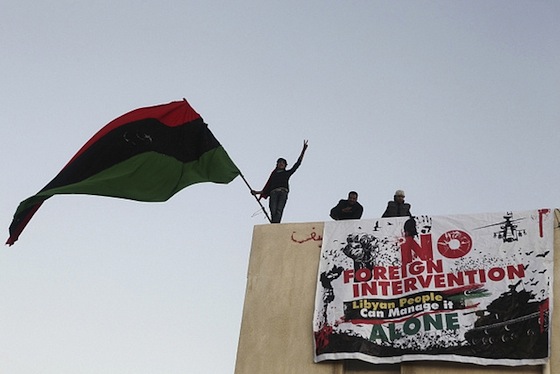
: Image via ЯAFIK ♋ BERLIN/flickr.

For more on the Arab Spring and the economy see:

Was The Arab Spring Good for Renewable Energy?
#Occupy Climate Change: The Arab Spring and Occupy Wall St

Arab Spring May Boost Chance for Desertec Solar Power

Arwa Aburawa
Arwa Aburawahttp://www.greenprophet.com
Arwa is a Muslim freelance writer who is interested in everything climate change related and how Islam can inspire more people to care for their planet and take active steps to save it while we can. She is endlessly suspicious of all politicians and their ceaseless meetings, especially as they make normal people believe that they are not part of the solution when they are the ONLY solution. Her Indian auntie is her model eco-warrier, and when Arwa is not busy helping out in the neighborhood alleyway garden, swap shopping or attempting fusion vegetarian dishes- with mixed success, she’d like to add- she can be found sipping on foraged nettle tea.
2 COMMENTS

LEAVE A REPLY

Please enter your comment!
Please enter your name here

TRENDING

How does one start prepping?

Faced with an extreme winter storm this year, Americans wonder how to be prepared for catastrophe. Miriam has lived through wars in the Middle East - so she's prepared on giving you a guide to prepping.

Oil pollution in Basrah’s soil is 1,200% higher than it should be

Soil pollution levels in parts of Basra are 1,200% to 3,300% higher than those typically measured in cities like Toronto or New York, according to new comparative soil data. It's getting into water.

Iran’s holiest city about to run dry as terror chosen over water management

Iran’s second-largest city, Mashhad, is facing an acute water emergency after dam reservoirs feeding the city fell below three percent capacity, according to Iranian state and local media. Officials warn that without rainfall or improved inflows from neighboring Afghanistan, the city’s supply could soon collapse.

Freedom Flotilla sets sail toward Gaza with Greta Thunburg on board to liberate Gaza

Inside the controversial voyage that merges climate activism, human rights, and Middle East politics. Will the Freedom Flotilla make it to Gaza?

The Emirates wants to help Lebanon become a sustainable winner

Can sustainable experts change the future of Lebanon for the better? The UAE is leading the way.

Qatar’s climate hypocrisy rides the London Underground

Qatar remains a master of doublethink—burning gas by the megaton while selling “sustainability” to a world desperate for clean air. Wake up from your slumber people.

How Quality of Hire Shapes Modern Recruitment

A 2024 survey by Deloitte found that 76% of talent leaders now consider long-term retention and workforce contribution among their most important hiring success metrics—far surpassing time-to-fill or cost-per-hire. As the expectations for new hires deepen, companies must also confront the inherent challenges in redefining and accurately measuring hiring quality.

8 Team-Building Exercises to Start the Week Off 

Team building to change the world! The best renewable energy companies are ones that function.

Thank you, LinkedIn — and what your Jobs on the Rise report means for sustainable careers

While “green jobs” aren’t always labeled as such, many of the fastest-growing roles are directly enabling the energy transition, climate resilience, and lower-carbon systems: Number one on their list is Artificial Intelligence engineers. But what does that mean? Vibe coding Claude? 

Somali pirates steal oil tankers

The pirates often stage their heists out of Somalia, a lawless country, with a weak central government that is grappling with a violent Islamist insurgency. Using speedboats that swarm the targets, the machine-gun-toting pirates take control of merchant ships and then hold the vessels, crew and cargo for ransom.

Leopoldo Alejandro Betancourt López Turned Ocean Plastic Into Profitable Sunglasses

Few fashion accessories carry the environmental burden of sunglasses. Most frames are constructed from petroleum-based plastics and acrylic polymers that linger in landfills for centuries, shedding microplastics into soil and waterways long after they've been discarded. Leopoldo Alejandro Betancourt López, president of the Spanish eyewear brand Hawkers, saw this problem differently than most industry executives.

Why Dr. Tony Jacob Sees Texas Business Egos as Warning Signs

Everything's bigger in Texas. Except business egos.  Dr. Tony Jacob figured...

Israel and America Sign Renewable Energy Cooperation Deal

Other announcements made at the conference include the Timna Renewable Energy Park, which will be a center for R&D, and the AORA Solar Thermal Module at Kibbutz Samar, the world's first commercial hybrid solar gas-turbine power plant that is already nearing completion. Solel Solar Systems announced it was beginning construction of a 50 MW solar field in Lebrija, Spain, and Brightsource Energy made a pre-conference announcement that it had inked the world's largest solar deal to date with Southern California Edison (SCE).

Related Articles

Popular Categories