
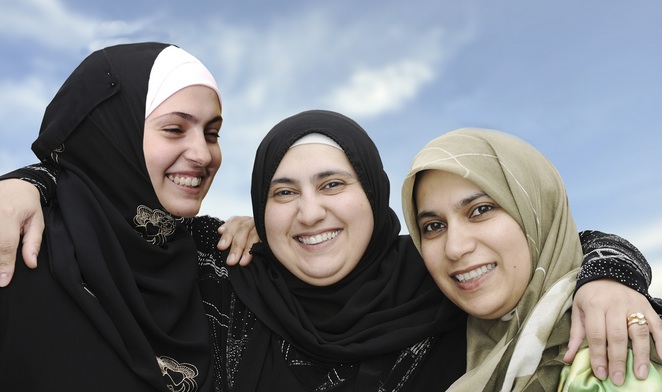

 The patriarchal kingdom of Saudi Arabia creates an all-female city where (the arguably better half) of humanity can work freely, within Islamic guidelines.
Saudi Arabia has an increasingly educated female population, but its ultraconservative interpretation of Wahabi sharia law and rigid tribal customs forbid women from interacting with men. The upshot is chronic female unemployment. An utterly Saudi solution is underway. Why shift cultural mores, when, instead, you can raise up a completely new, self-sustaining city that will be fully devoid of men? The pilot project will go live in 2012 in the Eastern Province city of Hofuf. Smaller “ladies-only” communities will then pop up in capital city Riyadh.
Saudi businesswomen cooked up the concept, according to the paper Al Eqtisadiah, and the ruling monarchy endorsed the scheme as a way to lower female unemployment while staying “consistent with the privacy of women according to Islamic guidelines and regulations,” Saudi Industrial Property Authority (Modon) said in a statement. Modon is leading the project development.
[youtube]http://youtu.be/alV4zS2FE20[/youtube]
“I’m sure that women can demonstrate their efficiency in many aspects and clarify the industries that best suit their interests, nature, and ability,” Saleh al-Rasheed, Modon Deputy Director General told the Guardian.
The Hofuf industrial zone will potentially employ 5,000 Saudi women in pharmaceutical, food-processing and textile industries, all of which will be female-managed. There will be places to eat, to shop, and to pray, but no mention of childcare facilities or recreation centers. The women are expected to live in adjacent neighborhoods. But who will drive them to work?
“Restrictions on women’s lives and productivity are so extreme – Saudi women need a male guardian’s permission to travel, seek employment, or marry – that the country is letting a potentially huge sector of the productive economy sit idle”, wrote Sarah Goodyear in The Atlantic. Women make up over 60% of college graduates in the country and 78% of them are unemployed. Only 15% of the Saudi workforce is female.
Saudi has all-female factories and the largest women-only university in the world, but all-female communities on this scale have never been attempted.
“Hofuf will be exceedingly productive,” predicts writer Zoe Williams in The Guardian. “As an industrial town with no men in it, it will presumably contain none of those mini-impediments to productivity known as ‘children.'” She foresees a future where these Saudi women “will be South Korea to their male counterparts’ North.”
Critics envisage that the project will either economically fail, or succeed fiscally and further segregate women from free public living. Homa Khaleeli of The Guardian offers this provocative suggestion, “Women should flock to them, close the doors, and refuse to leave until the kingdom’s rulers understand just what it is like to live without women.”
Is it a positive step for women? Depends on your point of view. What did you think of America’s special drinking fountains for “coloreds”? Was apartheid a winning proposition? A segregated city will never be as creative as one where different people can freely exchange ideas, unconstrained.
A year ago, King Abdullah announced that women would be able to vote in the 2015 local elections. In January, laws were enacted allowing Saudi women to be employed in lingerie and cosmetic shops, following a campaign by the women’s rights activist Reem Asaad, and by the end of 2012 women will replace salesmen in stores selling abayas too. Here again is that funny “perspective” phenomenon: the latter action could be viewed as progress in opening employment opportunities, or as a move towards further separation of the sexes.
Ponder the possibilities: educated women, soon to be placed into economic production. Once these women get a taste of professional autonomy and experience financial independence, what cracks in the machine will ensue? Or will they be predestined to failure like their Saudi Olympian sisters: pushed into a corporate arena for which they’ve not been trained to compete.
I’m heading to Turkey this week, and in my lazy pre-trip research I see that the Amazons founded the city of Ephesus. It’s one of my stops, and one of many single-sex towns allegedly built by that all-babe warrior nation that featured large in Greek mythology.
Maybe, centuries on, Saudi Ladytowns will be the stuff of legend too.
Image of Arab women from Shutterstock




louis vuitton and that figure is set to grow has opened her eyes to the more voracious consumer
Loay
I agree completely that participation by the Saudi women athletes was symbolic, and a very powerful symbol. Those young women’s bravery was Olympian, even if their athletic prowess was not.
My point (where I raise comparison between female entrepreneurs and athletes) is exactly that: that women-run corporations will also remain largely symbolic, and predestined not to excel, if the women have not been adequately prepared to succeed.
There’s no reason that symbolism and practical success need be mutually exclusive.
I hope the Hofuf businesses are staffed with well-educated, open-minded, and adequately experienced businesswomen and professionals so they may exceed symbolic status and become corporate giants (of course, with excellent corporate social and environmental responsibility – also known as “the woman’s touch”).
Thanks for the comment! Laurie
This issue needs to be talked about, because it is an issue. It is effecting our sisters because despite the mask of good intentions, it to validate the claims of discrimition against women; are there so few opportunities and so many boundaries to ‘success’ in ordinary arab society that we are having to resort to women having their own cities to work in? Why is that the case? Surely, if society afforded women their due rights and opportunies, there would be no need for such an idea? Also, a sad but true fact is that projects like this will reflect very negatively on Islam and will only confirm stereotypes of muslim countries treating women as second class citizens. Sadder still, we are seeing so many muslims grudgingly supporting the plans because, hey, a limited and sexism-born opportunity for social and economic freedom is better than no opportunies for social and economic freedom. It just sucks. The idea of a women’s only city just seems so alien from Islam that, it wasn’t so tragic, would be laughable.
First off I’d like to say bravo to those who are trying to be PROGRESSIVE by suggesting such an idea. I say it’s well worth the shot even if it resulted in failure. They would learn from the experience.
Second, the fact that you perceived what happened in the Olympics as a “failure” clearly indicates that you, the author, have clearly FAILED at recognizing that it was a symbolic participation and that it is a move forward. The Only fact you got right was that they weren’t trained in an olympic manner, and well thats the case with many other athletes who did not recieve medals.
Third, for Tom who commented last, I believe you are confused. Your use of “Muslim world” is incorrect. It is not Islam that does not allow women the rights or is oppressing them but the WRONGFUL INTERPRETATION of it that comes off as ultra conservative and illogical.
There is method in the madness, but it is sad that it has to be. The conflict with outdated norms and the needs of women in the muslim world is a long way from a solution.
Thanks
Tom
I heard some commenter in the USA said. “Didn’t the Saudi’s watch Jurassic Park?”
I think there may be madness in their method.