

 When we learned about Planetary Resources’ asteroid mining scheme, a well-known Cree Indian proverb came to mind: “Only when the last tree has died and the last river has been poisoned and the last fish has been caught will we realize we cannot eat money.” We knew this day would come.
Not content to change our consumer culture, which has been vastly destructive not just to the planet, but also to our very social fabric, Google billionaires are supporting a hugely expensive scheme to pull asteroids into the moon’s orbit and mine them for gold, platinum, and other rare earth metals. These will then be used to produce more unessential stuff on earth.
Asteroid Rush
Unfortunately, scientists claim that this not such a wild plan and that it is well within the realm of our technological capability and expertise. But just because we can doesn’t mean we should.
Before we launch into this litany, let’s first go over how a few overgrown boys (and one woman) with too much money on their hands dreamed up this ruinous plan and how they expect to execute it.
The Seattle-based company founded by Aerospace Engineers Eric Anderson and Peter Diamandis (who is also a medical doctor) has attracted a handful of wealthy investors, including former US presidential candidate Ross Perot and Google’s Eric Schmidt and Larry Page.
Advisors include Avatar film director James Cameron, who should know better than to support even more resource extraction, and General T. Michael Moseley, former Chief of Staff of the United States Air Force.
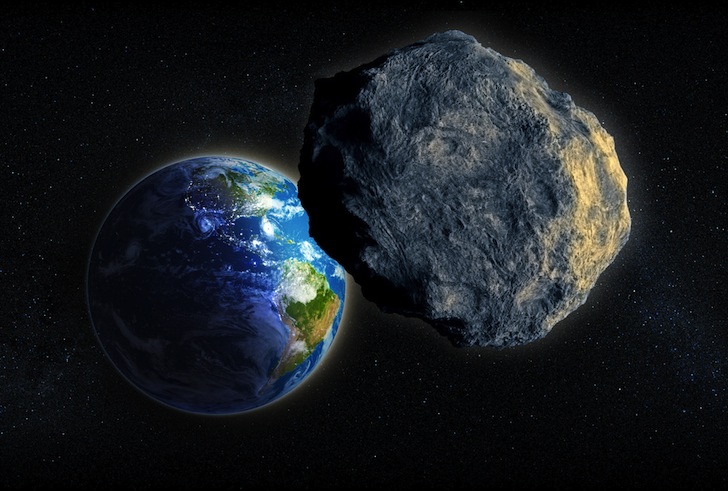
The team plan to launch a $10 million unmanned space craft equipped with telescopes to scout out resource-rich asteroids, and then send in another that will “lasso” these “lumps of rock” and gently bring them into earth’s orbit, where they will be broken down and mined.
Giant lumps of money
Gold, platinum, and rare earth metals such as rhodium taken from these “near Earth asteroids” will be brought to earth. In order to avoid saturating the market, however, and driving down the cost of what are rare, precious, and therefore expensive metals, some may be left in the moon’s orbit where they will be used to make rockets and other things.
According to the company’s website, “asteroids are primordial material left over from the formation of the Solar System. They are scattered throughout it: some pass close to the Sun, and others are found out beyond the orbit of Neptune.” They have a negligible gravity field, so shifting them is unlikely to create any galactic disturbance.
They are attractive because one 500 ton, 7 meter diameter asteroid contains the same quantity of metals that we mine on earth in an entire year. And there are said to be at least 1500 that are within earth’s proximity.
Planetary Resources also admits, “Despite their celestial age, our understanding of asteroids is still in its infancy. However, the more we learn about them, the more enticing destinations they become.”
Mine the landfills instead
The Guardian reports that this plan will cost billions of dollars and will take decades to produce fruit, but the company is convinced they can add trillions of dollars to our global GDP.
And that’s what this whole scheme really boils down to: GDP. Instead of spending that money to feed the billions of people living on the planet, we’re spending it so we can have more batteries and cell phones. All this even though we know that millions of people are starving, others lack access to basic needs such as water, and our own planet is in need of serious ecological restoration.
Instead of re-using the materials that we have on earth, so much of which languishes in landfills in the form of e-waste, instead of cleaning up our own mess, like children, we’re pretending it’s not there. Our shortsightedness, our absolute arrogance, our total disrespect for nature’s rhythms has taken on a whole new, interplanetary dimension.
Can somebody please give these boy-men a board game instead?
:: The Guardian
Image Credit, Asteroid Approaches Earth, Shutterstock
More on Space:
Nader Khalili Built Earth-Buildings Fit for Space
Virgin’s Galactic Space Travel – A Greener Trip From Abu Dhabi to L.A.
Virgin Galactic: Do We Really Need to Send Rich People into Space?




gold and platinum are not just useful to the developed world, both elements are extremely useful as during as catalysts during the conversion of crude oil to gasoline, and other industrial processes. We should definitely be turning our resources extraction towards space, and stop ming the earth. The earth is the ONLY planet we have evolved to survive on, and as such we need to take care of it. Asteroids on the other hand, while scientifically valuable, cannot sustain human life. Unfortunately, we can’t protect our earth, and then turn around and buy new laptops, cellphones, and other fancy electronics because it is these items that drive mining companies to keep extracting materials and destroying our planet with harmful extraction methods. This is honestly one of the greenest solutions we have left.
US now does not have rare earth sources and has to import them from China. This is a way for us to have “Rare metal” independence. This is also one more step toward space exploration. If we are going to get beyond Earth and Moon, we will have to learn to mine asteroids.
Tafline Laylin, yes it will not do anything for the world poor in a short-term. And it is not a purpose. But it could make a lot of stuff much cheaper(computer parts, smartphones, wind turbines and so on.
Marcello, what value has gold or platinum ever brought to the poor people of the world?
The undeniable fact is that it will be impossible to feed and take care of our growing population without advancements in technology, which space exploration can help us accomplish. Anything less is a recipe for global genocide. This is not a board game. Please take it seriously.
Yes you can “eat money” because those who are rich will be able to afford to have inside hydro-farms and hot houses and thus grow their own food. It’s the not so rich and especially the poor who will suffer as many already are.
As the human population grows beyond 7 billion and thousands of tons of waste materials are dumped around the World and the biosphere struggles to heal itself with raging storms, floods and longer droughts, it’s not likely humans will survive long enough to capture any asteroids.