
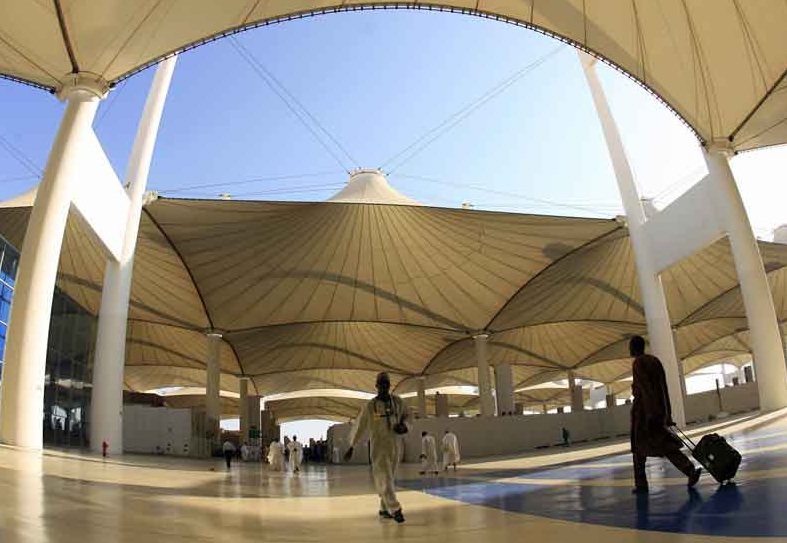

 Hajj Terminal, Jedda Saudi Arabia, the 6-week terminal at Abdul Aziz Airport built by Skidmore, Owings and Merrill, a Chicago-based architectural firm. It stands the test of time as a green gem.
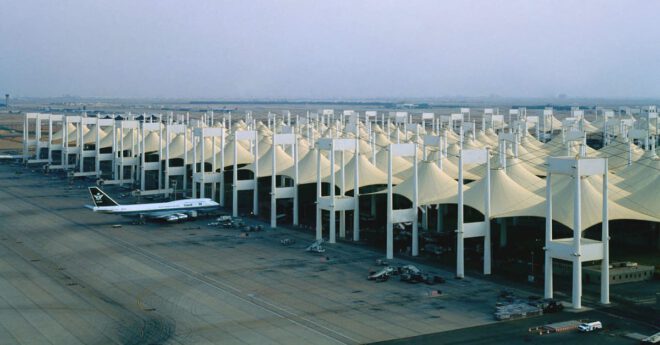
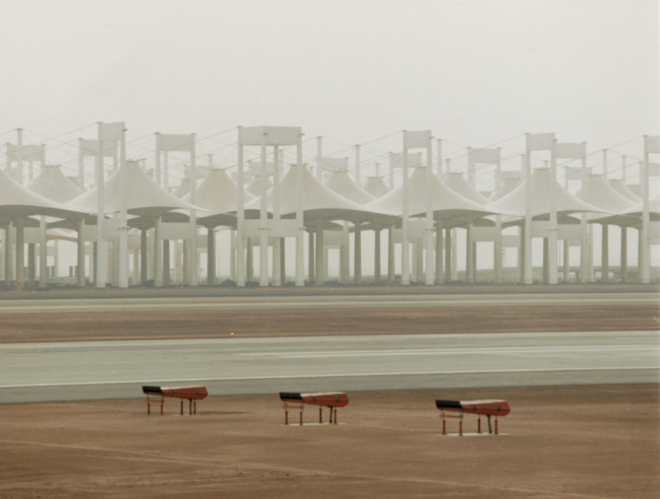
Dozens of gleaming white tents form a bold roofline covering 120 acres of passenger services; sustainable magnificence created by visionary architects Skidmore, Owings & Merrill over thirty years ago. Located in Jeddah’s King Abdulaziz International Airport in Saudi Arabia, the terminal serves as a temporary city for millions of pilgrims destined for Mecca to take part in the annual Hajj.
The world’s 1.7 billion Muslims are all encouraged to undertake the pilgrimage, and approximately 0.01 percent heed the call each year. With increasingly accessible air travel, the number of hajjis – or pilgrims – grows annually, now over 1.5 million.
A human tide rolls into the airport as pilgrims fly in from around the world before travelling by road to the holy cities of Mecca and Medina. The crush returns as Hajj concludes. The entire cycle occurs in a matter of weeks.
Crowd dynamics in Mecca led to stampedes in 2004 and 2005, killing 244 and 360 people, respectively. Safe and efficient handling of this eclectic population is a logistical challenge with critical risks.
Terminal plans hatched in the mid-‘60’s were mothballed in the decade after the 1967 Six Day War.
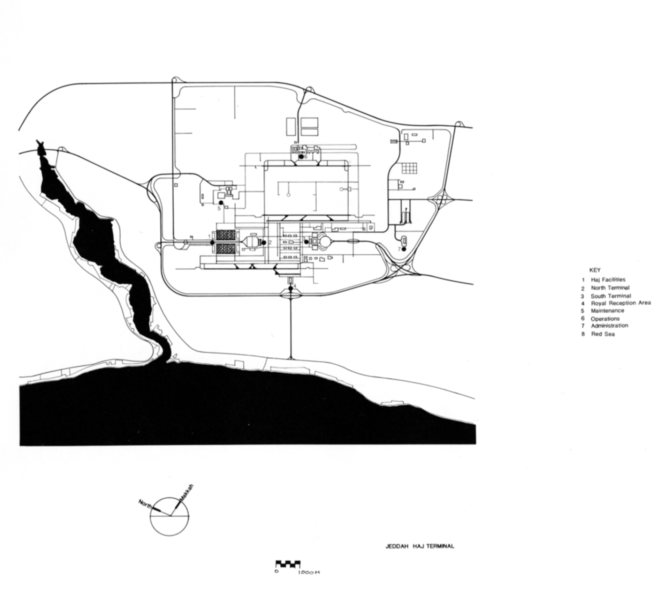
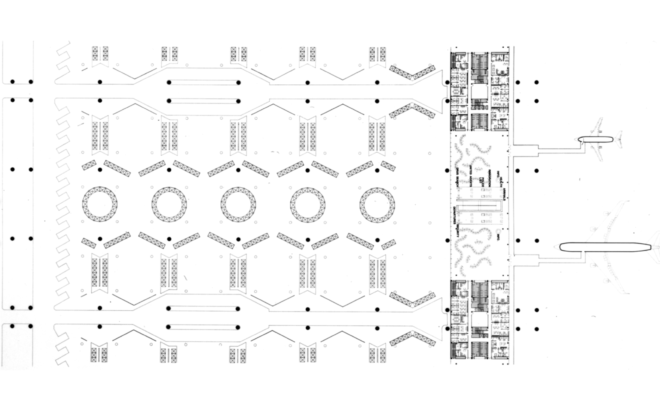
In 1974, SOM’s superstar design team led by Bengalese-born engineer Fazlur Kahn and American architect Gordon Bunshaft resumed work on the terminal, part of an ambitious airport Master Plan. Initially designed as a fully enclosed building (Edward Durrell Stone, modern architecture legend, consulted during early planning), this new design team had a flash of contextual insight and determined that a traditional air-conditioned terminal wasn’t ideal for the desert site, nor for the unique passenger demographic.
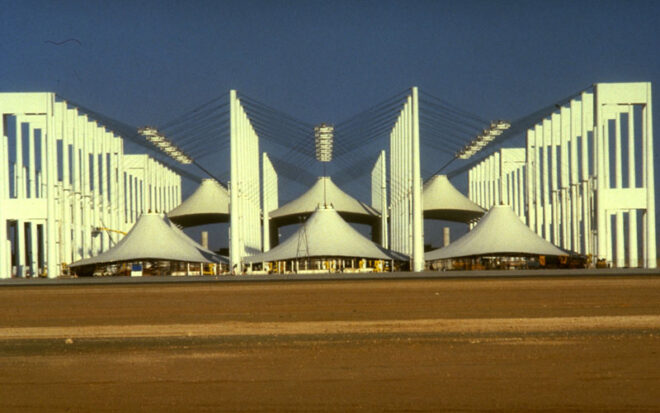
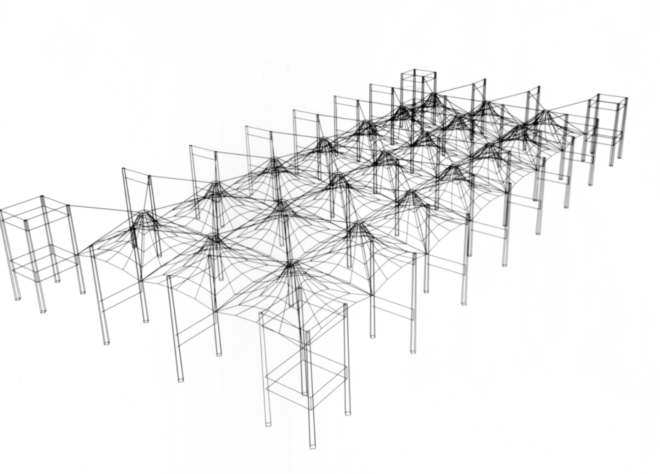
They played with Arabian imagery of desert tents, billowing fabric. In the wake of the moonwalk, they experimented with space-age materials. Tent-like shapes, made of Teflon-coated fiberglas (resistant to heat, humidity and sun-damage), suggested an open-air environment. Kahn’s radically innovative structural design allowed for long-span open spaces.
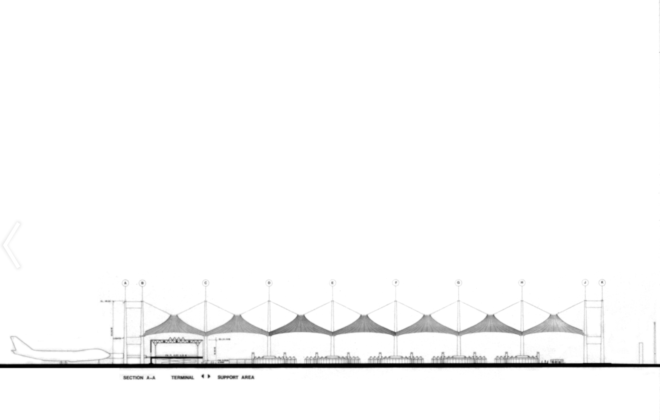
Two symmetrical sections of tent “modules”, framed by towering pylons, are separated by a landscaped mall. Steel cables weave between the elements, suspending the tents and eliminating clunky roof supports. The tents cover the air-conditioned arrival buildings, sited along terminal edges and housing security, check-in, toilets and shops.
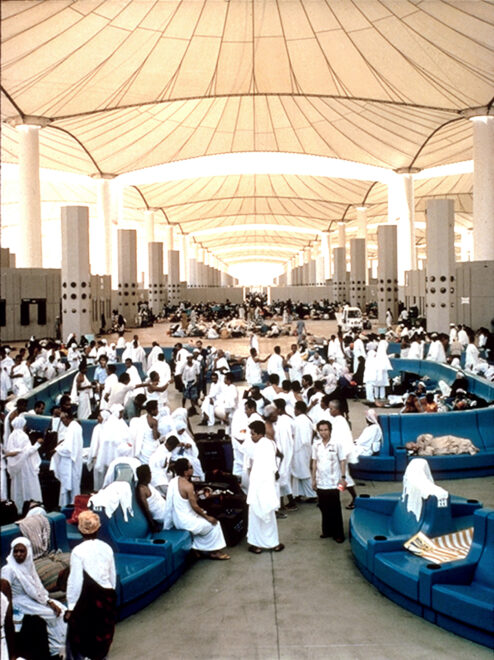
The tents are the showstopper, capable of accommodating 80,000 people at any time.
The white tents deflect heat and diffuse natural daylight into interiors. Their conical shape creates a chimney effect, cooling interiors with minimal mechanical assistance. When outside air burns at 120 degrees F, inside stays a balmy 75.
The designers understood these travelers’ needs. Tucked below the tents is a mosque. And gathering areas where pilgrims can meet their tour groups. There are private spaces for changing into ritual garments and performing ablutions. Travellers trade goods along the pilgrimage route and seek mementos of their Arabian experience, so SOM integrated a traditional market (souk) into the design.
Completed in 1981, the Hajj Terminal received that year’s Progressive Architecture award. In 1983 it scored an American Institute of Architects (AIA) National Honor Award and the 1983 Aga Khan Award for Architecture. In 2009, it received the AIA Twenty-Five Year award for its architectural design of “enduring significance”.
The AIA explained, “This project exemplifies the power of a clear idea. With a very simple bay repeated quite beautifully, they set the standard for many airports since.
“The architects created a highly sustainable project well ahead of the green movement. The terminal presents a sense of place, ecology, economy of means, and culture – not imposing on but learning from the local culture and environment. The brilliant and imaginative design of the roofing system met the awesome challenge of covering this vast space with incomparable elegance and beauty.”
Airport terminals evolve. Functional hangers to protect travelers from weather have morphed into ersatz shopping malls. A place to check luggage, then navigate increasingly difficult security hurdles. Run the gauntlet of duty-free; grab an overpriced bite; conduct impromptu business via wireless gadgetry; and eventually board a flight. Terminals have become a car-to-plane conduit, designed so we shop every step of the way. Can you name a new terminal that provides a real sense of place?
Last week, Frommers.com named this aviation old-timer as one of the best terminals in the world, based on stellar performance in key operational metrics such as on-time departures, cleanliness, and ease of travel to and from city center.
High functionality coupled with environmental smarts, wrapped in a gorgeous skin: Hajj Terminal is a timeless beauty.




Comments are closed.