
Egypt Is Middle East Region’s Cleanest and Most Environmental Country

egypt-environment-epiEgypt topped the world Environmental Performance Index for the Middle East and North Africa region, followed closely by Israel

Every two years, Yale University in collaboration with Columbia University release the world Environmental Performance Index which ranks most countries environmental performance. This year, Egypt topped the list for the MENA region, followed closely by Israel and the United Arab Emirates. In the wider context, however, the region is still trailing far behind with Egypt making it only to the ‘modest performers’ list. Egypt was ranked the 60th most environmental country with an EPI score of 55.18 – Switzerland which topped the chart scored 76.69.

The 2012 world EPI ranked 132 countries on 22 performance indicators including air pollution, water resources, forestry, fisheries, climate change and biodiversity. As well as tracking the environmental record of countries, the EPI list tracks who made the most significant gains in a ‘trends list’.

For example, Egypt made it to the top five in the trends list due to substantial gains made in the environmental health objective. This includes dealing with indoor air pollution, improving access to drinking water and sanitation. Saudi Arabia and Kuwait scored very low on the trends list.

Some of the worst performed in the MENA region included Iraq which scored an EPI of 25.32 due to the water scarcity facing the country, significant sustainability challenges and weak governance structures.

Modest Performers List

  1. Egypt [EPI score 55.18]
  2. Israel [54. 64]
  3. UAE [50.91]
  4. Saudi Arabia [49.97]

Weaker Performers List

  1. Algeria [48.56]
  2. Lebanon [47.35]
  3. Tunisia [46.66]
  4. Qatar [46.58
  5. Sudan [46.00]
  6. Morocco [45.76]
  7. Oman [44.00]
  8. Syria [42.75]
  9. Iran [42.73]
  10. Jordan [42.16]

Weakest Performers List

  1. Libya [37.68]
  2. Kuwait [35.54]
  3. Yemen [35.49]
  4. Iraq [25.32]

Although not included in the MENA region list, Turkey scored 44.8 which places it between Morocco and Oman in the Weaker performers list. To provide a pinch of salt to their research, Yale and Colombia acknowledge that there are significant data gaps in their index. These include nuclear safety, wetlands loss, species loss, freshwater ecosystems health, recycling, desertification and municipal and toxic waste management. For a county by country breakdown of the data go to the EPI website.

: Information and data via EPI 2012.

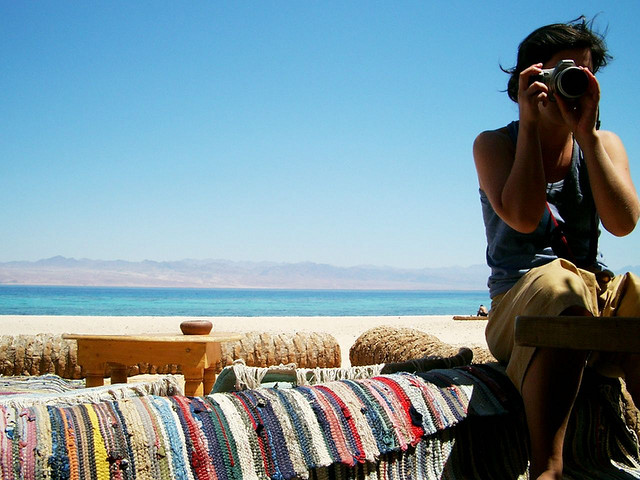
: Image via Creap/flickr.

For more data-led information on the Middle East’s Environment see:

Water and the Middle East (At A Glance)
The Middle East’s Carbon Emissions (Infographic)

Water and Israel – The Facts

Arwa Aburawa
Arwa Aburawahttp://www.greenprophet.com
Arwa is a Muslim freelance writer who is interested in everything climate change related and how Islam can inspire more people to care for their planet and take active steps to save it while we can. She is endlessly suspicious of all politicians and their ceaseless meetings, especially as they make normal people believe that they are not part of the solution when they are the ONLY solution. Her Indian auntie is her model eco-warrier, and when Arwa is not busy helping out in the neighborhood alleyway garden, swap shopping or attempting fusion vegetarian dishes- with mixed success, she’d like to add- she can be found sipping on foraged nettle tea.
4 COMMENTS
  1. Lol @ the UAE and Saudi Arabia being green countries. They are among the largest carbon producers in the world, and their dirt-cheap gasoline and increasingly energy intensive industries (such as aluminum smelting) are making it even more so. Dubai is hardly a model of environmental friendliness. If they could talk, the fish and reefs that were displaced by the contruction of the Jumierah Palm island might also tell you otherwise. Their constuction projects are extravagant and show no concern for the ecosystem at all, regardless of how much greenwashing they may do by talking about solar energy. Saudi Arabia has disallowed foreign tourism, which has had the effect of preventing beach development along its Red Sea coast, leaving them in a pristine state. So it scores points there. But it is incredibly inefficient and extravagant in so many other ways.

    The Aswan Dam has not helped the once-rich Nile Valley eco-system one bit. The entire Nile Delta region is literally crumbling into the sea because of the lack of silt. And the incessant unregulated construction of mega beach resorts along the Red Sea coast has completely destroyed most of the reefs along the northern Red Sea coast, and threatens to do the same in the south, now that Marsa Alam has an airport and people are fleeing the denuded northern coast.

    Israel has done quite a bit of damage, but it has managed what resources it has quite wisely. And it has reforested many areas and chosen plants that use modest amounts of water (i.e. oranges, dates, and avocados), while Egypt and Saudi Arabia have chosen water guzzlers like sugarcane and wheat.

  2. Thank you for highlighting the good news in MENA’s list. It would be wonderful if this friendly international eco-competition got as much attention as the world cup and the Olympics. Keep up the great writing!

  3. It’s amazing to hear that Egyptians are learning to see Egypt at theirs again!! Even in the small ways.

    Thanks for your insightful comment- what you say about people being happy to see ownership but not stewardship is sadly very true everywhere you go. People expect clean streets but they don’t seem to realise that it’s up to them to stop littering…

    Arwa

  4. I can’t remember the name of the Egyptian novelist or the book he wrote about the transition of last spring, but something he wrote struck a chord with me. He dropped a cigarette or piece of rubbish and an old woman ran up to him and told him to pick it up. He was shocked but again she scolded him to pick it up. She told him that if we’re going to have a new Egypt, it should be a clean Egypt.

    Despite politics which suggest that people care deeply about land ownership, too often people don’t take ownership of their environment. Here in Ireland 90 years after independence, many people seem to treat the outdoors as if it still belongs to a wealthy British landlord. So Dublin, a city of 1 million has more litter on its streets than Cairo, a metropolis of 7 million. Even in the U.S. more than 200 years after independence, generations after Woody Guthrie’s, “This Land is Your Land”– some people still don’t understand that ownership implies stewardship.

LEAVE A REPLY

Please enter your comment!
Please enter your name here

TRENDING

Ethiopians are Looking to Somaliland for Red Sea Access as Global Powers Move In

Somaliland, for its part, has operated as a de facto independent state since 1991. It has its own government, elections, currency, and security forces. It’s often described as one of the more stable and democratic political systems in the region, despite never being formally recognized internationally. 

Egypt building nuclear power

Egypt is building a nuclear energy plant, expected to go online in 2026 when countries like Germany have shut down all its domestic nuclear power. The El Dabaa Nuclear Power Plant is the first nuclear power plant planned for Egypt and will be located at El Dabaa, Matrouh Governorate, Egypt, about 320 kilometers northwest of Cairo. 

More investments of 1.2 GW in Benban solar, Egypt

Egypt’s Ministry of Electricity and Renewable Energy, the Egyptian Electricity Transmission Company, and a consortium comprising Infinity Power and Hassan Allam Utilities Energy Platform signed an agreement to jointly develop solar power projects at Benban Solar, one of the world's largest solar energy parks in Egypt.

Benban solar in Egypt and the companies that make the energy shine

Benban isn’t a single solar plant at all, but a collection of 41 facilities, each developed by different companies but connected through shared infrastructure. This structure is what makes Benban unique: dozens of developers working like nodes in a vast energy network, each feeding electricity into shared substations and Egypt’s national grid.

Undercover divers find fatal flaws in Egypt’s dive boat industry

German magazine stern and broadcaster RTL have confirmed what Green Prophet has reported for months — the sinking of Egypt’s Sea Story dive yacht in November 2024, which killed 11 people, was no freak accident. Their undercover investigation reveals the captain had no licence, the operator lacked legal authorisation, and the vessel had serious stability flaws. A wider probe of 17 Red Sea liveaboard boats found every one had dangerous safety deficiencies, echoing Green Prophet’s earlier coverage of Egypt’s dive tourism safety crisis.

Qatar’s climate hypocrisy rides the London Underground

Qatar remains a master of doublethink—burning gas by the megaton while selling “sustainability” to a world desperate for clean air. Wake up from your slumber people.

How Quality of Hire Shapes Modern Recruitment

A 2024 survey by Deloitte found that 76% of talent leaders now consider long-term retention and workforce contribution among their most important hiring success metrics—far surpassing time-to-fill or cost-per-hire. As the expectations for new hires deepen, companies must also confront the inherent challenges in redefining and accurately measuring hiring quality.

8 Team-Building Exercises to Start the Week Off 

Team building to change the world! The best renewable energy companies are ones that function.

Thank you, LinkedIn — and what your Jobs on the Rise report means for sustainable careers

While “green jobs” aren’t always labeled as such, many of the fastest-growing roles are directly enabling the energy transition, climate resilience, and lower-carbon systems: Number one on their list is Artificial Intelligence engineers. But what does that mean? Vibe coding Claude? 

Somali pirates steal oil tankers

The pirates often stage their heists out of Somalia, a lawless country, with a weak central government that is grappling with a violent Islamist insurgency. Using speedboats that swarm the targets, the machine-gun-toting pirates take control of merchant ships and then hold the vessels, crew and cargo for ransom.

Leopoldo Alejandro Betancourt López Turned Ocean Plastic Into Profitable Sunglasses

Few fashion accessories carry the environmental burden of sunglasses. Most frames are constructed from petroleum-based plastics and acrylic polymers that linger in landfills for centuries, shedding microplastics into soil and waterways long after they've been discarded. Leopoldo Alejandro Betancourt López, president of the Spanish eyewear brand Hawkers, saw this problem differently than most industry executives.

Why Dr. Tony Jacob Sees Texas Business Egos as Warning Signs

Everything's bigger in Texas. Except business egos.  Dr. Tony Jacob figured...

Israel and America Sign Renewable Energy Cooperation Deal

Other announcements made at the conference include the Timna Renewable Energy Park, which will be a center for R&D, and the AORA Solar Thermal Module at Kibbutz Samar, the world's first commercial hybrid solar gas-turbine power plant that is already nearing completion. Solel Solar Systems announced it was beginning construction of a 50 MW solar field in Lebrija, Spain, and Brightsource Energy made a pre-conference announcement that it had inked the world's largest solar deal to date with Southern California Edison (SCE).

Related Articles

Popular Categories