

 News that the French Parliament accused Israel of using water “apartheid” unleashed a fury of water war rhetoric that Friends of the Earth Middle East’s Director Gidon Bromberg is trying to calm.
Yesterday the Israeli paper Haaretz reported that the French Parliament accused Israel of using water as “a weapon serving the new apartheid.” Socialist Party MP Jean Glavany wrote that “450,000 Israeli settlers on the West Bank use more water than the 2.3 million Palestinians that live there.”
In response, Israel’s Government Press Office released a report yesterday entitled The Israeli-Palestinian Water Conflict: An Israeli Perspective by Haim Gvirtzman of the Begin-Sadat Center for Strategic Studies at Bar-Ilan University. Gvirtzman places responsibility for Palestine’s water shortages squarely on the shoulders of the Palestinian Authority’s ineffective governance.
Calming the rhetoric
In the introduction to Glavany’s report, he wrote that the goal of the study was not to unleash a water war, but rather to “contribute a broader reflection on how to ensure tomorrow for future generations, and ways of water governance adapted to the needs of man and the planet.”
But according to Haaretz, the French report accused Israel of ” systematically destroying wells that were dug by Palestinians on the West Bank,” and blocks “Many water purification facilities planned by the Palestinian Water Ministry.”
Israeli complaints
By contrast, Gvirtzman claims that Israel has contributed to increasing the Palestinian Territory’s water supply by 50% since the 1995 Interim Agreement, 30% more than was agreed. And instead of blocking water purification facilities, he claims that water problems in Palestine result from poor governance – on the Palestinian Authority side.
This seems to be a major Israeli complaint – that the PA has failed to properly manage or build sewage treatment centers, which is impacting Israel’s water supply, and that they have created several illegal wells that conflict with the interim government agreement. They also claim that the issue is less dramatic than most people believe.
Gvritzman wrote that “The current per capita consumption is 150 m3/c/y for Israelis versus 140 m3/c/y for Palestinians,” and that discrepancies between PA and Israeli data comes down to population counts.
The Palestinian Central Bureau of Statistics (PCBS) reported in 2004 on 2.4 million Palestinians residing in Judea and Samaria, while the American- Israeli Demographic Research Group (AIDRG) calculated only 1.4 million.
Israel has the last word
We have a poor translation of the French Parliament report, but Glavany seems to suggest that the Israeli civil administration has the last word when it comes to policies suggested by the Joint Water Commission, which was set up in 1995 to oversee water management in both Israel and the Palestinian Territory. They are the main barrier to the PA’s ability to improve its water supply.
Sometimes a permit is granted by the JWC, and then refused either wholly or partially by the Israeli civil administration. The difficulties to obtain any permission are related to the proliferation of wild wells or cisterns.
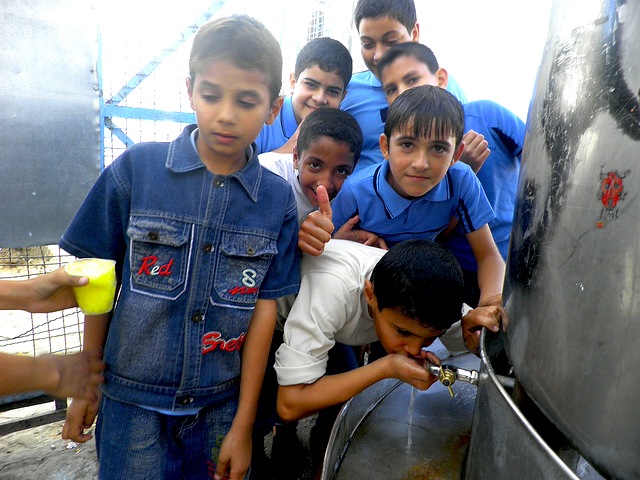
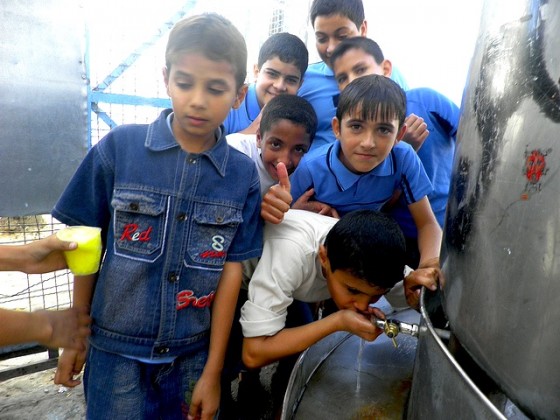
The water situation in the Palestinian Territory is dire, of that there is absolutely no question. Gaza’s farmers can no longer grow food, and groundwater supplies have become increasingly saline. But this problem also affects neighboring Jordan and Israel. Nature knows no boundaries, so there has to be cooperation between the three governments in order to secure everyone’s survival.
Friends of the Earth Middle East
In response to the French parliament’s report, the Israeli Director of Friends of the Earth Middle East – a well-respected non-government organization that has managed to overcome political obstacles in order to work on water issues affecting populations in Israel, Jordan, and Palestine – Gidon Bromberg said:
The report highlights the tremendous importance of promoting a solution acceptable to both peoples on the issue of water. On the other hand, instead of igniting the region on an issue where it is clear that an agreement can be reached, the governments need to urgently advance a solution that would serve the interests of both sides – meeting the water supply needs for Palestinians, as well as management of sewage and wastewater that affects the Israeli side.
As usual, Bromberg restores sanity to this ongoing debate.
:: Haaretz
image via Middle East Children’s Alliance, Flickr
More on Water Issues in the Middle East:
Water and the Middle East at a Glance (Infographic)
Palestine/Israel: A Stunning Tale of Peace, Water, and Walls



Problem of conflict between Palestine and Israel
Have you ever heard even though the Jewish people and the Palestinian people have different religions, they were originally from the same country and were good friends?
This story was proved by “The ship of the Sun” which came out from the desert in Egypt. It is also proved because both the Jewish people and the Palestinian people have the same DNA.
http://www42.tok2.com/home/slicer190190/5-23.html
http://www42.tok2.com/home/slicer190190/JPcontents-1.html
By Sennari Masuya
The basic problem is the growing populations in both Israel and the Palestinian territories, but nobody can argue with an instinct, especially the one that inspires all life on Earth.
@karin thank you for what’s probably the most reasonable statement on the entire issue
It’s inhuman to initiate such kinda of apartheidism, they had acquired that land illegally and discriminating the inhabitat. I pray for palestine recognition in UN. First ovation will come from france Inshaallah.
Some people believe, especially the North American natives, that no one owns the land. We are just here to protect it. If we look at the planet that way your comment just about applies to everyone. In shalla we will move on from this stupid idiotic blame game and start working to save our planet from ourselves.
I am Bromberg’s BIGGEST fan.