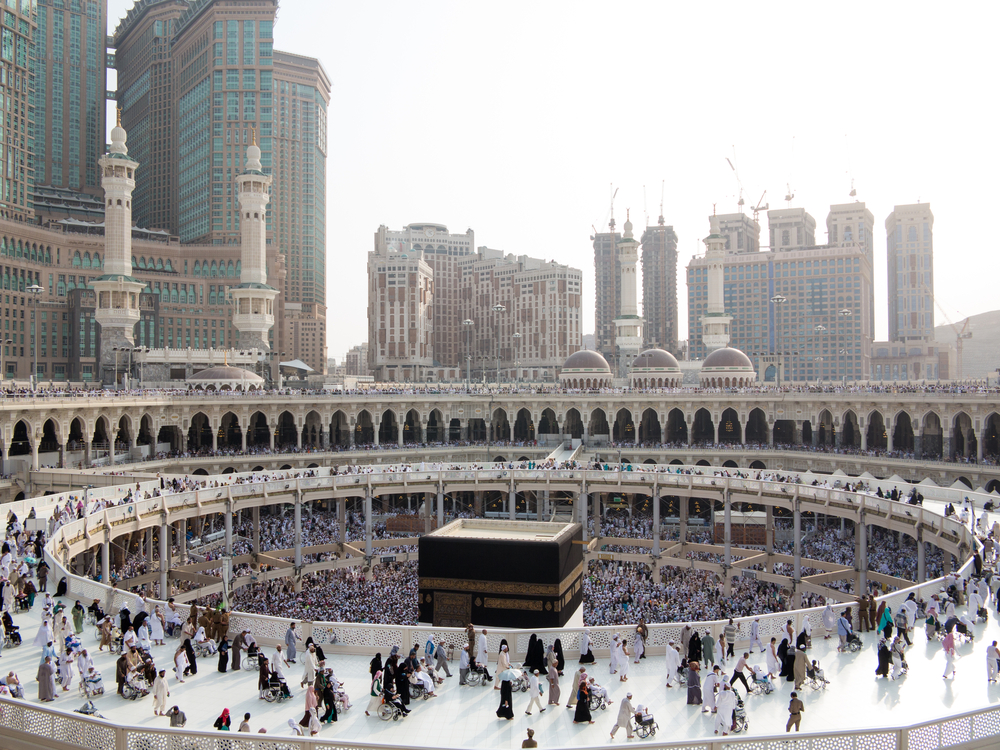

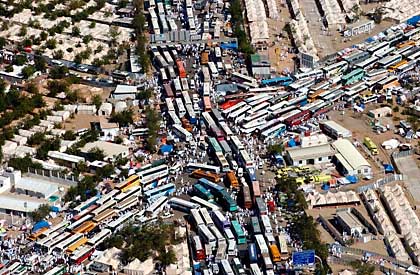
 From holy water to holy traffic to holy trash, millions of Muslim pilgrims in Makkah take a spiritual experience with them and leave truckloads of pollution behind.
Almost 3 million Muslim pilgrims arrived in the city of Mecca in November for Hajj. The Islamic pilgrimage gathers a record breaking number of people in the world who follow the historic footsteps of revered prophets and their families.
Every healthy and debt-free Muslim is obliged to make the Hajj journey at least once in their lifetime. But with the rising threat of climate change and famine, more organisations are calling for both pilgrims and Makkan authorities to reduce the environmental damage caused by the annual influx of travellers, CNN reports.
More pilgrims equals more damage
According to the Royal Embassy of Saudi Arabia, 1,799,601 pilgrims arrived in Makkah to perform Hajj in 2010. This year another record breaking number of foreign pilgrims descended, 1,828,195. That’s an extra 28,594 aeroplane seats, vehicle passengers, mouths to feed, waste producers and carbon emitters. Whether arriving through air travel, camel, and as we saw last year, on energy saving cycles, the polluting ‘footprint’ of pilgrims is a deep concern for Makkan residents and environmental agencies.
But it isn’t wholly fair to lay blame on all pilgrims. Muslims travel from every country on Earth for the Hajj journey, each with their own lifestyles and priorities. Community and livelihood concerns means that simple practices like picking litter and recycling are not a privilege for countries where even water is poorly managed.
With such a huge gathering of people in a short space of time, it brings a whole new meaning to the Islamic teaching of ‘walking lightly’ (Quran:25:63). A cleaner Hajj is therefore a matter of providing the education to those without. So, what can be done?
Earlier this month, we shared the launch of the world first environmental Hajj guide. Co-authored by Dr Husna Ahmed, The Green Guide for Hajj booklet promotes ecologically sustainable practices among Hajj pilgrims.
A study conducted at Faith Regen Foundation’s says that up to 100 million plastic bottles were dumped by pilgrims in 2010. Earlier this year distribution plans for bottling Zamzam water to Madina were set but Faith Regen says flasks are better. CEO of the foundation, Husna Ahmed, says that the Makkan authorities still fall short of providing adequate recycling sites and information for pilgrims.
Some ideas from The Green Hajj Guide to reduce the pilgrim ‘footprint’ include:
- Considering the carbon footprint of transport choices they make and avoiding or off-setting the impact of air travel
- Choosing travel companies with environmentally conscious policies regarding travel and accommodation for pilgrims
- Avoiding water waste, and recommending sustainable energy
- Avoiding the use of plastic bags and bottles, especially for traditional items such as misbahah (Dhikr beads) and sajjadah (prayer mats)
- Clearing up your own and other people’s litter and rubbish.
Green Prophet’s eco-Muslim reporter Arwa took the initiative to measure a pilgrim’s carbon footprint. Beginning with car journeys and ending on a flight, a typical British pilgrim’s journey creates approximately 32 tonnes of carbon. If that doesn’t sound dramatic, this is what one ton of carbon dioxide looks like.
Dr Ahmed also calculates that each pilgrim’s total energy consumption is vast. She told CNN,
“All the waste from food, all the fumes from coaches travelling around the city, all the energy used for powering local hotels, it has a significant environmental impact – and that’s before you think about the carbon footprint of those flying in from halfway around the world.”
A greener faith is the message from the newly formed Green Pilgrimate Network. Martin Palmer, secretary-general of the network says the multi-faith organisation aims to create a worldwide alliance of sustainable practices for holy cities throughout the world. Potential eco-movements include banning all vehicles on pilgrimage routes, investing in renewable energy and improving waste management systems.
Over the last few years dozens of red and yellow cranes have shadowed over sites in Makkah. The simple black box, Islam’s ‘House of God’ is bordered with huge metal scaffolding that can be seen from afar. The construction is part of a 6-year plan at increasing hotel space and improving facilities for pilgrims to make the Hajj safer and easier. New building work around the Kabah has opened up avenues for on-site sellers and street stalls that have upset visitors and residents for its artificialness.
“Mecca is the heart of the Islamic world… what we are doing is changing the heart from a natural heart to a mechanical one,” said one resident (National Post).
Holy cities Corrupted by Consumerism
According to the Green Pilgrimage Network, over 100 million people make a religious pilgrimage each year, and much of the journey has been “corrupted by consumerism”. Modern-day lifestyles have influenced holy cities like Mecca, Madina and Jerusalem, where once were palm trees and mountains, lay rows of fast-food chains.
Taking revolutionary steps towards a sustainable pilgrimage, the Green Pilgrimage Network asks major cities to sign up to the network and work towards “shared environmental goals”. Cities who live up to their community commitments will carry the honour of being a member. Makkah is not yet a member, although Palmer says “The Green Guide for Hajj” is a step towards getting on board.
Saudi Arabia’s local authorities already showed environmental reform when construction of Makkah’s Metro began.