

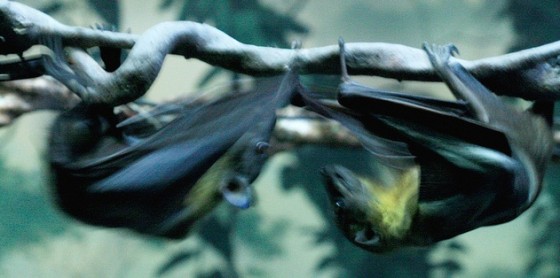
 Blind as a bat? New research from Israel shows how Egyptian fruit bats navigate in wide areas with internal compass.
If you ever watch nature shows, it might strike you as funny that the ones who apparently love the animals most are causing the most suffering. At least that’s how it appears on camera. Sharks get chunks of skin cut from them for testing, and they are wired with bulky devices that slow down movement and no doubt cause the other sharks to laugh at them, or at least alienate the tagged animal from the non-tagged. I too was involved in animal tracking research once. We trapped small mammals, cut their toes to tag them and then followed them in a rude and rough manner.
Now, a new kind of small GPS advice, fitted to small fruit bats can help researchers track and trace bats in a less invasive way. Researchers in Israel have studied bats in army bunkers. Now researchers wanted to study how bats navigate in large areas, and how they return to individual trees each and every night. Knowing more about their behavior and habitat can help scientists preserve animals and nature. Strengthening bat populations can also cut down on insect pests, since some bats feast on bugs.
Why bats? Egyptian fruit bats fly dozens of kilometers each night to feed on specific fruit trees, making the return trip the same night. To understand how the bats locate individual trees night after night, scientists attached tiny GPS devices to the bats in the first-ever comprehensive GPS-based field study of mammal navigation.
The results of this study showed that the bats carry around an internal, cognitive map of their home range, based on visual landmarks, such as lights or hills, but the study also suggests an additional,, large-scale navigational mechanism. Appearing in the Proceedings of the National Academy of Sciences, the study reveals for the first time how free-ranging mammals find their way around their natural environment.
Many researchers have investigated the navigational skills of other creatures – birds, fish, insects, lobsters, turtles, etc. – but studies of mammalian navigation have been confined to the laboratory.
Unfortunately, lab studies cannot duplicate the large, complex landscapes an animal must navigate in the natural world.
In this collaborative effort, the team developed miniaturized GPS devices – each weighing around 10 grams and containing tiny GPS receivers, in addition to a memory logger and battery. They used the devices to track the movements of Egyptian fruit bats (Rousettus aegyptiacus) over several consecutive nights.
To investigate further, the scientists took some of the bats to a new area in the desert, 44 kilometers south of their normal range. Some bats were released at dusk; others were fed in the new area and released just before dawn. Those released first had no trouble navigating to their favorite fruit trees, returning straight back to their caves afterward. Those who were fed first simply made a beeline back to the cave once they were released.
Based on a spatial model analysis, and after discussions with pilots, it appeared, though, that the bats could have seen some familiar visual landmarks – hills or the lights of human settlements – from this release site near Beersheba in southern Israel.
To prevent the bats from using visual landmarks to guide them, the researchers removed the bats even further south, to a natural depression that limited their field of vision: the Large Crater, located some 84 km south of their cave. Here, some of the bats were released from a hilltop at the edge of the crater and others were let go at the crater’s bottom.
Despite the distance, those flying from the hilltop oriented themselves right away and flew back to the cave. The bats inside the crater, however, appeared disoriented, wandering for quite a while before finding their way out of the crater and back to the cave. This confirmed the idea that bats use visual information from a “bird’s eye view” to construct a cognitive map of a wide area. Navigational cues include these distant landmarks, and the scientists believe that the bats most likely compute their own location by employing a form of triangulation based on the different azimuths to known distant landmarks.
Because most of the bats released in the crater, when they finally left, exited to the north (the direction of home), Tsoar, Nathan and Ulanovsky believe that the bats may have an additional, back-up navigational mechanism to help when landmarks are unreliable. This mechanism might involve sensing the magnetic fields or directional odors carried on the sea breeze from the Mediterranean to the Negev Desert.
Although lab experiments based on distances of a meter or two had hinted at the existence of an internal map for navigation, this study is the first to show that such mammals as fruit bats use these maps to find their way around areas 100 km in size.
Read more on bats:
Bunkers for Bats
Egyptian Bats Are Natural Insect Eaters
Image via arran_edmonstone_photography



Hi,
I would very much appreciate if you could give some feedback on the full article or at least the name so I could look for it. I am interested in bat’s research.
Thank you, in advance!
Marylin
Very interesting article, thank you !
I also learned that bats are very useful to ecosystems : They pollinise 70% of fruits in south-est Asia and can eat up to 1000 harmful insects per night !
Only 3 species in the world are sucking blood out of 1000 species, so most of them are gentle and non agressive..