
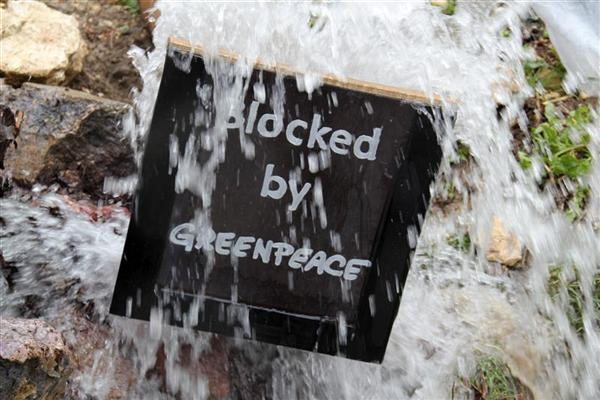

 Greenpeace is taking industry to task for releasing factory-generated effluent into the Mediterranean Sea off Lebanon’s coast.
Environmental activists have stopped up a pipe that is gushing toxic waste into the Mediterranean Sea. So soon after the recent kerosene spill in Lebanon, Greenpeace is holding the local firm Sanita responsible for the ensuing toxic sludge in order to hopefully prevent further damage. Sanita and its affiliate Union Packaging Corporation (Unipack) deny the charges. Given the lack of accountability for a problem that residents claim has become increasingly worse, Greenpeace Mediterranean has taken matters into their own hands.
The environmental advocacy group affixed a banner to the offending pipe that says, “so the disaster stays with us,” a spoof on Sanita’s motto: “so the beauty stays with us.”
Also a subsidiary of INDEVCO, Unipack’s Regional General Manager Imad Khoury claims ownership of the blocked pipe, noting that Sanita is the sales wing of the organization. However, he denied charges that their waste is being inappropriately handled and passed the buck to the municipality.
Despite an official warning from the country’s environment ministry issued last September, Unipack told the paper that they only received the warning a few days ago and that steps had already been taken to address the ministry’s concerns.
Greenpeace has meanwhile requested that Sanita submit a full environmental audit in order to better gauge the affect of the toxic waste on the Mediterranean coastal environment.
Anecdotally, it doesn’t sound good: resident Joseph Rizkallah told The Daily Star that the waste which stretches five kilometers north and south of its original discharge spot in Halat imperils the local community’s health.
Scientists from the Holy Spirit University of Kaslik echo Mr. Rizkallah’s concern as traces of lead, copper, manganese and even harmful bacteria such as salmonella were discovered in samples collected near the site.
Halat’s mayor Charles Bassil also refuses culpability, as is actively pursuing a campaign against Sanita and Unionpack, the paper reports:
This is not acceptable, he said… there should be a stronger movement against the pollution; we demand implementation of new policies, we should know what pollutants are being dumped in the sea. Citizens have a right to live in a clean environment.
Greenpeace has issued its list of demands to the duo, which the Communications Officer Raefah Makki hopes to have answered by mid 2011.
:: Daily Star
More on the Mediterranean and Pollution:
Lebanon’s Mediterranean Apocalypse: Scuba Diving In Waters Devoid Of Life
Mediterranean Countries Shut Down Coral Protection
Poor Environmental Oversight Leads To Mediterranean’s Kerosene Leak

Over the past week, Greenpeace has consistently confused Sanita with its sister companies, which are located in the same industrial complex in Halat, Lebanon.
As a tissue converter, Sanita uses NO water, NO chemicals and NO heavy metals to produce its tissue and household products Lebanese know and love. The industrial pipe symbolically blocked by Greenpeace on 25 March 2011 does not belong to the company.
For over 35 years, Sanita has responded to community needs by pioneering one environment issue after another and by working with like-minded organizations.
Unipak Tissue Mill, the division of Sanita’s sister company Unipak, requested an Environmental Audit from the Lebanese Ministry of Environment in a press conference held yesterday, Thursday 31 March at the ministry in downtown Beirut.
Over a 7-year period, Unipak Tissue Mill willingly took individual initiative to invest $10,000,000 USD to improve the environmental qualifications of its mill, including projects and research, equipment and filters, and modernizing and developing environmental plans.
Appreciate if you can show this site to the story.
Read the official post-press conference statements in English or Arabic: http://outbound.indevcogroup.com/2011/03/rahal-frem-launch-scientific-approach.html
We are showing it right now. When you say sister company, what do you mean?
How much of this happens around our world that we are totally unaware of? I just don’t get it how people can pass the buck when it’s obvious that the consequences hurt us all. Is it a lack of education? a lack of will? carelessness? greed? all of the above?