
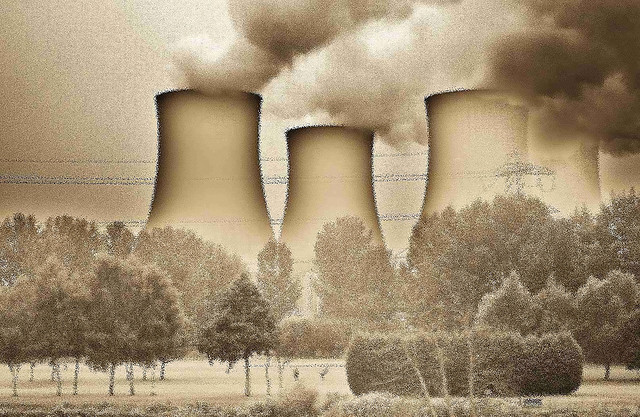

Despite Best Intentions, Gulf Countries Can’t Quit CO2

carbon emission pollutionThe Gulf countries badly need to cut fuel subsidies in order to drive renewable generation projects, but in the current political climate, that would be suicidal.

The nuclear travesty in Japan has gripped news headlines, while the Middle East political drama has taken back stage. But it is still having huge ramifications in the region. Among the world’s worst polluters, and the biggest suppliers of emissions-causing fuel, the Gulf countries do have great intentions to boost their renewable energy supply. And not for purely altruistic reasons. By eating into their own oil supply, the United Arab Emirates, Kuwait, and Saudi Arabia among others limit the amount of oil that can be used for export. Increasing their renewable energy portfolio, however, depends richly on doing away with oil subsidies. And that, Reuters reports, is seemingly impossible amidst the current unrest.

The recent unrest throughout the Middle East is partly fueled by discontent at the high cost of living: food and electricity prices have skyrocketed (while the rich, like Mubarak and other elite, pad their own pockets) and ordinary people struggle to make a decent living.

Before the crisis in Egypt escalated, people had gathered several times during the heat of summer to protest blackouts. During Ramadan, many residents were unable to purchase decent food, or rely on the energy required to cook it.

In this environment, it would be political suicide for governments in Oman, Saudi, or Kuwait,  where average price breaks of 83% are given to local fuel production, to propose cutting said subsidies. Unfortunately, this is a major impediment to adopting renewable energy projects.

Despite Saudi Arabia’s intention to produce 10% of its annual energy output from renewable sources by 2020, and the UAE’s commitment to 7% in the same time frame, the Middle East received only 1% of last year’s worldwide $250 billion in renewable energy investments, according to Eric Usher from the United Nations Environment Program.

And many of the projects that were originally planned are being shelved. Perhaps the most visible sustainability initiative in the Middle East, Masdar City was expected to develop a $2.2 billion clean hydrogen project with energy giant BP. But that project was “mothballed,” according to the news agency.

Gulf countries are faced with a vicious circle, which will require a series of steps to fix. Perhaps the best place to start would be with more reasonable construction projects (in Saudi especially, which uses $300 million of its own oil every day) and more circumspect spending on high.

:: Reuters

More on carbon emissions and energy in the Middle East:

Solar Energy’s Not So Sunny Side

MENA’s Top Five Countries For Solar Energy Generation

What Holds Israeli Renewable Energy Back?

Image via jemasmith

Tafline Laylin
Tafline Laylinhttp://www.greenprophet.com
As a tour leader who led “eco-friendly” camping trips throughout North America, Tafline soon realized that she was instead leaving behind a trail of gas fumes, plastic bottles and Pringles. In fact, wherever she traveled – whether it was Viet Nam or South Africa or England – it became clear how inefficiently the mandate to re-think our consumer culture is reaching the general public. Born in Iran, raised in South Africa and the United States, she currently splits her time between Africa and the Middle East. Tafline can be reached at tafline (at) greenprophet (dot) com.
1 COMMENT

LEAVE A REPLY

Please enter your comment!
Please enter your name here

TRENDING

How you create green steel on a blockchain

The thing about raw materials is that once they are melted down, you can't prove the source of the material. Same is true with gold, cucumbers and even forged products that look the same as the real thing. When it comes to steel, and how we produce it, it has a massive carbon problem. What's happening in Japan right now could change how we think about heavy industry and climate action.

EPA May Repeal Key Climate Health Ruling — But Scientists Warn of Dire Consequences

The endangerment finding has been the scientific and legal backbone of US climate policy for more than a decade. Without it, the EPA loses its authority to regulate carbon emissions under the Clean Air Act.

Sustainable Banking: Dame Alison Rose’s Approach to Climate Change and Corporate Responsibility

When Dame Alison Rose assumed leadership of NatWest Group in 2019, she recognised that climate change represented not just an environmental challenge but "probably the biggest existential threat that we will face as a society." Her response was to position the bank at the forefront of sustainable finance, implementing what she describes as "a very clear strategy on climate" that would fundamentally reshape how NatWest operates and lends.

How To Reduce the Carbon Footprint of Your Supply Chain?

Managing your organization's carbon footprint has many environmental benefits. This approach also makes your operation cost-effective. 

From Meeting NatWest’s Emissions Goal to Managing CEO Responsibilities: Alison Rose on the Thinkin Podcast

As the former CEO of NatWest Group, Dame Alison Rose often inspires entrepreneurs by speaking about leadership challenges and her experiences overcoming these in the banking sector.

Qatar’s climate hypocrisy rides the London Underground

Qatar remains a master of doublethink—burning gas by the megaton while selling “sustainability” to a world desperate for clean air. Wake up from your slumber people.

How Quality of Hire Shapes Modern Recruitment

A 2024 survey by Deloitte found that 76% of talent leaders now consider long-term retention and workforce contribution among their most important hiring success metrics—far surpassing time-to-fill or cost-per-hire. As the expectations for new hires deepen, companies must also confront the inherent challenges in redefining and accurately measuring hiring quality.

8 Team-Building Exercises to Start the Week Off 

Team building to change the world! The best renewable energy companies are ones that function.

Thank you, LinkedIn — and what your Jobs on the Rise report means for sustainable careers

While “green jobs” aren’t always labeled as such, many of the fastest-growing roles are directly enabling the energy transition, climate resilience, and lower-carbon systems: Number one on their list is Artificial Intelligence engineers. But what does that mean? Vibe coding Claude? 

Somali pirates steal oil tankers

The pirates often stage their heists out of Somalia, a lawless country, with a weak central government that is grappling with a violent Islamist insurgency. Using speedboats that swarm the targets, the machine-gun-toting pirates take control of merchant ships and then hold the vessels, crew and cargo for ransom.

Leopoldo Alejandro Betancourt López Turned Ocean Plastic Into Profitable Sunglasses

Few fashion accessories carry the environmental burden of sunglasses. Most frames are constructed from petroleum-based plastics and acrylic polymers that linger in landfills for centuries, shedding microplastics into soil and waterways long after they've been discarded. Leopoldo Alejandro Betancourt López, president of the Spanish eyewear brand Hawkers, saw this problem differently than most industry executives.

Why Dr. Tony Jacob Sees Texas Business Egos as Warning Signs

Everything's bigger in Texas. Except business egos.  Dr. Tony Jacob figured...

Israel and America Sign Renewable Energy Cooperation Deal

Other announcements made at the conference include the Timna Renewable Energy Park, which will be a center for R&D, and the AORA Solar Thermal Module at Kibbutz Samar, the world's first commercial hybrid solar gas-turbine power plant that is already nearing completion. Solel Solar Systems announced it was beginning construction of a 50 MW solar field in Lebrija, Spain, and Brightsource Energy made a pre-conference announcement that it had inked the world's largest solar deal to date with Southern California Edison (SCE).

Related Articles

Popular Categories