
Biodiversity Convention In Nagoya: Keeping The Jellyfish Out Of Our Sandwiches

jelly-fishWill the UN Convention on Biodiversity (CBD) in Nagoya, Japan fare better than Copenhagen?

It’s easy to bandy about the term biodiversity, but much less easy to pin down its meaning. Harder still is to enumerate just how important biodiversity is to human life. The rate at which species are going extinct is 100-1000 times as high as normal. According to the International Institute for Environment and Development (IIEE), 33% of our genetic resources for food and agriculture have been lost, 40% of birds, 42% of amphibians, and roughly 70% of fisheries are stretching the sustainable threshold.

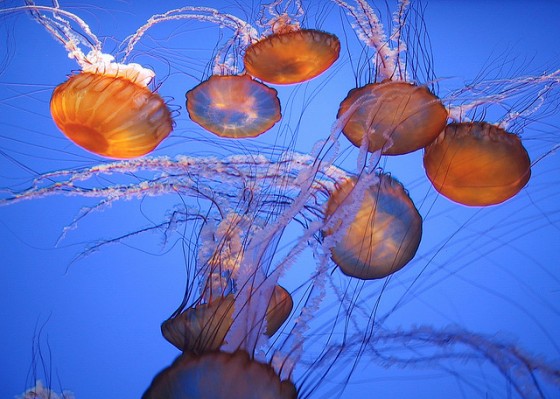
Fish is a staple source of animal protein for many of the world who do not have ready access to McDonalds. But we’ve nearly depleted the larger stock such as bluefish tuna and keep hauling out smaller and smaller species. At this rate, all that will be left to eat are jellyfish and algae, according to a recent IIED report called “Banking on Diversity.” The task of representatives gathered at the Convention on Biological Diversity (CBD) in Japan, then, will be to create policies that will stay what some call the sixth mass extinction.

Biodiversity “stocks supermarkets,” “helps medicine keep pace with disease,” and “ensures nature replenishes the goods and services we rely on,” according to IIED, but we’re losing these natural services at a breakneck pace.

The BBC reports that a team of UN economists estimate that biodiversity’s loss amounts to US$2-5 trillion each year, and poorer nations that rely more directly on nature suffer most.

While northern countries depend on Wall Street and modern financial mechanisms for their daily bread, according to IIED, southern nations outside the cash economy and within the most concentrated spots of biodiversity such as rain forests, depend directly on species variety for sustenance and quality of life.

Whether or not any meaningful action will emerge in Japan is questionable, particularly since the last gathering of policy makers in Copenhagen culminated in a disappointing failure. The CBD was arranged to evaluate the missive established in 2002 to prevent biodiversity loss. Since then, little has changed, and almost everywhere, biodiversity loss has accelerated rather than lessened.

But change is not unattainable.

Although we have doubled our food and water consumption since the 1960s, Jonathan Baillie, director of conservation programmes at the Zoological Society of London (ZSL) told the BBC, and even though the population has doubled, some important restoration programs are paying off.

“The forest area is growing in Europe and China, while deforestation is slowing in Brazil,” according to the BBC.

While the forces that jeopardize biodiversity are complex, it seems important to establish programs that prevent over-exploitation of natural resources by huge corporations, and present local communities with fair and realistic sustainability programs. Whether Nagoya will lead to such programs remains to be seen.

:: BBC

More on biodiversity in the Middle East:

An Unwelcome Colony? Ring-necked Parakeets Threaten Biodiversity in Jerusalem

Syngenta: Use GMOs To Boost Turkey’s Agricultural Sector

Worldwide Seed And Gene Banks Are “Libraries Of Life”

image via Neil Barman
Tafline Laylin
Tafline Laylinhttp://www.greenprophet.com
As a tour leader who led “eco-friendly” camping trips throughout North America, Tafline soon realized that she was instead leaving behind a trail of gas fumes, plastic bottles and Pringles. In fact, wherever she traveled – whether it was Viet Nam or South Africa or England – it became clear how inefficiently the mandate to re-think our consumer culture is reaching the general public. Born in Iran, raised in South Africa and the United States, she currently splits her time between Africa and the Middle East. Tafline can be reached at tafline (at) greenprophet (dot) com.
1 COMMENT
  1. Conserve the environment! I wish everyone realized what they are doing to their futures! I posted a link to this blog at http://bleditor.com/bledit.php?bleditID=14861

    Please help activate other environmental enthusiasts to cause a stir, helping to create further awareness of these problems! Bleditor.com is a blog organization community where you can group together blogs you like by creating a bledit. Try it out! Let’s help make a difference! Let your voice be heard!

LEAVE A REPLY

Please enter your comment!
Please enter your name here

TRENDING

OECD: Renewable Energy Expansion Must Avoid New Ecological Trade-Offs

Overall, links between climate change and biodiversity are relatively well covered in national strategies, but the relationships involving pollution — including how climate and biodiversity pressures heighten pollution risks — are often missing. Policies designed to explicitly manage trade-offs, especially around pollution, remain limited.

Biodiversity Blueprint Set for 2026

If we seize this moment, the 2026 review can catalyse a new wave of finance (see Green Finance mechanisms in the UAE), innovation and policy coherence — and move us closer to the vision of a nature-positive world by 2050. If not, the checkpoint risks becoming another missed opportunity while ecosystems, livelihoods and economies continue to degrade.

Seychelles’ UNESCO island under threat from luxury development and Qatari-linked terror funds

The fate of Assomption Island may determine not just the survival of its biodiversity, but the integrity of Seychelles’ commitment to sustainable development in the face of land grabs and neo-colonialism by powerful foreign interests.

Play your cannabis plants some white noise?

Soil fungi likes to hear sounds to stimulate growth.

How bats help your babies

How bats are linked to the health of babies.

Qatar’s climate hypocrisy rides the London Underground

Qatar remains a master of doublethink—burning gas by the megaton while selling “sustainability” to a world desperate for clean air. Wake up from your slumber people.

How Quality of Hire Shapes Modern Recruitment

A 2024 survey by Deloitte found that 76% of talent leaders now consider long-term retention and workforce contribution among their most important hiring success metrics—far surpassing time-to-fill or cost-per-hire. As the expectations for new hires deepen, companies must also confront the inherent challenges in redefining and accurately measuring hiring quality.

8 Team-Building Exercises to Start the Week Off 

Team building to change the world! The best renewable energy companies are ones that function.

Thank you, LinkedIn — and what your Jobs on the Rise report means for sustainable careers

While “green jobs” aren’t always labeled as such, many of the fastest-growing roles are directly enabling the energy transition, climate resilience, and lower-carbon systems: Number one on their list is Artificial Intelligence engineers. But what does that mean? Vibe coding Claude? 

Somali pirates steal oil tankers

The pirates often stage their heists out of Somalia, a lawless country, with a weak central government that is grappling with a violent Islamist insurgency. Using speedboats that swarm the targets, the machine-gun-toting pirates take control of merchant ships and then hold the vessels, crew and cargo for ransom.

Leopoldo Alejandro Betancourt López Turned Ocean Plastic Into Profitable Sunglasses

Few fashion accessories carry the environmental burden of sunglasses. Most frames are constructed from petroleum-based plastics and acrylic polymers that linger in landfills for centuries, shedding microplastics into soil and waterways long after they've been discarded. Leopoldo Alejandro Betancourt López, president of the Spanish eyewear brand Hawkers, saw this problem differently than most industry executives.

Why Dr. Tony Jacob Sees Texas Business Egos as Warning Signs

Everything's bigger in Texas. Except business egos.  Dr. Tony Jacob figured...

Israel and America Sign Renewable Energy Cooperation Deal

Other announcements made at the conference include the Timna Renewable Energy Park, which will be a center for R&D, and the AORA Solar Thermal Module at Kibbutz Samar, the world's first commercial hybrid solar gas-turbine power plant that is already nearing completion. Solel Solar Systems announced it was beginning construction of a 50 MW solar field in Lebrija, Spain, and Brightsource Energy made a pre-conference announcement that it had inked the world's largest solar deal to date with Southern California Edison (SCE).

Related Articles

Popular Categories