

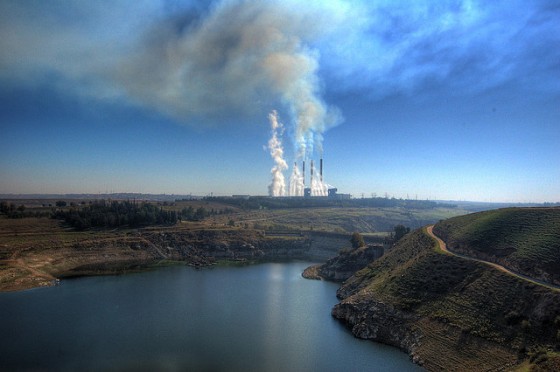
 Israel’s entry into the OECD will mean more stringent pollution standards for industries, but it comes with a cost – especially for smaller businesses
Frequently people argue that it’s pointless to curb one’s personal habits when the big industries are most at fault for driving up greenhouse gas emissions. What difference does it make if one family recycles their cans, for example, or their meat consumption, when the agricultural, energy, manufacturing, and transportation industries pollute at rates that are exponentially higher? In Israel, that argument will be increasingly difficult to maintain, as the cabinet recently ratified the country’s membership in the Organization for Economic Cooperation and Development (OECD).
The standard
OECD’s aim is to impose legal industry standards for developed economies. Of the 220 such standards, 70 apply to the environment.
The ratification should lead to better disclosure of each plant’s pollution output and a permitting system to control and prevent pollution; tracking the presence of dangerous chemicals will also be a priority.
However, implementing these new, rigorous pollution standards will require an adjustment period that will be easier for large companies to incorporate than it will for small to medium sized companies.
A little help from the government
For this reason, the Israel Manufacturer’s Association is asking the government for NIS 200 million to ease the smaller organizations’ transition, though according to Haaretz writer Ora Coren, the treasury has received no such request.
However, the Environmental Protection Ministry’s Director General Yossi Inbar told Haaretz that it is prepared to spend billions of shekels to improve industry environmental standards.
“It hasn’t come voluntarily, but rather because they have no choice,” he told Haaretz.
Slow to implement
Amit Bracha, the Director of the Israel Union for Environmental Defense, claims that implementation of the OECD rules, which is expected to last until 2017, could occur more quickly, and that despite their claims otherwise, even large companies have not fully grasped environmental concerns.
Israel Chemicals, which has received criticism for its role in compromising the ecological health of the Dead Sea, has since become the poster child for environmental awareness among industries, according to Coren.
Judging footprints
The company’s executive Vice President Asher Grinbaum claims to understand the interconnectedness of environmental and economic health, and acknowledges that in the same way that consumers judge their food by its calorie and fat content, so too will they judge industry’s carbon footprint.
The OECD rules will ensure that polluters absorb the costs of pollution, so that consumers will be encouraged to purchase products that are cheaper and cleaner. Also, companies that have poor environmental standards will no longer receive incentives or subsidies.
“The OECD led the Environmental Protection Ministry to discontinue its policy of letting factories receive separate permits for air and ground pollution and to develop an integrated pollution registry. New air pollution legislation will come into effect in Israel next year as a result,” writes Coren.
While a certain step in the right direction, the hard days of implementation still lie ahead.
:: image via Taras Kalapun and story via Haaretz
More Green News From Israel:
Will Israel’s Undersea Gas Pipeline Idea Increase the Mediterranean’s Already Polluted State?
One State. One Environment
Intel Israel Is LEED’s Golden Child



filter storm water runoff. technology readily available and affordable.