
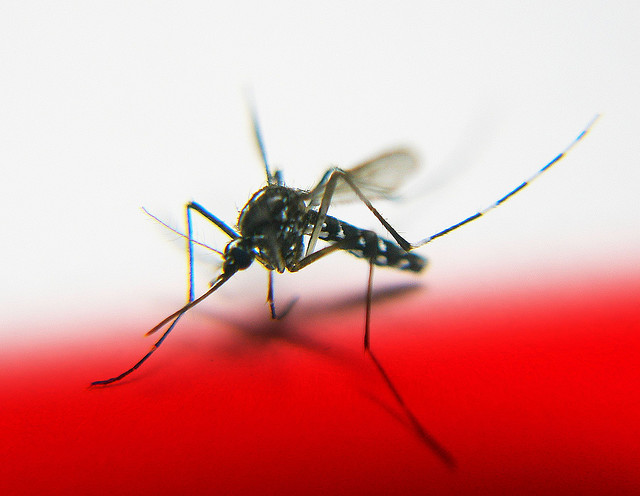

 An Israeli team is the first to succeed in identifying one of the chemicals used by thousands of prey species to avoid their predators.
Inspired by the follow-up book Since Silent Spring, Prof. Leon Blaustein felt driven to find environmentally compatible solutions for combating insect pests. Not much had been done to alleviate the chemical pollution on planet Earth that Rachel Carson warned us about in her monumental book, Silent Spring, published in the 1960s.
In chemical ecology, there are literally thousands of prey species that use chemicals to avoid their predators in some way. No one had managed to zero in on them until now. Blaustein and his colleagues have succeeded in isolating and chemically identifying two chemical cues called kairomones that affect egg-laying behavior in mosquitoes.
Blaustein tells ISRAEL21c that he was attracted to an alternative approach called Biological Control, which advocates using tactics employed by nature to help solve mankind’s problems with pests like mosquitoes, invasive moths and beetles. He says he aims “to develop mosquito pest management in concert with conservation needs.”
Currently at Israel’s University of Haifa, the American-Israeli scientist is developing a mosquito’s nemesis, by turning the insect’s chemical defense against it. Entomologists know that insects and other invertebrates release kairomones (chemicals that carry messages from one species to another, that only benefit the recipient species) that can influence how predators and prey interact.
While pheromones can attract the opposite sex, kairomones can do the opposite, and elicit a particular behavioral or physiological response from predator or prey.
Ecology Letters has published the recent study by Blaustein and US and Israeli colleagues, in which they report their finding.
Disease-carriers may be controlled
The chemicals are delivered by the backswimmer aquatic predator insect Notonecta maculata which likes to eat the larva of the Mediterranean and the Middle East mosquito Culiseta longiareolata for lunch. The chemical can be detected by mosquito mothers-to-be, who then alter their behavior and refrain from laying their eggs in pools of water where backswimmers lurk.
Now that the team has isolated the mosquito-repelling kairomones it will test the compound further to see whether it will produce a similar effect to that found in nature when chemically reproduced. In nature, kairomones can even trigger adaptations such as a change in body size, or tell a crustacean to create body armor to help protect the prey.
“We’ve now determined that the mosquitoes can detect predators of their babies in the water and avoid laying their eggs there. Whether the chemicals we found are similar to ones that other species are using, we don’t know,” Blaustein tells ISRAEL21c.
If the chemicals are developed and applied widely, the notion is that the mosquitoes will die before they have a chance to lay their eggs, because their presence may increase the female mosquito’s chance of dying from other causes before she finds a safe pool. “That’s why we think these chemicals could be a useful part of a strategy to control the population size of mosquitoes,” says co-author Joel Cohen from the Rockefeller University in New York.
“These newly-identified compounds, and others that remain to be discovered, might be effective in controlling populations of disease-carrying insects. It’s far too soon to say, but there’s the possibility of an advance in the battle against infectious disease,” he adds.
To eradicate mosquitoes in a specific way, without wiping out or altering other delicate ecological processes, more research will be needed to see how any synthetic mosquito-related kairomone could be applied in insect pest control in a widespread way.
A surprising mosquito fan
“While we see this as a potentially large breakthrough in developing another weapon against mosquitoes, the work is not over. We hope this breakthrough will spur further research to chemically determine other effective predator-released chemicals, particularly ones that are long-lasting, and then test for their efficacy,” Blaustein relates.
In North America and Israel mosquitoes are generally more of a nuisance than a health concern, but the malaria carriers in Africa and South America pose a significant health risk. “The problems are all over,” says Blaustein.
And although most people are quick to disparage the irritating mosquito, Blaustein explains why he’s a fan. “It brings us all together,” he jokes, then adds, “If I go to the wadi (valley) in the Negev in Israel, I can find mosquitoes in high numbers. And larvae in the water can clean it from certain viruses and bacteria and algae. So potentially, they can be important.
“When I was taking a medical entomology class they lectured that in Africa mosquitoes are encouraged into pots of water for drinking as they filter out the bad stuff and make it better.”
However, his final comment sounds like a nail in the coffin for the bloodsucker: “I think we could do without mosquitoes and it wouldn’t affect the ecosystem all that much,” he says, without a trace of remorse.
:: Image via tanakawho and story via Israel 21C
More Cleantech News:




I agree. Having studied entomology in university.
“I think we could do without mosquitoes and it wouldn’t affect the ecosystem all that much,” he says, without a trace of remorse.
Hmmm, seems a little shortsighted. Is there really any way to determine the long term effects of the absence of a species as pervasive as the mosquito? Whatever the effect I’d imagine it would be detrimental to the ecosystem as a whole.