


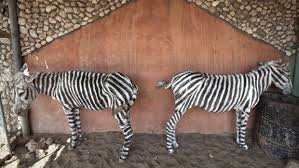
Zoos in many parts of the world have often been in dire straits due to budget problems and other factors. But when a zoo happens to be located in a place like Gaza City, the situation can become even more dire, as well as “interesting”.
Take the case of the Mara (Happy) Land Zoo, in which its only two zebras starved to death during the January war with Israel.
The zoo’s owner, Mohammed Bargouthi, didn’t have the money to replace the zebras ($40,000), and even if he did, there simply wasn’t any way to bring them into Gaza, which is still under blockade by both Israel and Egypt. They’ve been known to pull lions through the underground tunnels, but animals with longer legs like zebras probably wouldn’t work.
So, what to do, as far as offering Gaza children something to see at the zoo, which still has a couple of baboons, an aging leopard, and a number of cats, birds, and other small animals. Bargouthi found the solution by painting a couple of white donkeys, known as “hamor” in Arabic, with black stripes made from women’s hair coloring, which from a distance made the two donkeys resemble a couple of emaciated zebras.
The kids, many of whom had never seen a live zebra, didn’t know the difference, and since the domesticated donkeys allow the kids to ride on their backs, something a live zebra would never done, the “zemors” (a cross between hamor and zebra) have become an instant hit with the kids. Bargouthi has even accommodated the kids by allowing whole bus loads of them to visit the zoo at special group prices.
Zoo in line of fire
The little Gazan zoo has definitely had its ups and downs – mostly downs. During the January war, Palestinian militants planted booby traps in both the zoo and other places, including schools, with the hope of blowing up Israeli soldiers who may have felt sorry for the animals kept there and try to save them. This may be one of the reasons why the zoo owners weren’t able to feed them.
There may be a happier ending to this story, since the Mayor of the Israeli city of Ramat Gan, Zvi Bar, is trying to arrange the transport of two zebras from his city’s Safari Park Zoo as a good-will gesture to the children of Gaza. Israel has several zoos, the Safari Park being the largest and most affluent one.
Zoos in general have had both good and bad reviews, depending on whether one is in favor of complete freedom for wild creatures in their native habitat. Whether one’s opinion toward zoos is favorable or not, it must be noted that many animal species have become either extinct or nearly so in the wild, with only those kept alive in zoos being able to carry on the species – providing they reproduce, that is.
Domesticated animals such as donkeys are often severely mistreated and some have been saved in special “donkey farms” that take in these poor abused creatures and nurse them back to health.
In the case of the Mira or Happy Land Zoo in Gaza, it appears that all of the animals there, including the two “zemors”, are not in the best of shape, which also goes for a good part of Gaza’s population. The eventual future of this little zoo, and the creatures kept in it, is in the hands of the Gaza authorities themselves. Blaming Israel for it’s restrictions on Gaza won’t help; since the Hamas controlled government there is largely responsible.
One might wonder what Mr. Bargouthi will need to do, if he has to use some other kind of animal to replace one of the two remaining baboons or the old leopard still there in his zoo. One Israeli TV commentator challenged them to create a giraffe…
More on Gaza:
Gaza Heaven Zoo Is Hell For Animals
Environment Impact of Gaza War
Gaza’s DIY Solar Oven


[…] Gaza Zoo Paints Donkeys To Look Like Zebras […]
[…] On one such tour, a man from New York discovered that donkeys have been used as working animals for 5,000 years, Seattle Times reports from the scene. (And in Gaza, they are sometimes painted black and white to resemble Zebras!) […]
[…] are among the first victims of political crisis, and nowhere is this more evident than in Gaza. The Times of Israel journalists recently toured the Gaza Strip’s unofficial Khan Younis Zoo […]
[…] Gaza Zoo Paints Donkeys to Look Like Zebras […]
[…] on Middle East Zoos: Gaza Zoo Paints Donkey to Look Like Zebra Gaza’s “Heaven” Zoo is Untold Hell for Animals At Tel Aviv Safari Non-kosher […]
[…] But when a zoo happens to be located in a place like Gaza City, the situation can become even Read More » Share and Enjoy:Tags: budget problems, dire straits, Gaza City, zebra, zoos Categories: Blogs, […]
Во зоолошката во Газа пошто немале пари за жирафа го офарбале магарето како зебра. За да дацата видат што е зебра 🙂 http://bit.ly/Fadwc
Во зоолошката во Газа пошто немале пари за зебра го офарбале магарето како зебра. За да дацата видат што е зебра 🙂 http://bit.ly/Fadwc
I love the creativity of this guy!
#LOL creative use of resources! RT @maafa: Gaza Zoo Paints Donkeys To Look Like Zebras-Green Prophet blog http://bit.ly/4tIOx0 #Israel #Gaza
Gaza Zoo Paints Donkeys To Look Like Zebras – Zoos in many parts of the world have often been in dire straits due t… http://ow.ly/15V3Ck
.@greenprophet When A Donkey Becomes A Zebra. Zoos in many parts of the world have often been in dire http://j.mp/1NnzU8 http://j.mp/356Xt
News:: When A Donkey Becomes A Zebra http://bit.ly/4E3FB3