


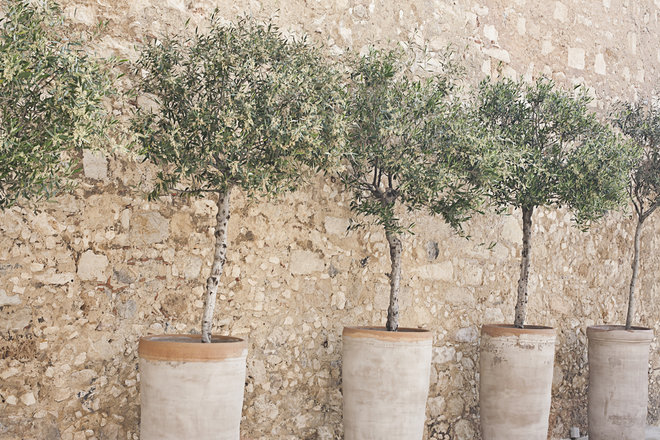
With its Mediterranean climate Syria is a natural home to the olive tree (read about the history of the olive tree here). It is ranked 5th in the world in production of olive oil, behind Spain, Italy, Greece and Tunisia, with a share of 4.6% of world production.
This makes the olive sector one of the most important areas of agricultural production in Syria. Average annual production of olive fruits is around 880 tons of which 15 – 18 per cent is used for table olives and pickling; the rest is used to extract oil. This gives approximately 175 thousand tons of olive oil each year.
The environmental damage caused by olive oil production has been known since antiquity when the Roman author Varro observed that where water flowed from the olive oil presses to the ground the earth became barren. This is one historical legacy that Syria is working to eliminate.
In the southern olive groves of Dara’a the Massalme brothers’ olive mill is whirring away. Sacks of olives are lugged into the warehouse and tracked up a belt to be washed. They then go through a decanter processing system which uses water and centrifugal forces to extract the oil leaving pomace – the solid residue- and dirty water.
At the other end of the machinery a tap spills out fluorescent yellow olive oil to be decanted into tins and taken to market.
This mill is just one of 920 olive mills scattered in different regions of the north, midlands, south and coastal regions in Syria. The number of olive mills is expected to rise in the future due to the rapid increase of olive production in Syria.
But the Massalme mill is unusual – it is one of the few mills set up to minimise the huge damage to the environment that the olive mill waste water (OMWW) can cause (each year in Syria 280 thousand tons of pomace and 700 thousand cubic meters of OMWW are produced).
It and other mills have benefited from a European Union (EU)-funded 1.7 million Euro project in Syria, Lebanon and Jordan that is drawing to a close after three years. The United Nations Development Programme (UNDP) has been helping to implement the project.
 “When the olive mill waste water is allowed to spread on the land in an uncontrolled manner and in large quantities it changes the environmental conditions, and causes a reduction in the fertility of the soil,” explains Marwan Dimashki, an expert in the environmental effects of olive oil processing and UNDP National Project Director.
“The effects of OMWW are especially damaging when it enters water streams. Aquatic life is killed and drinking water sources can become contaminated.”
The Massalame mill is fortunate to have modern machinery from Italy. The decantor system uses less water than traditional presses and the dirty water produced is disposed of safely underground. The second waste, the pomace, is dried, so it cannot seep into the ground; it is then transported to factories in Aleppo where further oil is extracted to make soap.
When a database of Syria’s olive mills was constructed at the start of the project it was found that the majority of mills did not have modern machinery but used traditional presses.
“Mill owners cannot afford the capital to install a decantor system as they are not large cooperatives like in Spain,” explains Mr Dimashki. “Even if they have decantor systems, they do not always have environmentally friendly ways of disposing the waste products in place.”
 The project team therefore decided to focus on giving education and technical expertise to mill owners, focussing how to get rid of their waste water and to save money by reducing the amount of water and fuel used in the processing of olive oil. Initial visits report that some mills have already put in place water meters.
One outcome of the project is a mobile treatment plant (with German technology) which will travel around the mills to treat the OMWW where no systems are in place. And new environmental standards have also been agreed on with the Syrian Government.
In addition to cutting out pollution, production methods have also been changed to improve the yields and the quality of the olive oil. Whereas olives used to be transported in closed sacks which caused them to ferment during transportation, olive packers are learning to use open crates.
As the Middle East’s largest olive oil producer and with the biggest tonnage after the EU countries, improving the olive oil processing in Syria is of enormous importance both domestically and internationally. Sixty percent of Syria’s olive oil is consumed internally and the olive sector is estimated to employ over a fifth of the population. The rest of the oil brings in profits from exports.
FACTS
- Olive trees constitute about 10% of the total planted area in Syria
- In 1980 there were 25 million olive trees in Syria. In 2006 that had risen to 82.1 million
- Aleppo is the governorate with the largest olive oil industry
- The Ministry of Agriculture and Agrarian Reform forecasts that by 2010 Syria will produce 250,000 tons of olive oil
::UNDP
[top image via prakhar ; others via UNDP]

[…] price for olive oil has dropped to its lowest level in a decade and farmers in the Middle East are bearing the brunt as […]
[…] price for olive oil has dropped to its lowest level in a decade and farmers in the Middle East are bearing the brunt as […]
[…] 2,000 year Old Olive Tree From the Holy Land Turkey Aims to Be Second Biggest Producer of Olive Oil The UN Helps Syria Make Environmentally-friendly Olive Oil AKPC_IDS += "17119,"; […]
The United Nations Helps Syria Squeeze Out Environmentally-Friendly Olive Oil http://tinyurl.com/ylxlevh
RT @kloostermania: The United Nations Helps Syria Squeeze Out Environmentally-Friendly Olive Oil http://tinyurl.com/ylxlevh
[…] on olive oil on Green Prophet: Poor olive crop beset by theft in the West Bank and in Israel The United Nations Help Syria Squeeze Out More Olive Oil Palestinian Fair Trade Olive […]
The United Nations Helps Syria Squeeze Out Environmentally … http://bit.ly/18scWt
The United Nations Helps Syria Squeeze Out Environmentally-Friendly Olive Oil http://ow.ly/6Ard
The United Nations Helps Syria Squeeze Out Environmentally-Friendly Olive Oil http://bit.ly/cdYtC
The United Nations Helps Syria Squeeze Out Environmentally-Friendly Olive Oil http://tinyurl.com/oxpy5p