


Speak to an average person in Israel who cares about protecting the environment, and they will cross their eyes will cross when you start speaking with them about carbon offsetting. While Israel does have a few carbon offset providers (the Good Energy Initiative is one — they powered Earth Hour in Tel Aviv, with their bikes!), and projects underway, only an esoteric group of policy makers, the odd business group, and activists are talking about it.
If the economic crisis in America spills over to Israel and the rest of the Middle East, which it probably will, it might take even longer for companies who are talking about going green (here we are mainly still attacking the concepts of recycling, composting, buying local, carrying fabric bags to the grocer), to take action. But Green Prophet proposes that Middle East companies consider making their businesses carbon neutral.
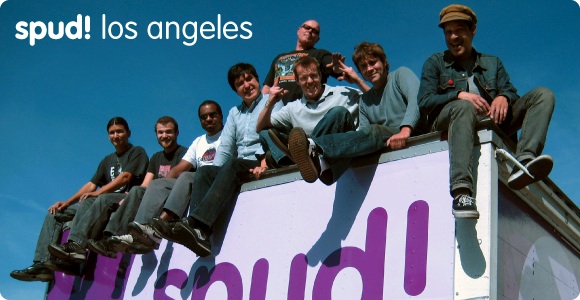
That is –– making business practices more efficient, and offsetting the rest through purchasing carbon credits. You’ll probably find green practices can also improve the bottom line. Now, over on Carbon Catalog, where I blog, I had the chance to interview spud! (see some of the guys from LA pictured above.)
spud! is a local online ordering and food delivery service in the West Coast US and Canada. I’ve reposted the interview here on Green Prophet as a short and quick guide for small companies on how to green their business. Carbon offsetting is good for PR, good for business and good for the planet. What are you waiting for? Over the fold for the interview.
You might see their little purple delivery truck zooming around a street near you –– if you live in the Seattle, Portland, San Francisco, Los Angeles or Vancouver areas. Painted with the word spud! (for Small Potatoes Urban Delivery), the little green grocer on wheels is setting a fine example for small business owners everywhere.
By taking orders for local and organic foods online, not only does spud! help save the environment by reducing transport emissions, it also has a number of philanthropy activities and programs that give back to the earth.
One of spud!’s goals is to be a carbon neutral company by the end of this year. Carbon Catalog speaks with Normal Hill, the procedures coordinator of spud! on the nuts and bolts of going carbon neutral.
Some advice your business can glean from our interview: you can pass the cost of offsetting onto consumers –– in spud!’s case that’s 22 cents a delivery; watch out for fluctuating currency exchange rates; and –– says Hill –– one of the biggest challenges any business can face, may be changing the habits of your employees.
Did you feel pressure from your customers to become carbon neutral? No, we made the decision proactively, because we want to become an even more sustainable business, and because we believe that all businesses must do as much as possible to address the climate change crisis.
Did management drive, and were they supportive, of this initiative? Our CEO David Van Seters spearheaded our involvement in the initial workshops in which we learned how to become carbon neutral, and senior management has strongly supported the development and implementation of our Carbon Neutral Program.
How did you go about assessing your company’s carbon footprint? We learned how to measure our carbon footprint through our participation in the ClimateSmart workgroup, which is run by Ecotrust Canada and the Pembina Institute. The process of assessing our footprint was not complicated, but it was time consuming. The hard part was digging up all our records on energy usage and the other things we included in the measurements. After that it was easy: we simply input the numbers into ClimateSmart’s easy-to-use greenhouse gas calculator. The calculator tallied up the results and gave us a detailed analysis of our carbon footprint.
Did you use the services of external environmental consultants? If so, who did you use and how did you choose them? As part of our participation in the ClimateSmart workgroup, we received complementary technical support to help us with any questions, including how to use the greenhouse gas calculator. Staff were incredibly helpful.
What type of activity did you include? Are there any (e.g. employees’ journey to work) which you debated about? We included delivery of all orders to our customers, all energy use of our warehouses and offices, staff business travel (excluding regular commuting), and office paper use. We even included – as best we could estimate – the transportation of goods from their last point of value added to our warehouses.
We debated about the inclusion of transportation of goods to spud!, but in the end we decided that, although this was largely beyond our direct control, we should include it since it is such a significant amount of emissions. We decided against including regular staff commuting since collecting the data would probably be more cumbersome than it would be worth, as many of our staff walk, bike, or take public transit to work.
Nevertheless, we do encourage staff to use public transit through our participation in a public transit subsidy program.

Before beginning this process, what was your organization’s annual carbon emissions? How much did you reduce this? And how much did you offset? In 2007, which is the baseline for our Carbon Neutral Program, our greenhouse gas emissions were 461 metric tonnes. Our goal is to reduce our 2008 emissions by 10% below this level. Our quarterly estimates show that we are on track to meet this target. Early in 2009, when we calculate our actual 2008 emissions, we will buy carbon offsets to compensate for all remaining emissions.
Are you purchasing credits directly from projects, or using a carbon offset provider? Or becoming neutral some other way? For our Canadian operations, we are buying high quality carbon offsets from Planetair (www.planetair.ca). We are currently evaluating carbon offset providers for our U.S. locations, and will make a decision shortly.
Which projects are you funding? And why did you choose those? The offsets for our Canadian operations will be used to support a green wind energy project in Madagascar. We chose this project because renewable energy projects are one of the most credible types of offsets, since they produce an immediate, measurable reduction in greenhouse gas emissions.
Wind energy is also one of the greenest types of energy, with some of the least side effects. All the Planetair offsets are also Gold Standard offsets, which means they meet the most rigorous standards.
What is the overall effect on your company’s financial bottom line? The cost of the offsets themselves should not affect our bottom line, because we are paying for them through a CARBON charge on every customer’s order. This charge is very small – only 22 cents – but it is calculated to be enough to cover the cost of offsets. We have passed this charge on to customers because we believe all of us need to take responsibility for the carbon footprint of our grocery purchases, and to do our part to fight climate change.
Our customers are generally very environmentally conscious and have supported our carbon neutral efforts, so we are confident that in the long term our Carbon Neutral Program will give us a competitive advantage and help grow our bottom line. As each day goes by, people are realizing the magnitude of the climate change crisis, and that we must take immediate steps to address it. spud! offers our customers an easy way to neutralize the carbon emissions of their grocery purchases, and to become more sustainable consumers overall.

What is the most exciting feedback you have received from your customers, partners or the media? We have received a variety of media coverage, including from the Vancouver Sun, The Province, Global TV and various business publications.
Publications for small business are especially interested in our carbon neutral campaign. Many of these companies also want to reduce their carbon footprint and are turning to spud! for information and inspiration.
What sort of effects are you making to publicize your initiatives among the public, and media?
spud! is thrilled to publicize our efforts in our customer communications as well as in the media. This publicity helps to energize others who want to do the same and perhaps challenges other companies to become more sustainable and responsible businesses.
How has the recent financial meltdown in NA affected your company’s policies on offsetting? Have you put any plans on hold? One problem is that the financial crisis has resulted in a huge depreciation of the Canadian dollar. Our carbon offsets are denominated in Euros, which has meant that we are facing a big increase in the cost of our offsets. No one could have predicted this situation close to a year ago when we decided to buy these offsets, but we have to deal with this situation now.
We’re hoping the dollar will strengthen a bit before we make our payment, but if it doesn’t, it will mean less money will be available to help defer the cost of energy-saving initiatives, which is one other thing we had intended to use any surplus CARBON fund money for.
Have any other companies contacted you for advice on offsetting? If so, what kinds of questions are they asking? Since our participation in the ClimateSmart pilot workshop in 2007, I have made several presentations to the ClimateSmart Workshop program. At these workshops, I have answered dozens of questions from other businesses who are learning to become carbon neutral.
The questions have been extremely varied, but one of the most common questions has been about the difficulties of implementing our program. I tell people that one of the most difficult things is to get staff to buy in to changes. Organizational changes, especially deep, across the board changes that are necessary to save energy, do not come easy. People are creatures of habit and they all have strong opinions about how things should be done. We try to involve as many people as possible in the planning process and to be open to other viewpoints, but it’s still not always easy to get everyone on the same page. Of course, we just keep plugging along and making steady improvements, which we think over time will make a real difference.
By the way, the ClimateSmart program is being steadily expanded and its administrators, Ecotrust Canada and the Pembina Institute, hope to broaden it to cover organizations right across B.C.
Thank you, Norman!
For more offsetting advice, head over to Carbon Catalog and read:
Green wind energy in Madagascar
Guide To Greening Your Business Convention
TreeHugger’s John Laumer on Managing Corporate Carbon Legally
Show Your Customers You Know Your GreenHouse Gases




Meal Delivery Los Angeles…
More posts please ^_^…
I work for a company that provides business opportunities for people ot set up their own Energy Saving business, then they can help companies to save money by saving energy which helps profits and also helps reduce their carbon footprint.
Check us out, in the middle east we have partners but not in Israel.
http://www.enign.com
http://enigin.typepad.com