Israel's Ministry of the Environment Could Double Its Budget by Collecting Fines

Zalul sea report pollution sewageZalul, the non-profit marine NGO, has released it’s 2008 State of the Sea Report. Yesterday a press conference was held at Cafe Masada in Tel Aviv with over 20 members of the press gathering to hear the latest news about the state of Israel’s Mediterranean Sea.

This year was a wake-up call to the public and the government. The report discovers that by implementing the law that requires the government to institute a discharge fee for polluters the Ministry of the Environment could double, even triple its (currently paltry) budget!

Zalul's Executive Director, Yariv Abramovich, is interviewed by Israel Army Radio (Galei Tzahal) at the 2008 Sea Report press conference.

This year’s report is focused on the lack of economic incentives for factories to reduce their pollution. It calculates the cost of a pollution discharge fee (if one were to be implemented) for several polluting companies and compares this to their profits.

We believe this report will have dramatic reverberations that will lead to change, particularly with the implementation of a discharge fee for polluters which will strongly encourage them to update their treatment facilities.

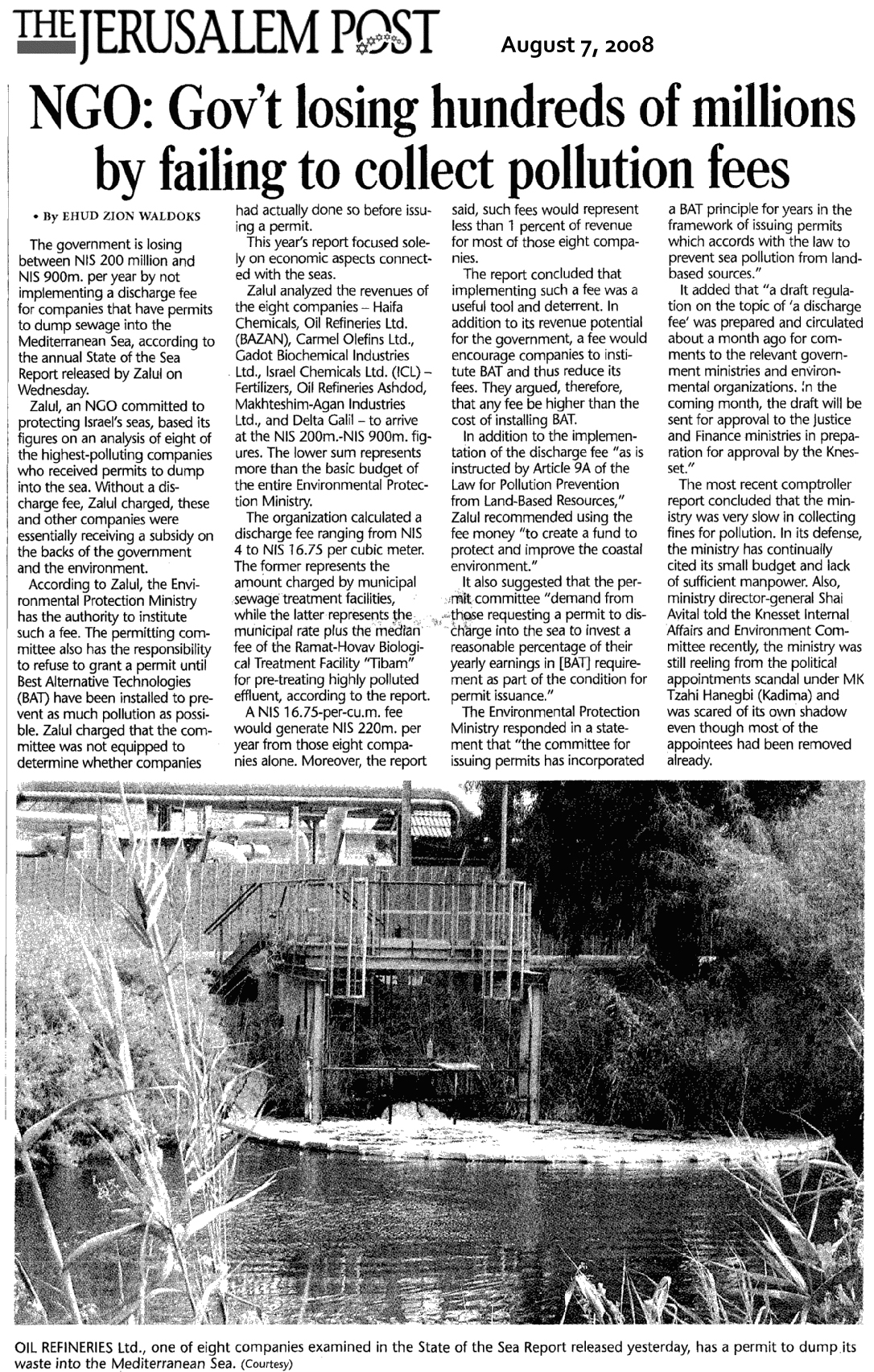
Each year over 50 million cubic meters of industrial effluents and sewage are dumped into the coastal waters of Israel by special permit of the Inter-ministerial Committee for Issuance of Discharge Permits without any discharge fee. This amount does not include municipal sewage from treatment plants. Actual total effluent and sewage discharges are estimated at over 100 million cubic meters.
Zalul pollution sea report sewage

The report It finds that millions of shekels stay in the hands of corporations rather than going towards the application of best available technologies or a governmental fund for protecting the environment. Issuing permits without demanding any discharge fee results in marine pollution and lack of advanced treatment technologies.

According to a calculation of industrial discharge volumes and a treatment fee of 4 to 16.75 shekels per cubic meter (based on existing land based sewage treatment fees for effluent of various quality), the amount of money which is not collected and stays in the hands of the factories, is over 200 million shekels, and may be as high as 900 million shekels (the Ministry of Environment’s annual budget is less than 200 million shekels each year).

The report finds that the discharge fee would represent between 1.3% and 5.4% of the annual profits and less than one percent of annual revenues of the 8 companies evaluated. These results indicate that many companies clearly have an ability to implement advanced effluent treatment, but because of market failures, have no incentive to do so.


LEAVE A REPLY

Please enter your comment!
Please enter your name here

TRENDING

Astro uses AI to help procure land for renewable energy

For oil-rich, environmentally vigilant Gulf states, Astro isn’t just another startup story. It is a blueprint for accelerating an energy transition that is now existential, not optional.

Fishermen sue tire manufacturers on behalf of the salmon

A federal trial in San Francisco has brought US tire manufacturers, fishing groups, and environmental scientists into court over a chemical most drivers have never heard of — but which scientists say may be silently reshaping aquatic ecosystems.

Sink holes from over-watering farmers’ fields

Sinkholes are rapidly appearing in Turkey’s central Anatolian farming region, particularly around Konya and Karapınar. These giant gaping holes in the ground in areas of farmland, known locally as obruk, are not random geological events. They are linked to prolonged drought, climate-driven heat stress, and heavy groundwater extraction for agriculture in one of the country’s most important breadbaskets.

Oil pollution in Basrah’s soil is 1,200% higher than it should be

Soil pollution levels in parts of Basra are 1,200% to 3,300% higher than those typically measured in cities like Toronto or New York, according to new comparative soil data. It's getting into water.

Factors That Determine the Payout of Asbestos Cases

Asbestos is found in eye shadow and talc. Know your rights of this deadly environmental hazard.

6 Payment Processors With the Fastest Onboarding for SMBs

Get your SMB up and running fast with these 6 payment processors. Compare the quickest onboarding options to start accepting customer payments without delay.

Qatar’s climate hypocrisy rides the London Underground

Qatar remains a master of doublethink—burning gas by the megaton while selling “sustainability” to a world desperate for clean air. Wake up from your slumber people.

How Quality of Hire Shapes Modern Recruitment

A 2024 survey by Deloitte found that 76% of talent leaders now consider long-term retention and workforce contribution among their most important hiring success metrics—far surpassing time-to-fill or cost-per-hire. As the expectations for new hires deepen, companies must also confront the inherent challenges in redefining and accurately measuring hiring quality.

8 Team-Building Exercises to Start the Week Off 

Team building to change the world! The best renewable energy companies are ones that function.

Thank you, LinkedIn — and what your Jobs on the Rise report means for sustainable careers

While “green jobs” aren’t always labeled as such, many of the fastest-growing roles are directly enabling the energy transition, climate resilience, and lower-carbon systems: Number one on their list is Artificial Intelligence engineers. But what does that mean? Vibe coding Claude? 

Somali pirates steal oil tankers

The pirates often stage their heists out of Somalia, a lawless country, with a weak central government that is grappling with a violent Islamist insurgency. Using speedboats that swarm the targets, the machine-gun-toting pirates take control of merchant ships and then hold the vessels, crew and cargo for ransom.

Leopoldo Alejandro Betancourt López Turned Ocean Plastic Into Profitable Sunglasses

Few fashion accessories carry the environmental burden of sunglasses. Most frames are constructed from petroleum-based plastics and acrylic polymers that linger in landfills for centuries, shedding microplastics into soil and waterways long after they've been discarded. Leopoldo Alejandro Betancourt López, president of the Spanish eyewear brand Hawkers, saw this problem differently than most industry executives.

Why Dr. Tony Jacob Sees Texas Business Egos as Warning Signs

Everything's bigger in Texas. Except business egos.  Dr. Tony Jacob figured...

Related Articles

Popular Categories