After America’s fossil water goes dry, will the Middle East follow?

manmade-river-in-Libya-560x357
Ample fresh water supplies for agriculture and drinking by the world’s burgeoning population are becoming more and more scarace these days due to over-consumption and the ravages of global warming and climate change. This has resulted in the need to tap into prehistoric underground aquifers, such as North Africa’s Nubian Aquifer under Libya; and the the Disi and Wasia aquifers Jordan and Saudi Arabia.

Aquifers in other parts the world, containing large amounts of ancient or “fossil water” , are also in jeopardy as these non-renewable sources of fresh water are being exploited by countries with increasing water needs.

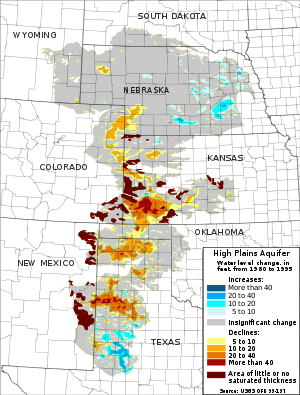
One of America’s largest “fossil water” aquifers is the Ogallala aquifer, which lies under 8 states in America’s “bread basket” wheat growing region; stretching from South Dakota to Texas. This aquifer covers a land area of 111.8 million acres (45.24 million Hectares) and 175,000 square miles (281,635 sq kilometers).

The water in this ancient aquifer is estimated to be at least 10 million years old and created during a period when there was considerably more water in that region; such as during the last great Ice Age. The water trapped in this aquifer in not replenished through annual rainfall; so once it is used up, it’s gone – possibly forever.

Intensive farming in this region has resulted in large amounts of Ogallala water being tapped to grow grains such as wheat, corn and sorghum. These grains provide much needed foodstuffs and animal feeds for people living in the US as well as other parts of the world.

More recently, grains like corn and sorghum have also been used to manufacture biofuels like ethanol. The depletion of water in aquifers like the Ogallala is becoming a big concern to environmentalists who now estimate that most of the water remaining is this aquifer alone will be used up by the year 2028 in areas like Texas and Kansas. These states are now in the midst of one of the worst droughts in recorded history.
300px-Ogallala_changes_1980-1995_svg

If prehistoric aquifers like Ogallala are in danger of being depleted in non-desert regions, it doesn’t take much imagination to figure out what will be fate of fossil water in desert aquifers like those under Jordan, Saudi Arabia and Libya.

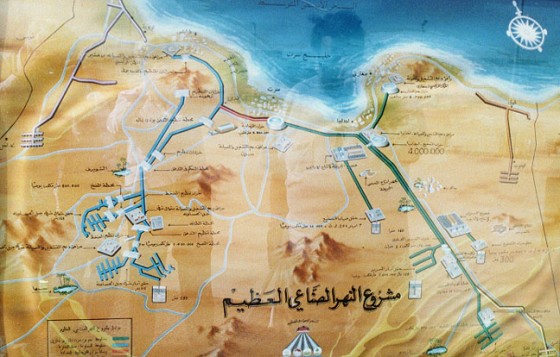
When ex-Libyan leader Muamar Gadaffi began his Great Man-Made River project in 1984, he boasted that the water in the Nubian Aquifer could supply the needs of Libya for “hundreds of years” and turn that country into an agricultural wonder. When the water was created there, animals like elephants, giraffes, wildebeests and other African species roamed that region and were hunted by primitive peoples.

The fossil water in Saudi Arabia’s Disi (part of which is under Jordan) and Wasia aquifers may be even more ancient.

Jordan is now involved in a project to extract large amounts of Disi aquifer water and convey it to Amman in large underground pipes.  It’s only a matter of time before this not replaceable water will be used up as well. There’s no sure solution to the problems of severe water shortages, even with more strict water conservation and recycling of waste water supplies. This appears to be the reality facing many countries; especially those in water scarace regions like the Middle East.

Read more on water scarcity and undergeround aquifers:

Saudi Arabia and Iran Are Exploiting Their Ground Water Supplies

Jordan’s Disi Water Conveyance is on Track; But to Where?

Libya’s Great Man Made River Project Could Stop Flowing

Map of water depletion on Ogallala Aquifer, by NBCNews.com

Maurice Picow
Maurice Picowhttps://www.greenprophet.com/
Maurice Picow grew up in Oklahoma City, U.S.A., where he received a B.S. Degree in Business Administration. Following graduation, Maurice embarked on a career as a real estate broker before making the decision to move to Israel. After arriving in Israel, he came involved in the insurance agency business and later in the moving and international relocation fields. Maurice became interested in writing news and commentary articles in the late 1990’s, and now writes feature articles for the The Jerusalem Post as well as being a regular contributor to Green Prophet. He has also written a non-fiction study on Islam, a two volume adventure novel, and is completing a romance novel about a forbidden love affair. Writing topics of particular interest for Green Prophet are those dealing with global warming and climate change, as well as clean technology - particularly electric cars.

TRENDING

Forever chemicals banned from Europe’s drinking water

The EU is taking a bold step in making sure all European Union member states worked to monitor and reduce PFAS levels in drinking water.

Iran’s holiest city about to run dry as terror chosen over water management

Iran’s second-largest city, Mashhad, is facing an acute water emergency after dam reservoirs feeding the city fell below three percent capacity, according to Iranian state and local media. Officials warn that without rainfall or improved inflows from neighboring Afghanistan, the city’s supply could soon collapse.

Finalists for the Zayed Sustainability Prize vie for millions in prize money for impact

The United Arab Emirates is serious about supporting renewable energy, clean water and smart agriculture. Part of the way they support impact companies is through the Zayed Sustainability Prize. Millions of dollars is up for the winning.

New water gen from air invention, uses biomimicry, the sun and salt channels

A new advance in water generation from air looks at how plants cool themselves using ion channels.

Forever chemicals PFAS linger in German drinking water

Comprising more than 4,700 chemicals, perfluorinated and polyfluorinated alkyl substances (PFAS) are a group of widely used, man-made chemicals that accumulate over time in humans and in the environment. They are known as ‘forever chemicals’ as they are extremely persistent in our environment and bodies.

Turning Your Energy Consultancy into an LLC: 4 Legal Steps for Founders in Texas

If you are starting a renewable energy business in Texas, learn how to start an LLC by the books.

Tracking the Impacts of a Hydroelectric Dam Along the Tigris River

For the next two months, I'll be taking a break from my usual Green Prophet posts to report on a transnational environmental issue: the Ilısu Dam currently under construction in Turkey, and the ways it will transform life along the Tigris River.

6 Payment Processors With the Fastest Onboarding for SMBs

Get your SMB up and running fast with these 6 payment processors. Compare the quickest onboarding options to start accepting customer payments without delay.

Qatar’s climate hypocrisy rides the London Underground

Qatar remains a master of doublethink—burning gas by the megaton while selling “sustainability” to a world desperate for clean air. Wake up from your slumber people.

How Quality of Hire Shapes Modern Recruitment

A 2024 survey by Deloitte found that 76% of talent leaders now consider long-term retention and workforce contribution among their most important hiring success metrics—far surpassing time-to-fill or cost-per-hire. As the expectations for new hires deepen, companies must also confront the inherent challenges in redefining and accurately measuring hiring quality.

8 Team-Building Exercises to Start the Week Off 

Team building to change the world! The best renewable energy companies are ones that function.

Thank you, LinkedIn — and what your Jobs on the Rise report means for sustainable careers

While “green jobs” aren’t always labeled as such, many of the fastest-growing roles are directly enabling the energy transition, climate resilience, and lower-carbon systems: Number one on their list is Artificial Intelligence engineers. But what does that mean? Vibe coding Claude? 

Somali pirates steal oil tankers

The pirates often stage their heists out of Somalia, a lawless country, with a weak central government that is grappling with a violent Islamist insurgency. Using speedboats that swarm the targets, the machine-gun-toting pirates take control of merchant ships and then hold the vessels, crew and cargo for ransom.

Related Articles

Popular Categories