

Why the octopus does not get tied in knots

octopus-arms-knots

This is one for the kids to answer at dinnertime: An octopus’s arms are covered in hundreds of suckers that will stick to just about anything, with one important exception: those suckers generally won’t grab onto the octopus itself. If they did, the flexible animals would quickly find themselves all tangled up.

How do they manage this?

Researchers from the Hebrew University of Jerusalem report that they discovered how octopuses manage this feat, even as the creatures’ brains are unaware of what their arms are doing. A chemical produced by octopus skin temporarily prevents their suckers from sucking.

“We were surprised that nobody before us had noticed this very robust and easy-to-detect phenomenon,” says Guy Levy, who carried out the research with co-first author Dr. Nir Nesher in the Department of Neurobiology at the Hebrew University’s Alexander Silberman Institute of Life Sciences.

“We were entirely surprised by the brilliant and simple solution of the octopus to this potentially very complicated problem.”

RELATED: using jellyfish as super absorbent diapers.

Prof. Binyamin (Benny) Hochner, Principal Investigator in the Hebrew University’s Octopus Research Group, and his colleagues had been working with octopuses for many years, focusing especially on their flexible arms and body motor control.

Hochner explains there is a good reason that octopuses don’t know where their arms are the same way that people or other animals do. “Our motor control system is based on a rather fixed representation of the motor and sensory systems in the brain in a formant of maps that have body part coordinates.”

That works for us because our rigid skeletons limit the number of possibilities.

“It is hard to envisage similar mechanisms to function in the octopus brain because its very long and flexible arms have an infinite number of degrees of freedom,” Hochner adds. “Therefore, using such maps would have been tremendously difficult for the octopus, and maybe even impossible.”

Indeed, experiments have supported the notion that octopuses lack accurate knowledge about the position of their arms. And that raised an intriguing question: How do octopuses avoid tying themselves up in knots?

To answer that question, the researchers observed that octopus arms remain active for an hour after amputation. Those observations showed that the arms never grabbed octopus skin, though they would grab a skinned octopus arm.

The octopus arms didn’t grab Petri dishes covered with octopus skin, either, and they attached to dishes covered with octopus skin extract with much less force than they otherwise would.

“The results so far show, and for the first time, that the skin of the octopus prevents octopus arms from attaching to each other or to themselves in a reflexive manner,” the researchers write. “The drastic reduction in the response to the skin crude extract suggests that a specific chemical signal in the skin mediates the inhibition of sucker grabbing.”

In contrast to the behavior of the amputated arms, live octopuses can override that automatic mechanism when it is convenient. Living octopuses will sometimes grab an amputated arm, and they appear to be more likely to do so when that arm was not formerly their own.

Hochner and his colleagues haven’t yet identified the active agent in the animals’ self-avoidance behavior, but they say it is yet another demonstration of octopus intelligence. The self-avoidance strategy might even find its way into bio-inspired robot design.

“Soft robots have advantages [in] that they can reshape their body,” Nesher says. “This is especially advantageous in unfamiliar environments with many obstacles that can be bypassed only by flexible manipulators, such as the internal human body environment.”

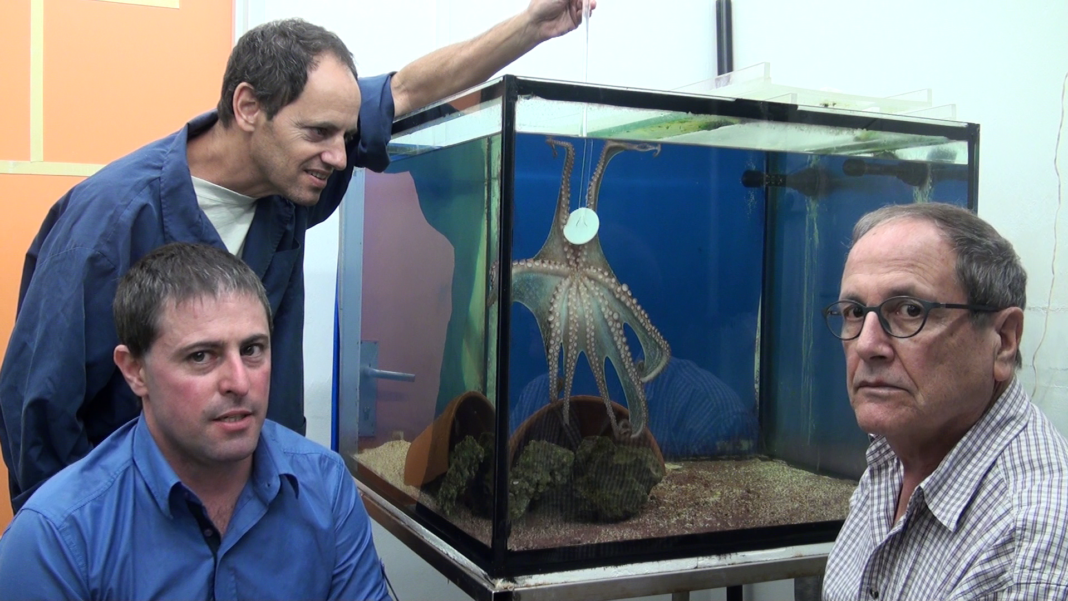
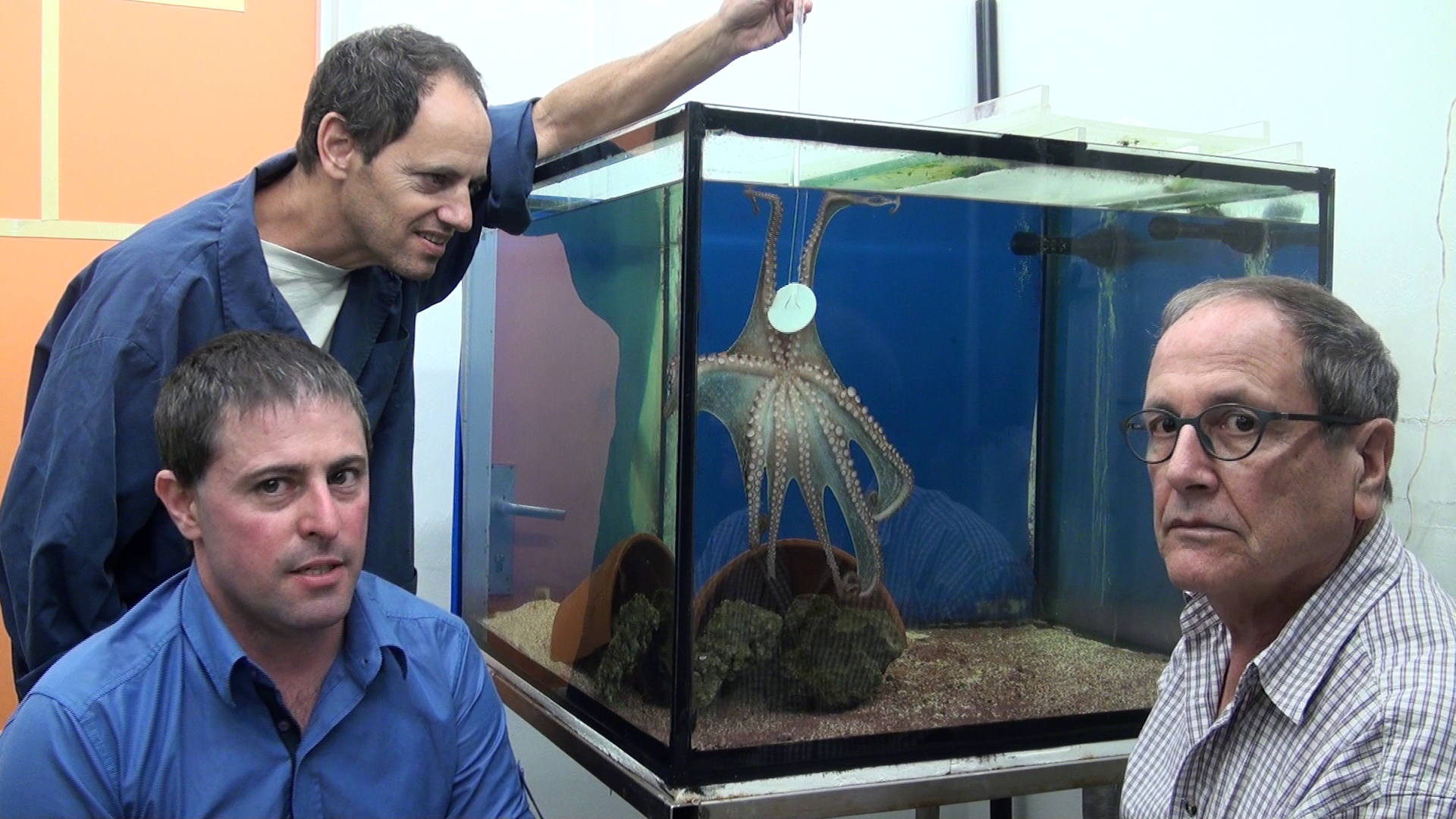
Octopus investigators: From left to right, Dr. Nir Nesher (standing), Dr. Guy Levy and Prof. Benny Hochner at the Hebrew University of Jerusalem (Photo: Guy Levy)


LEAVE A REPLY

Please enter your comment!
Please enter your name here

TRENDING

Astro uses AI to help procure land for renewable energy

For oil-rich, environmentally vigilant Gulf states, Astro isn’t just another startup story. It is a blueprint for accelerating an energy transition that is now existential, not optional.

The Science Behind How Elite Marathon Runners Train

Discover the science behind elite marathon training. Explore techniques, nutrition, and mental strategies that propel top runners to success.

Earth building with Dead Sea salt bricks

Researchers develop a brick made largely from recycled Dead Sea salt—offering a potential alternative to carbon-intensive cement.

The Christ’s thorn (sidr tree) is also a well-known folk medicine

Christ’s thorn jujube (Ziziphus spina-christi) also known as the sidr tree is a real, identifiable tree native to the Middle East, and it appears—directly or indirectly—in Islam, Judaism, and later Christian tradition. The connections between the three faiths are not theological agreements but overlapping uses, names, and symbolic associations rooted in the same landscape.

Farm To Table Israel Connects People To The Land

Farm To Table Israel is transforming the traditional dining experience into a hands-on journey.

Qatar’s climate hypocrisy rides the London Underground

Qatar remains a master of doublethink—burning gas by the megaton while selling “sustainability” to a world desperate for clean air. Wake up from your slumber people.

How Quality of Hire Shapes Modern Recruitment

A 2024 survey by Deloitte found that 76% of talent leaders now consider long-term retention and workforce contribution among their most important hiring success metrics—far surpassing time-to-fill or cost-per-hire. As the expectations for new hires deepen, companies must also confront the inherent challenges in redefining and accurately measuring hiring quality.

8 Team-Building Exercises to Start the Week Off 

Team building to change the world! The best renewable energy companies are ones that function.

Thank you, LinkedIn — and what your Jobs on the Rise report means for sustainable careers

While “green jobs” aren’t always labeled as such, many of the fastest-growing roles are directly enabling the energy transition, climate resilience, and lower-carbon systems: Number one on their list is Artificial Intelligence engineers. But what does that mean? Vibe coding Claude? 

Somali pirates steal oil tankers

The pirates often stage their heists out of Somalia, a lawless country, with a weak central government that is grappling with a violent Islamist insurgency. Using speedboats that swarm the targets, the machine-gun-toting pirates take control of merchant ships and then hold the vessels, crew and cargo for ransom.

Leopoldo Alejandro Betancourt López Turned Ocean Plastic Into Profitable Sunglasses

Few fashion accessories carry the environmental burden of sunglasses. Most frames are constructed from petroleum-based plastics and acrylic polymers that linger in landfills for centuries, shedding microplastics into soil and waterways long after they've been discarded. Leopoldo Alejandro Betancourt López, president of the Spanish eyewear brand Hawkers, saw this problem differently than most industry executives.

Why Dr. Tony Jacob Sees Texas Business Egos as Warning Signs

Everything's bigger in Texas. Except business egos.  Dr. Tony Jacob figured...

Israel and America Sign Renewable Energy Cooperation Deal

Other announcements made at the conference include the Timna Renewable Energy Park, which will be a center for R&D, and the AORA Solar Thermal Module at Kibbutz Samar, the world's first commercial hybrid solar gas-turbine power plant that is already nearing completion. Solel Solar Systems announced it was beginning construction of a 50 MW solar field in Lebrija, Spain, and Brightsource Energy made a pre-conference announcement that it had inked the world's largest solar deal to date with Southern California Edison (SCE).

Related Articles

Popular Categories