


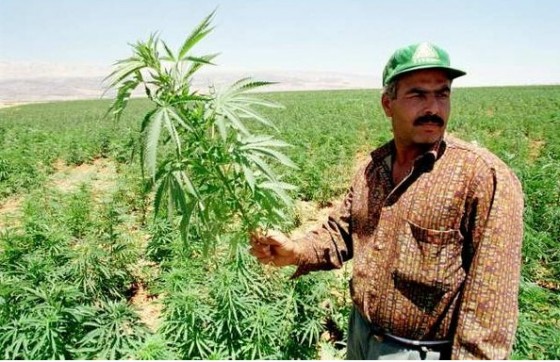
 Why grow apples in Lebanon when hashish and cannabis is hundreds of times more lucrative? An overview of Lebanon’s unsustainable drug business in the Bekaa Valley.
Escalating clashes between armed tribesmen trying to protect their cannabis fields and the Lebanese armed forces are pushing Lebanon to readdress the long-standing issue of cannabis cultivation in the Bekaa valley.
During the lawless years of Lebanon’s 1975 to 1990 Civil War, the fertile plain of the Bekaa Valley was carpeted with fields of green cannabis sativa plants, generating some $500 million USD annually. At its peak in 1988, Lebanon’s narcotic market was making an estimated $1.5 billion.
Back then, government-run eradication programs coupled with international development projects which incentivize farmers to profitably grow legal crops was supposed to bring Lebanon’s cannabis business down. But production continued, with several politicians known to be taking a cut of the profits. Furthermore several international projects failed to deliver plausible income generating alternatives. For example, the US generously donated Holstein cows to farm, however these cost more in upkeep than they provided in income. Unable to make a living, several projects were abandoned and farmers returned to their hash cultivation.
The 2006 war rendered government run eradication programs and as a result cannabis growing has been on the rise again. This year, however, the government turned its attention again to illegal crop farming and has been destroying hash fields and burning the plants.
On Aug. 4, residents of Yammouneh, a small village in the Bekaa, blocked the road to prevent Lebanese soldiers and police from gaining access to the hashish fields ( of course the roads were blocked using Lebanon’s preferred protest measure: burning tires).
Clashes erupted between heavily armed tribesmen and an equally overwhelmingly armed group of soldiers resulting in a couple of wounded soldiers. These clashes should not be understated.
This time, unlike the other, three of the largest and strongest tribes in the Bekaa valley decided to unite forces to protect their illegal commerce. The Jaafars, the Shammas, and the Sharifs recent success in confronting the government and checking the eradication campaign has allegedly spurred other tribes in the far north of the Bekaa to consider also allying and resisting armed forces.
Given that a large, and growing, percentage of cultivation in the Bekaa valley is dedicated to hash and given these clashes involve heavily armed angry farmers and tribes, the Lebanese government is forced to seriously readdress the economic and social consequences of a microsystem that relies on illegal crops. An escalation of this problem would only add to Lebanon’s many unaddressed issues.
The business of cannabis cultivation in Lebanon
Consider that the cultivation of one kilogram of hashish costs the farmer about $200. Farmers then extract the most potent powder through a large sieve and the congealed powder is then packaged and sold to the drug dealer for $300 to $400 per kilo.
According to the Executive, the farmer can make about $100 to $200 from every kilo he sells to the local dealer, and about $400 to $800 per average cultivated dunam (1 dunam = 1,000 square meters).
Outside dealers then come to the Bekaa to buy hashish from the local dealers, who sell in bulk. One kilogram of hashish wholesale will cost approximately $1,000. In Beirut, the street value of 20g is approximately $50. Thus, dealers can make about $1,500 profit from one kilogram of hashish purchased in the Bekaa.
In Europe, a kilogram of Lebanese hashish sells wholesale for $4,400 to $5,900 – $3,660 of this goes directly in the dealers pocket after having accounted for shipment costs, labor, bribes, confiscated shipments and security.
In a good year, a dealer can sell 5 tons of hash and make seven to eight million dollars abroad.
When so much demand and money is involved it will be extremely hard to try and suppress the cannabis market. Periods of war and instability have historically been a safe haven for opium and hash growers and a moment of great opportunity for dealers- so stability in Lebanon would also be one of the key solutions to controlling the narcotics market.
Identifying the hash alterative crop
The issue is how to incentivize farmers to switch from a relatively lucrative product to one that generates less income but is legal. So far, no alternative crops have succeeded in earning the farmers a livable wage. In the Bekaa valley the other substitute to cannabis is apples but one kilogram (2.2 pounds) of apples is worth 30 cents, while a kilogram of processed cannabis resin is worth $300 to $400 to farmers- which explains the preference for hashish cultivation.
The UNDP alternative crop programs ceased in the late 1990s with no success, western officials accused the UN of wasting the money it did receive through mismanagement and corruption.
Edgard Chehab, the current UNDP Energy and Environment Program manager, admits that the agency made major mistakes in the past. “They [the UNDP’s earlier initiative] did not identify alternative crops that farmers were used to,” he says. “The crops needed lots of water, maintenance and investment, which made the project unsuccessful. They didn’t look at the marketing for farmers before.”
A sustainable, industrial hemp alternative?
In cooperation with the Beirut-based private investment firm Phystone, the UNDP introduced pilot projects in the Bekaa for hashish farmers to grow industrial hemp — the non-intoxicating cousin of cannabis.
“The farmers are used to hashish and industrial hemp is very similar,” says Chehab. “It doesn’t need water and the Bekaa is dry. No fertilizer is necessary.”
Hemp oil, which is rich in Omega 3 and Omega 6, is a popular dietary supplement in Europe and the US and the fibers can be used as a combustible to heat homes, or to make rope and textiles.
Phystone and the UNDP will guarantee the farmers a net profit of $150 to $160 per dunam.“With industrial hemp, their profit will be cut by half — but its legal and sustainable,” Chehab says. “It is better than tomatoes, but not as good as hashish.”
It doesn’t seem like harnessing cannabis’ potential through hemp has worked yet in Lebanon, but this concept has good potential. Imagine a series of organic hemp clothes and products coming from the Bekaa valley one day.
Image Lebanon hash via the LA Times blog



Oh, an excellent publish! No idea the way you came up with this textual content. It’d consider me personally long hours. Worthwhile although, I’d presume. Have you thought about selling ad space in your blog?
reference please…..