
 Can’t stand the climate change heat? Why not move underground?
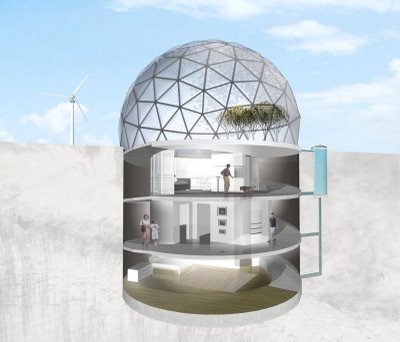
For Reynard Loki and Jennifer Daniels, the future might lie, for some people in places such as Israel or Australia, in what they are calling Underground Desert Living Units, UDLU for short.
Loki began working on the idea in March 2008, and he later found Daniels to do the illustrations.
When asked how he was inspired to create UDLU, Loki said a news article titled “Exotic climate study sees refugees in Antarctica” got him thinking about where such refugees might live. Another news article titled “Global Warming Threatens Australia’s Iconic Kangaroos” spoke of climate models showing up to a six-degree rise in Australia’s temperature by the year 2070.
The article predicted that large swaths of Australia will become dry and parched.
And then a radio interview with British scientist James Lovelock about New Zealand serving in the future as a “lifeboat” for climate refugees in the southern hemisphere convinced Loki that the idea of UDLU might be useful to think about and envision.
“You’ve seen it happening in Australia already: Desert is spreading and things just won’t grow,” Lovelock told a New Zealand radio station reporter last year. “The island nations like New Zealand will be spared that kind of damage.”
Loki remembers how the idea for UDLU came to him: “Thinking about the possible eventual loss of fertile land, the growth of desert climates and creation of global warming refugees recalled my own desire to
build a house in the desert when I first visited California’s Mojave Desert several years ago. The idea back then was to build a biomorphic living space based on cell structure as a way to emulate nature. All of the rooms would be circular — there would be no corners.”
The concept of the Underground Desert Living Unit (UDLU) takes certain design elements moves them underground, envisioning a localized solution for “global warming refugees,” allowing them to stay in their original region, according to Loki, who lives in New York City.
UDLUs could be easily interconnected, allowing flexibility and community growth, leaving a wind energy generator, a solar energy generator, a solar-powered greenhouse and an air purifier system above ground, he says.
The idea of UDLU is to give an option to the millions of possible “global warming refugees,” he adds, noting: “So we don’t have to go to New Zealand or to polar regions to live in so-called polar cities, also under development as a futuristic idea. We can move underground, underneath our newly-born desert landscapes.
Questions still linger, Loki admits.
He asks: “How will UDLUs be built? What will they be made of? How will energy be generated? How will food be grown in these newly-formed arid regions? How will water will be accessed? What will living underground do to us physically or psychologically?”
Loki has set up the Underground Desert Living Research Institute (UDLRI) to promote the research and development of an inexpensive, flexible, easily constructed, sustainable, eco-friendly Underground Desert Living Unit (UDLU) and hopes to collect, share and analyze information about global warming, green architecture and sustainable technologies, he says.
More on climate refugees:
Climate Change Kills Syrian Villages
This guest post is by Dan Bloom, a climate activist working in Taiwan. He graduated from Tufts College in 1971 in Boston. He is an advocate of polar cities, building retreats for humankind for when the effects of global warming will make regions we live in today inhospitable.



awesome thinking…impressive!!
I am very, very interested in this design and the environmental ideas/ideal behind it. I’ve been through tons of designs for sustainable living over the last 30 yrs trying to determine what will work best for my purposes. This, actually, was one of my designs. The greenhouse accessibility on a top level as well as a separate, but connected area for egg producing foul was among the best. One could live anywhere a good well could be drilled that produces plentiful water. Are there any further drawings or detailed info on this plan? I’d like to know what materials are suggested for the exterior, how the system room would be set up, how many stories are optimum and so on.
Hi Danny,
I left a comment on your Greenprophet post on UDLU, but it didn’t show up yet, or immediately. I guess it is set up for comment moderation. Anyway, I hope it shows up — I included several links to stories that I have come across in my UDLU research.
Hope all is well on your side of the globe. It’s been raining cats and dogs in NYC.
Cheers,
Reynard Loki
Here are some interesting snippets of my recent research. Any comments/suggestions would be greatly appreciated. Contact me at [email protected].
1) “Growing Food in a Desert City Using Rainwater and Urban Runoff,” Brad Lancaster, Chelsea Green Publishing, July 11, 2009, http://www.alternet.org/water/141141/growing_food_in_a_desert_city_using_rainwater_and_urban_runoff_/
2) “Subdivisions,” Ross Racine, July 28, http://www.swiss-miss.com/2009/07/subdivisions.html
“New York artist Ross Racine creates aerial views of fictional suburbs, examining the relation between design and actual lived experience.” I thought that this kind of layout could be useful in developing UDLU communities.
3) “Europe Eyes Africa for Solar Power,” Paul Voosen, Scientific American, July 22, http://www.scientificamerican.com/article.cfm?id=solar-thermal-power-europe-meditteranean-sea&sc=DD_20090722
“By 2050, massive solar thermal plants, which concentrate the sun’s energy using mirrors to heat steam-generating media, would sprawl across the Sahara and Middle East.” If so, these locales would be perfect places for UDLU communities.
4) “Why Our Next Fuel Source May Come from Our Own Waste,” Greg Breining, Yale Environment 360, July 13, http://www.alternet.org/water/141209/why_our_next_fuel_source_may_come_from_our_own_waste/
Using your own waste to help fuel your UDLU! Awesome.
5) “Rain Zone Moving North,” Christie Nicholson, Scientific American, July 2, http://www.scientificamerican.com/podcast/episode.cfm?id=rain-zone-moving-north-09-07-02&sc=DD_20090702
“the now arid Galapagos Islands had a very wet climate about 400 years ago.” Looks like UDLUs will be more necessary in the southern climes.
6) “Migration and climate change: A new (under) class of travellers,” The Economist, June 25, http://www.economist.com/world/international/displaystory.cfm?story_id=13925906
“Victims of a warming world may be caught in a bureaucratic limbo unless things are done to ease—and better still, pre-empt—their travails.”
7) “Green Power Takes Root in the Chinese Desert,” Keith Bradsher, July 2, New York Times, http://www.nytimes.com/2009/07/03/business/energy-environment/03renew.html
“This oasis town deep in the Gobi Desert along the famed Silk Road and the surrounding wilderness of beige sand dunes and vast gravel wastelands has become a center of China’s drive to lead the world in wind and solar energy.”
8) “New Washing Machine Uses Only 1 Cup of Water,” Alastair Jamieson, The Telegraph (UK), June 25, http://www.alternet.org/water/140818/new_washing_machine_uses_only_1_cup_of_water_/
“The appliance, which could save billions of litres of water a year, has been developed at the University of Leeds.”
For a regularly updated list of related articles, check http://www.udlu.org.
Reynard Loki in NYC has now seen this post and I hope he will post some updates on what is going on with this UDLU idea and some links, too. I have heard that the New York Times DOT EARTH blog is interested in underground living ideas for climate issues, and Mr Loki’s ideas might get written up there in future, too. But this story first appeared here. Bravo, Greenprophet, for getting this story going….
Maurice, I don’t think UDLUs are for everyone or even intended for mass migration living. But it is an interesting concept and the design is cool.
Who’s your cousin? Names! names!
Human nature is what it is , hon; especially in a place like Oklahoma – even with all them tornados !
How much does he want for it? Maybe he hasn’t yet found the right kind of buyers!
Living underground is not really the answer, however. My cousin built the modern version of “that little old sod shanty on the plains” in Norman Oklahoma about 25 years ago; in which only one side is exposed.
While it is great for cooling in the summer and warmth in the winter (he also has a Franklin Stove to provide heat), trying to sell that place is a bit problematic, as he has found out – it’s like selling the land, and throwing in the house for free!