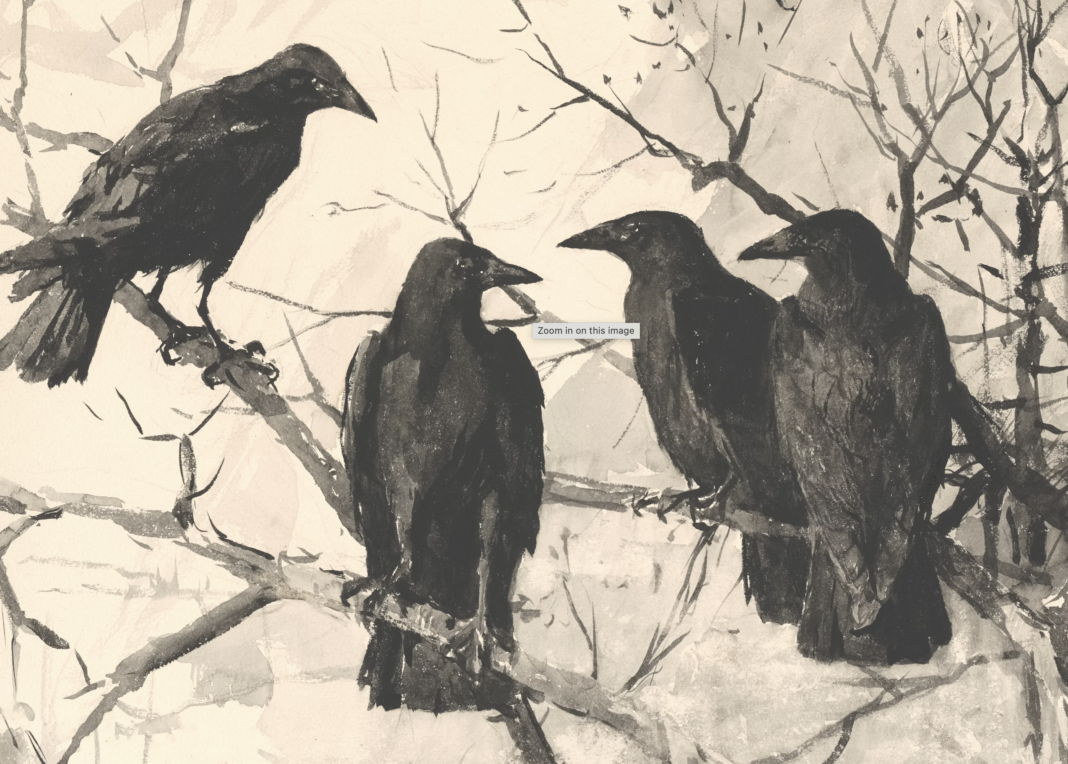


If you’ve ever found your roof littered with stray bits of chicken bones, discarded tuna cans, and wrappers from snacks, you’ve probably encountered the handiwork of crows. These feathered scavengers aren’t just opportunistic when it comes to their food – they’re also highly skilled at solving complex problems. They are also highly skilled at evening scores if they have a vendetta against you or your dog.
But recent research has revealed that their intelligence doesn’t stop at finding food scraps and chasing dogs they don’t like; crows are proving to be mathematical savants with an impressive talent for spotting shapes. The research is reported in Science.
“Claiming that it is specific to us humans, that only humans can detect geometric regularity, is now falsified,” said Andreas Nieder, the study’s lead researcher. “Because we have at least the crow.”
Related: Birds in Iran migrate from polluted cities to less-polluted ones
Researchers have been studying carrion crows (Corvus corone), who have already demonstrated their remarkable problem-solving abilities.
In a new study, the crows were presented with sets of six shapes and tasked with identifying the odd one out. The challenge? The odd shape was sometimes just slightly different from the others – a distorted quadrilateral among otherwise perfectly regular shapes, or a crescent moon in a group of stars. And the crows? They aced it, detecting the odd shape with ease, even when it was rotated or scaled.

What makes this discovery even more fascinating is the fact that the crows didn’t just rely on simple visual cues; they were able to apply geometric reasoning. They could perceive subtle differences in shape, a skill that mirrors the kind of pattern recognition seen in humans. This advanced form of visual cognition is something that few animals, aside from humans and a few primates, can claim to possess.

But the mathematical prowess of crows doesn’t end there. Their intelligence extends into other areas as well. Crows are known to recognize faces, use tools, and even hold grudges. In fact, crows are notorious for carrying vendettas against humans or other animals they feel have wronged them. If you’ve ever witnessed a crow’s behavior shift dramatically after a negative encounter, you’ll know just how seriously they take these “feuds.” Their ability to remember and react to these past interactions suggests a deep level of cognitive processing, not unlike the complex emotions and social dynamics seen in humans.
“I hope that my colleagues are looking into other species,” said Nieder. “I’m pretty sure they may find that other intelligent animals can also do this.”
And then there’s the scavenging behavior. Crows seem to have a particular fondness for “treasure” in the form of human leftovers. On my roof, I often find signs of their recent visits – remnants of snacks they’ve swiped from construction sites or leftovers they’ve found in trash bins. From the naked bones of chickens to the crinkled bags of chips, crows are keen opportunists, making use of whatever they can find. But they don’t just forage blindly. Research suggests that they can plan their meals, choose the best times to scavenge, and even store food for later, anticipating when resources might be scarce.
As these intelligent birds continue to surprise us with their cognitive abilities, we may need to rethink how we view them and every animal on this planet.
Far from being mere scavengers, crows are complex problem-solvers, capable of advanced mathematical reasoning, emotional depth, and even strategic planning. So next time you find a crow’s “gift” on your roof, remember that it’s not just a bird with a good eye for food – it’s a true mastermind of shape detection and cognitive complexity.