Water Theft and Punishment on the Rise in the Middle East

Dubai, water, theft, water shortages, urban

We’ve been talking about chronic water shortages in the Middle East and North Africa for a long time. But now a new and troubling trend is beginning to emerge in the region: municipal, regional and national governments are taking more drastic measures to police water consumption.

Jordan broke out the big (security) guns to prevent its citizens from “stealing” what is actually a part of the commons and most recently, Dubai has threatened to punish water thieves in various neighborhoods throughout the emirate with fines of up to $2,722.

Water belongs to everyone

The editor of All That We share: A Field Guide to the Commons, Jay Walljasper notes that water  belongs to everyone.

“Put simply, the water commons means that water is no one’s property; it rightfully belongs to all of humanity and to the earth itself. It is our duty to protect the quality and availability of water for everyone around the planet. This ethic should be the foundation of all decisions made about use of this life-giving resource. Water is not a commodity to be sold or squandered or hoarded,” he wrote.

Even so, it’s not a simple issue to address. Despite Dubai’s prolonged drought and notoriously short supplies of groundwater, more than 40 residents living in the Satwa, Al Quoz and Ras Al Khor neighborhoods of Dubai have been caught drilling for water, which is used to wash cars and for other personal use, according to Gulf News.

Perhaps accustomed to having as much water as the desalination plants could produce, Emiratis are not always conscientious of water conservation. Why should they be when their government has long subsidized water expenses (and energy.)

80,000 Groundwater wells at risk of drying up in the UAE

All of the emirates stopped exporting groundwater in February following a study conducted by the Ministry of Environment and Water that revealed that as many as 80,000 groundwater wells are at risk of drying up completely.

Accordingly, only companies that receive licenses from the Department of Economic Development and approval from the Dubai municipality are lawfully permitted to extract water.

Everyone else may have to pay up to nearly $3,000 for taking water illegally.

“The water you use should come from authorised channels,” Khalid Suletin, Director of Dubai Municipality’s Environment Emergency Office, told Gulf News.

But as shortages increase and authorized distribution channels short circuit (or favor the rich), we should expect a lot more thefts and stricter efforts to control them.

It is a sad state of affairs when human beings have to have permission for using what is the very essence of life.

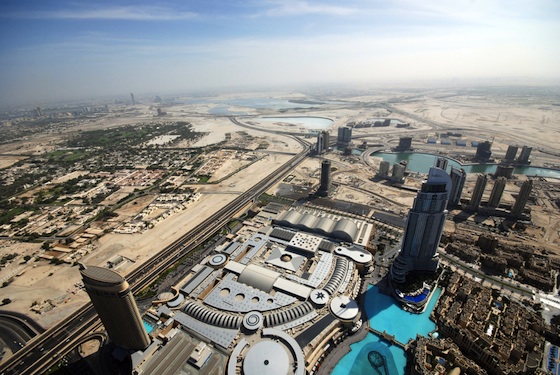
Image credit: Arial view of Dubai, Shutterstock

Tafline Laylin
Tafline Laylinhttp://www.greenprophet.com
As a tour leader who led “eco-friendly” camping trips throughout North America, Tafline soon realized that she was instead leaving behind a trail of gas fumes, plastic bottles and Pringles. In fact, wherever she traveled – whether it was Viet Nam or South Africa or England – it became clear how inefficiently the mandate to re-think our consumer culture is reaching the general public. Born in Iran, raised in South Africa and the United States, she currently splits her time between Africa and the Middle East. Tafline can be reached at tafline (at) greenprophet (dot) com.
1 COMMENT
  1. Wow this is quite eye opening. It seems a bit harsh to punish people for drilling water. At the same time if quantities are limited, then keeping things fair across the board to prevent people from taking too much seems fair.

Comments are closed.

TRENDING

Forever chemicals banned from Europe’s drinking water

The EU is taking a bold step in making sure all European Union member states worked to monitor and reduce PFAS levels in drinking water.

Elon Musk to create Mars base station on the Moon

For those unaware, SpaceX has already shifted focus to building a self-growing city on the Moon, as we can potentially achieve that in less than 10 years, whereas Mars would take 20+ years.

Astro uses AI to help procure land for renewable energy

For oil-rich, environmentally vigilant Gulf states, Astro isn’t just another startup story. It is a blueprint for accelerating an energy transition that is now existential, not optional.

Sink holes from over-watering farmers’ fields

Sinkholes are rapidly appearing in Turkey’s central Anatolian farming region, particularly around Konya and Karapınar. These giant gaping holes in the ground in areas of farmland, known locally as obruk, are not random geological events. They are linked to prolonged drought, climate-driven heat stress, and heavy groundwater extraction for agriculture in one of the country’s most important breadbaskets.

Oil pollution in Basrah’s soil is 1,200% higher than it should be

Soil pollution levels in parts of Basra are 1,200% to 3,300% higher than those typically measured in cities like Toronto or New York, according to new comparative soil data. It's getting into water.

Turning Your Energy Consultancy into an LLC: 4 Legal Steps for Founders in Texas

If you are starting a renewable energy business in Texas, learn how to start an LLC by the books.

Tracking the Impacts of a Hydroelectric Dam Along the Tigris River

For the next two months, I'll be taking a break from my usual Green Prophet posts to report on a transnational environmental issue: the Ilısu Dam currently under construction in Turkey, and the ways it will transform life along the Tigris River.

6 Payment Processors With the Fastest Onboarding for SMBs

Get your SMB up and running fast with these 6 payment processors. Compare the quickest onboarding options to start accepting customer payments without delay.

Qatar’s climate hypocrisy rides the London Underground

Qatar remains a master of doublethink—burning gas by the megaton while selling “sustainability” to a world desperate for clean air. Wake up from your slumber people.

How Quality of Hire Shapes Modern Recruitment

A 2024 survey by Deloitte found that 76% of talent leaders now consider long-term retention and workforce contribution among their most important hiring success metrics—far surpassing time-to-fill or cost-per-hire. As the expectations for new hires deepen, companies must also confront the inherent challenges in redefining and accurately measuring hiring quality.

8 Team-Building Exercises to Start the Week Off 

Team building to change the world! The best renewable energy companies are ones that function.

Thank you, LinkedIn — and what your Jobs on the Rise report means for sustainable careers

While “green jobs” aren’t always labeled as such, many of the fastest-growing roles are directly enabling the energy transition, climate resilience, and lower-carbon systems: Number one on their list is Artificial Intelligence engineers. But what does that mean? Vibe coding Claude? 

Somali pirates steal oil tankers

The pirates often stage their heists out of Somalia, a lawless country, with a weak central government that is grappling with a violent Islamist insurgency. Using speedboats that swarm the targets, the machine-gun-toting pirates take control of merchant ships and then hold the vessels, crew and cargo for ransom.

Related Articles

Popular Categories