Protei Designs Sailing Robots to Clean the Sea

protei sailing robotIt is estimated that BP’s Deepwater Horizon disaster spilled 205 million gallons of oil into the Gulf of Mexico.  Local fishermen and other cleanup workers suffered from the toxic oil and carcinogenic dispersants, but at best only 3% of this oil was ever recovered.  The absorbent booms were never designed for open water.  When Cesar Harada heard about this disaster, he quit his dream job at MIT and moved to New Orleans to find a better way to clean up these spills.  His inspiration combined ancient sailing technology with modern materials and robotics.  He used crowd-funded kickstarter loan to hire some engineers and founded Protei.org.  Harada released the designs under an OpenSource Hardware (OSHW) license so that others can learn, refine and share solutions.

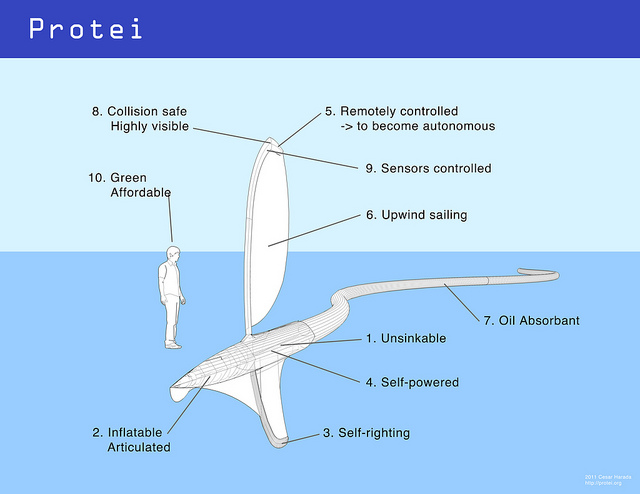
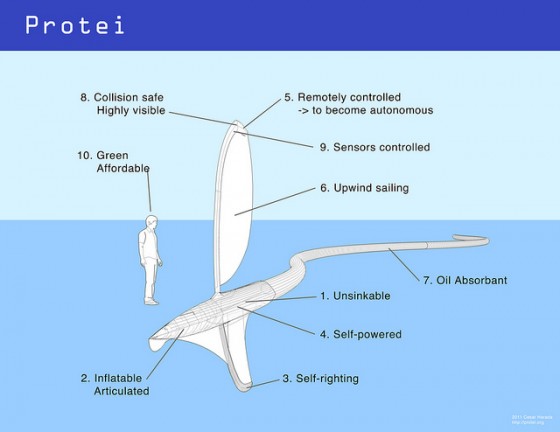
The idea is simple, oil spills move downwind so by dragging the absorbant booms upwind, robots can capture oil more effectively.  A sailboat can use wind power to tack (zig zag) upwind in a pattern that is almost perfect for cleaning oil, but traditional sailboats don’t steer well when dragging a large object.  Herada found that moving the rudder forward reduced this problem but others experimented with an articulated boat which steers by bending like a fish.  One team found that this might make it possible for the boat to sail directly upwind without tacking.  Harada also theorized that such flexibility might make it move more efficiency through waves and eliminate two sources of turbulence as the keel and rudder are no longer separate from the hull.

[youtube]http://www.youtube.com/watch?v=iNDXvJjSniI[/youtube]

Sailing robots needn’t be limited to oil recovery, they can also help us clean up plastic garbage or monitor radioactivity in our seas.

Sailing is one of this author’s personal pastimes and I happen to own an inflatable windsurfer.  One of Protei’s recent designs is also made of inflatable plastic with a water and sand ballasted keel.  Harada calls this monohull an “Ocean Blimp”, but to me it has more than a passing resemblance to a Portuguese Man-Of-War (relative of a jellyfish.)  This shows that our most advanced technology might eventually become something that both works with and resembles nature.

Protei image via opensailing.net

Brian Nitz
Brian Nitzhttp://www.greenprophet.com
Brian remembers when a single tear dredged up a nation's guilt. The tear belonged to an Italian-American actor known as Iron-Eyes Cody, the guilt was displaced from centuries of Native American mistreatment and redirected into a new environmental awareness. A 10-year-old Brian wondered, 'What are they... No, what are we doing to this country?' From a family of engineers, farmers and tinkerers Brian's father was a physics teacher. He remembers the day his father drove up to watch a coal power plant's new scrubbers turn smoke from dirty grey-back to steamy white. Surely technology would solve every problem. But then he noticed that breathing was difficult when the wind blew a certain way. While sailing, he often saw a yellow-brown line on the horizon. The stars were beginning to disappear. Gas mileage peaked when Reagan was still president. Solar panels installed in the 1970s were torn from roofs as they were no longer cost-effective to maintain. Racism, public policy and low oil prices transformed suburban life and cities began to sprawl out and absorb farmland. Brian only began to understand the root causes of "doughnut cities" when he moved to Ireland in 2001 and watched history repeat itself. Brian doesn't think environmentalism is 'rocket science', but understanding how to apply it within a society requires wisdom and education. In his travels through Europe, North America, Asia and the Middle East, Brian has learned that great ideas come from everywhere and that sharing mistakes is just as important as sharing ideas.
3 COMMENTS
  1. lets start today with all the out of work fishermen just to skim the surface with the old nets.
    then tomorrow send out all war machines to fight the war on the environment, retool war ships into cleaning tools.
    after that we can put money in new and better places.
    but we can not wait….

  2. Yes of course. But there are 30,000 oil wells in the Gulf of Mexico. 27,000 of them are abandoned so even if “Mr. Fusion” comes along and kills our appetite for oil tomorrow morning, eventually one of these oil holes is going to leak. That fact that we were totally unprepared in 2010 is regrettable. When (not if) a big leak happens again, there will be no excuse for being so unprepared.

Comments are closed.

TRENDING

Fix Cash Flow Issues in Wind Energy Biz

Wind energy is a business that looks ahead 35 years. How to keep financing stable?

Astro uses AI to help procure land for renewable energy

For oil-rich, environmentally vigilant Gulf states, Astro isn’t just another startup story. It is a blueprint for accelerating an energy transition that is now existential, not optional.

How wind energy must adapt to a changing climate

For a wind farm designed on 20 years of historical data, this matters. A project that looks profitable today may deliver less energy in the future, on the opposite, way more. Uncertainty replaces confidence.

She Rebrands ACE as GoodPower to Accelerate the Energy Transition

GoodPower’s new identity is paired with its 2030 Strategic Plan, “Upward Spiral.” The plan calls for scaling proven programs, investing in breakthrough technologies, and deepening work in communications, research, and grassroots field organizing.

Don’t Regret Your Host: Alternatives to SiteGround That Impress

Discover top alternatives to SiteGround that offer impressive features and performance. Make an informed choice for your hosting needs today!

Turning Your Energy Consultancy into an LLC: 4 Legal Steps for Founders in Texas

If you are starting a renewable energy business in Texas, learn how to start an LLC by the books.

Tracking the Impacts of a Hydroelectric Dam Along the Tigris River

For the next two months, I'll be taking a break from my usual Green Prophet posts to report on a transnational environmental issue: the Ilısu Dam currently under construction in Turkey, and the ways it will transform life along the Tigris River.

6 Payment Processors With the Fastest Onboarding for SMBs

Get your SMB up and running fast with these 6 payment processors. Compare the quickest onboarding options to start accepting customer payments without delay.

Qatar’s climate hypocrisy rides the London Underground

Qatar remains a master of doublethink—burning gas by the megaton while selling “sustainability” to a world desperate for clean air. Wake up from your slumber people.

How Quality of Hire Shapes Modern Recruitment

A 2024 survey by Deloitte found that 76% of talent leaders now consider long-term retention and workforce contribution among their most important hiring success metrics—far surpassing time-to-fill or cost-per-hire. As the expectations for new hires deepen, companies must also confront the inherent challenges in redefining and accurately measuring hiring quality.

8 Team-Building Exercises to Start the Week Off 

Team building to change the world! The best renewable energy companies are ones that function.

Thank you, LinkedIn — and what your Jobs on the Rise report means for sustainable careers

While “green jobs” aren’t always labeled as such, many of the fastest-growing roles are directly enabling the energy transition, climate resilience, and lower-carbon systems: Number one on their list is Artificial Intelligence engineers. But what does that mean? Vibe coding Claude? 

Somali pirates steal oil tankers

The pirates often stage their heists out of Somalia, a lawless country, with a weak central government that is grappling with a violent Islamist insurgency. Using speedboats that swarm the targets, the machine-gun-toting pirates take control of merchant ships and then hold the vessels, crew and cargo for ransom.

Related Articles

Popular Categories