The Kala on Samui Sets Eco Bar for Thailand

kala room samui thailand
Nestled in a seaside grove of coconut trees planted by her husband’s father, and a deep commitment to planting roots Nuan Re-Ki built The Kala,  eco-resort on the tropical paradise of Koh Samui in Thailand. And she built it for keeps.

Unlike other boutique and luxury hotels on the Gulf of Siam island Nuan and her husband wanted to build something to last, and for her children and grandchildren to inherit. This is the basis of sustainable eco-tourism, and The Kala is a great escape for anyone looking to dip into some traditional Asian aesthetics in Thailand.

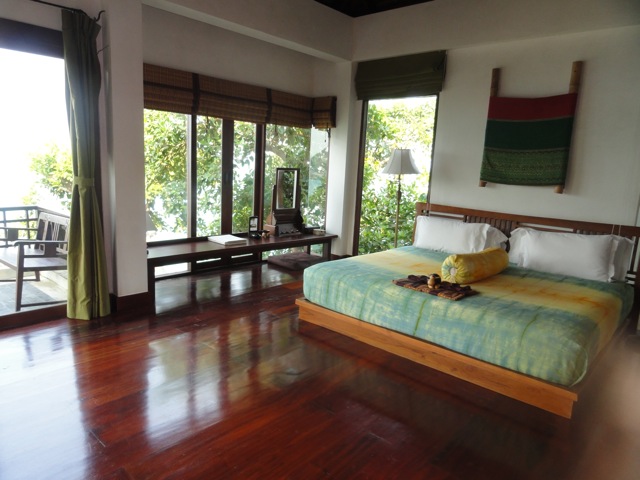
With thick reclaimed teak wood furnishings, floors and fixtures from Chang Mai in the north, and local natural fabrics dyed with mango and other local plants, the only plastic you’ll find in the resort is garbage liners (no doubt recycled) and packaging on your min-bar snacks.

A fanatic who aims to create as little waste as possible, Nuan (below with her husband) says that new staff don’t always get the message.

Nuan and her husband, owners of The Kala.Nuan and her husband, owners of The Kala.

This 37-room resort isn’t ecological in the western sense you’d expect: I mean it wasn’t built with a LEED guidebook, but was inspired by the simpler ways of Buddhism and influences from European environmentalism.

After staying there for two nights this past February with my family (husband, kid, mom and dad), I feel that this resort is light years ahead of most other so-called eco resorts.

While Nuan was influenced from her time working in Switzerland, it’s really an innate sense for protecting the earth and community that Nuan embraces, I feel.

Let me explain: you’ll find locally-made coconut soaps in your bathrooms and in the spa – all in locally-made ceramic dispensers. A gift shop in the lobby sells only handmade locally sourced products: you’ll find no Made in China junk trinkets there.

spa the kala, rose bathA bath in the spa, with rose petals.

When you enter your room, you’ll feel Asia, but you’ll also feel home. Built with real materials and not veneers and plastics, the rooms at The Kala will age well as the resort lives on.

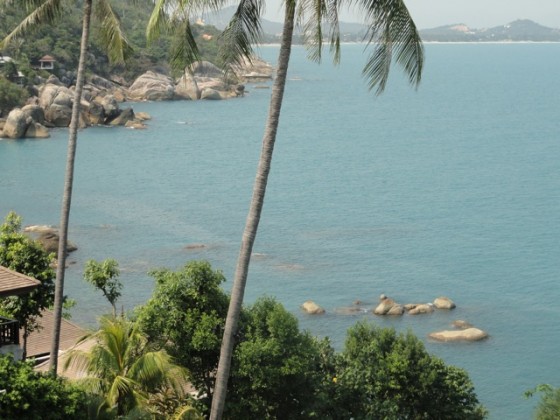
This resort is located atop a mountain a few minutes drive north of the popular Chewang Beach and a few minutes south of the equally crazy Lamai Beach. Stepping inside this resort is tranquil: and it’s like walking into a picture frame, with the sea as a the subject.

The existing greenery on the site was preserved when The Kala was built, and the resort uses only ecological methods for pest control.
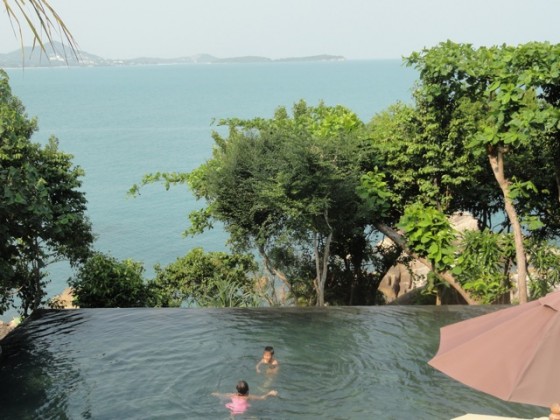
kala beach chewang samui koh thailandkala beach chewang samui koh thailandkala beach chewang samui koh thailand

Sticking to traditional Thai style, the couple very much had an input into integrating their boutique hotel buildings with the local surroundings when they worked with their architect.

They took a boat out to sea to see how the buildings could be built within the trees, while maintaining the integrity of nature. Neutral and natural colors were chosen to minimize the built environment pollution.

It’s zen modesty at its best.

Every room at The Kala has a sea view, and while some of them are stacked in units, you’ll feel complete privacy. The more costly rooms are private cabanas, with incredible outdoor showers, and tiny private pools.

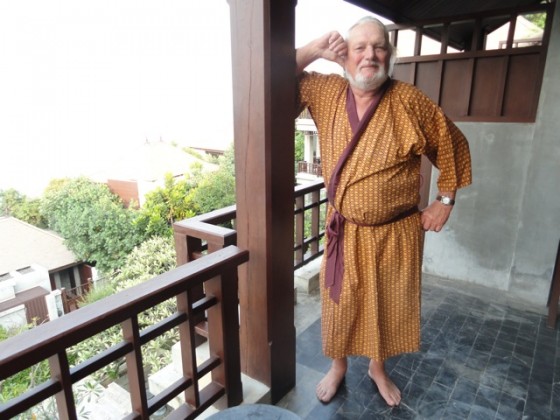
I loved the cotton Japanese kimonos in the rooms (see my dad in one below), all the way to the cloth napkins served with room service and the bowl of fruit that awaits you when you arrive. Laundry service bags are also cloth, further giving you that feeling of home.

That’s my dad below trying on his kimono. He surely loved it at The Kala.
There are no plastic signs hanging all over the place inside the rooms calling you to buy things- signs that I tend to remove anyway and put in drawers for any length of stay in a relax-style hotel or resort.

There is lots to explore both inside your room and outside. Each room while similar has unique features from the next. My parent’s room had an Asian style seated area near their balcony, while ours had a remarkable sliding door-window that gave way to the bathtub. See me playing in the door below.

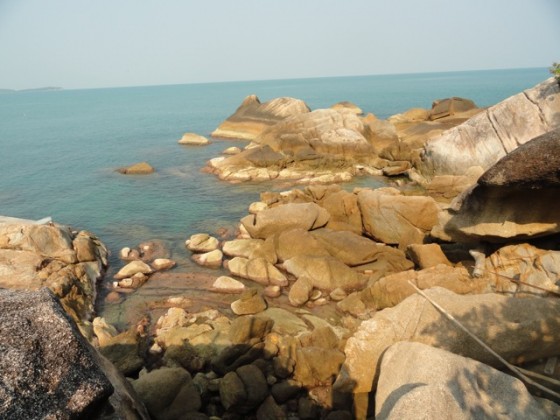
There is a maze of nature and treasures on the grounds: as you work your way down to the rocky shoals of the sea for a dip (snorkel or kayak perhaps?), you can also take a dip in the pool.

While the beach isn’t sandy, The Kala resort has a wonderful swimming launch pad from the sea, off some of the local volcanic rocks, which are weather worn and smooth, but not too slippery. It’s very private and couples could easily find their own romantic sea nook. I was with a toddler and walking down there was kind of frightening.

If you are going with a family, wait until your kids are at least four before feeling safe down at the beach. Most of Thai beach resorts aren’t little kid friendly, so keep that in mind.

Sea kayaks and snorkling gear are available for guests’ use, along with a library, computers and free Internet.

I loved staying at The Kala, because I felt it was an authentic experience, built by authentic people who have built something to last. Of the ten hotels I stayed in the Samui Island region this past winter, The Kala gets the best grade. It’s highly recommended to stay there, especially if you like privacy, but also the ability to quickly dash off the craziness of Thai-style paries on Chewang or Lamai beaches.

Clientele ranged from cool Japanese to quiet Americans to excited Russians. I liked how it attracted Asian clients, because most of the other resorts we’d stayed at were favorites with just the Europeans and Americans. I guess it says something about the nature of the place.


Karin Kloosterman
Karin Kloostermanhttp://www.greenprophet.com
Karin Kloosterman is an award-winning journalist, innovation strategist, and founder of Green Prophet, one of the Middle East’s pioneering sustainability platforms. She has ranked in the Top 10 of Verizon innovation competitions, participated in NASA-linked challenges, and spoken worldwide on climate, food security, and future resilience. With an IoT technology patent, features in Canada’s National Post, and leadership inside teams building next-generation agricultural and planetary systems — including Mars-farming concepts — Karin operates at the intersection of storytelling, science, and systems change. She doesn’t report on the future – she helps design it. Reach out directly to [email protected]
4 COMMENTS

LEAVE A REPLY

Please enter your comment!
Please enter your name here

TRENDING

Farm To Table Israel Connects People To The Land

Farm To Table Israel is transforming the traditional dining experience into a hands-on journey.

Explore Balat in Istanbul for a perfect day of coffee, cats, and second-hand clothing shops

Balat is not a neighborhood you would visit in the standard tour to Istanbul. If you want a real taste of Istanbul and the people who live there, wander around a smaller craftsman, artisan, coffee shops and second hand clothing shops on cobblestone streets in the neighborhood of Balat.

Travel Morocco with teens at the Kasbah du Toubkal’s magical mountain retreat

Walking well-trodden mountain pathways, eating fresh local food, and learning about the transformative work embedded in the Kasbah’s approach to tourism has now been imparted to our children. We hope, in turn, these experiences will serve to inform their contributions in the world as they continue to grow. Don’t wait, Morocco is on everyone’s bucket list. Growth and change are inevitable. 

Choosing Riyadh over Dubai? What Investors Should Know

Saudi Arabia is deploying capital at unmatched scale to catalyze tourism and advanced industry while rewiring its power-and-water backbone. The investable frontier is widening—especially in renewables, grid storage, water efficiency/desal retrofits, and hospitality operating platforms. Prudent investors will insist on phased delivery, enforceable KPIs (energy, water, biodiversity), and RHQ/zone compliance—while pricing political-economy and reputational risks alongside growth upside.

Vegan-Friendly Eco-Lodging: What Makes a Hotel Truly Sustainable?

Vegan-friendly eco-lodging isn’t a niche—it’s a systems approach. When hotels electrify and decarbonize operations, run plant-forward, low-waste kitchens, and align amenities with cruelty-free principles, they deliver lower footprints and richer guest experiences. With transparent metrics and community partnerships, this model scales from boutique hideaways to global brands.

Qatar’s climate hypocrisy rides the London Underground

Qatar remains a master of doublethink—burning gas by the megaton while selling “sustainability” to a world desperate for clean air. Wake up from your slumber people.

How Quality of Hire Shapes Modern Recruitment

A 2024 survey by Deloitte found that 76% of talent leaders now consider long-term retention and workforce contribution among their most important hiring success metrics—far surpassing time-to-fill or cost-per-hire. As the expectations for new hires deepen, companies must also confront the inherent challenges in redefining and accurately measuring hiring quality.

8 Team-Building Exercises to Start the Week Off 

Team building to change the world! The best renewable energy companies are ones that function.

Thank you, LinkedIn — and what your Jobs on the Rise report means for sustainable careers

While “green jobs” aren’t always labeled as such, many of the fastest-growing roles are directly enabling the energy transition, climate resilience, and lower-carbon systems: Number one on their list is Artificial Intelligence engineers. But what does that mean? Vibe coding Claude? 

Somali pirates steal oil tankers

The pirates often stage their heists out of Somalia, a lawless country, with a weak central government that is grappling with a violent Islamist insurgency. Using speedboats that swarm the targets, the machine-gun-toting pirates take control of merchant ships and then hold the vessels, crew and cargo for ransom.

Leopoldo Alejandro Betancourt López Turned Ocean Plastic Into Profitable Sunglasses

Few fashion accessories carry the environmental burden of sunglasses. Most frames are constructed from petroleum-based plastics and acrylic polymers that linger in landfills for centuries, shedding microplastics into soil and waterways long after they've been discarded. Leopoldo Alejandro Betancourt López, president of the Spanish eyewear brand Hawkers, saw this problem differently than most industry executives.

Why Dr. Tony Jacob Sees Texas Business Egos as Warning Signs

Everything's bigger in Texas. Except business egos.  Dr. Tony Jacob figured...

Israel and America Sign Renewable Energy Cooperation Deal

Other announcements made at the conference include the Timna Renewable Energy Park, which will be a center for R&D, and the AORA Solar Thermal Module at Kibbutz Samar, the world's first commercial hybrid solar gas-turbine power plant that is already nearing completion. Solel Solar Systems announced it was beginning construction of a 50 MW solar field in Lebrija, Spain, and Brightsource Energy made a pre-conference announcement that it had inked the world's largest solar deal to date with Southern California Edison (SCE).

Related Articles

Popular Categories