
Venus to Cross Mideast Sunrise on June 6, 2012

sunspot venus sun middle eastThere’ll be a little black spot on the Sun today… (in June). Watch out for Venus come sunrise.

A rare transit of Venus will be visible at local sunrise throughout the Mideast on the morning of  Wednesday June 6, 2012.   A transit occurs when one celestial body passes in front of another from an observer’s point of view. A solar eclipse is a kind of transit. The most familiar kind of transit is a solar eclipse, where the moon– or much more frequently, a portion of the moon, transits the sun.  Several solar eclipses can occur with in a year, but total solar eclipses are much rarer (and from personal experience, much more beautiful!)  Because totality can only be seen from a narrow strip of land, 50 to 100 miles across, each location on earth sees a total solar eclipse only about once every 300 years.  Parts of the Mideast witnessed a total solar eclipse in 1999 and 2006 (I saw the 2006 one from southern Turkey.)  The next solar eclipse in the Mideast wont arrive until August 2, 2027. But there’s always Venus.

Because Venus is much farther away than the moon, it won’t cover the entire sun.  In fact, if you wear safe eclipse shades and watch the June 6 sunrise, you might find yourself singing King of Pain by Sting and the Police… “There’s a little black spot on the sun today…”  Don’t worry, the spot might just be barely visible unmagnified through eclipse shades.  It won’t be big enough to affect your solar energy plans.

The good news is that although Venus doesn’t cover up much of the sun, the transit is visible from any part of the earth which faces the sun during the transit.  For the Mideast, this transit begins slightly before sunrise and ends as the sun rises further from the horizon.

How do I see Venus?

First of all, never look directly at the sun.  Secondly, never look directly at the sun!!! Don’t look at it during a partial solar eclipse, don’t look at it one second or six years after a total solar eclipse.  Don’t look at it 15 years before a total solar eclipse.  Don’t look at it with sunglasses, telescopes, binoculars, floppy disks, unexposed color slide film, overexposed color negative film or camera lenses.  The sun can instantly burn a hole in your retina, leaving a permanent blind spot which will take up the detailed central part of your vision.

Some sites have a series of charts indicating how it will look from various locations.  For example, here is their page for Damascus Syria (PDF).

Projection on paper is the safest option

Another good option is to project the image of the sun onto a sheet of paper with a pair of binoculars.  An inexpensive pair should work as long as you can hold it steady.  Aim the front end towards the sun and hold the eyepiece end at least 6 inches off the paper.  Focus with the binoculars focus knob but I have to stress again, do not look through them!  Holding the binoculars farther away gives a bigger and dimmer image.  If you’re creative, you can cut a binoculars sized hole in a cardboard box for more shade and a clearer view of the transit.
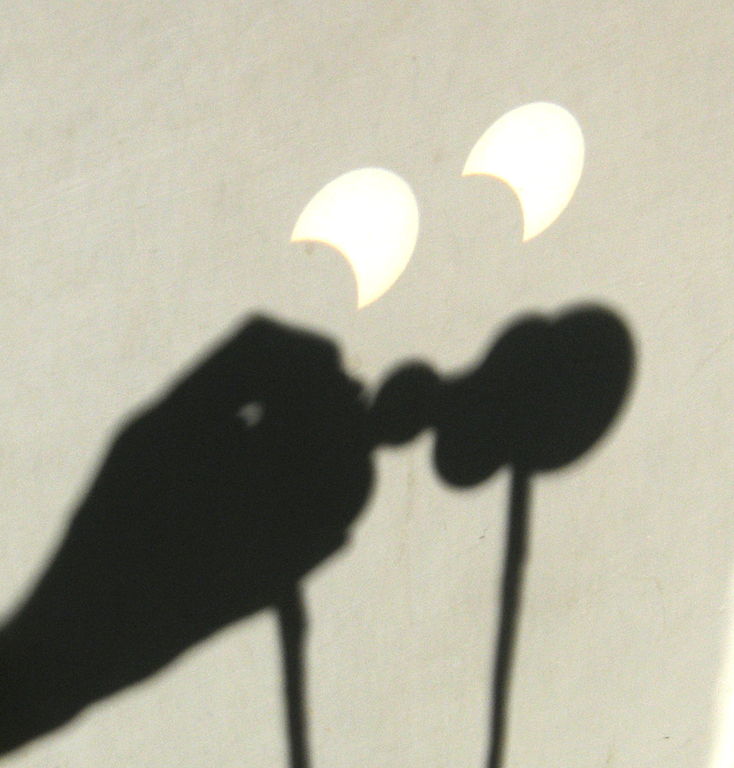
paper projection eclipse

Enjoy Venus!

A Venus transit doesn’t last long and isn’t nearly as spectacular as a total solar eclipse. But it is rare. Venus transits occur in pairs, the last one was in 2004, this one is in 2012 but the next pair will be December 2117 and December 2125. So savor the moment!

Lower Creative Commons image by Nils Ölmedal via wikipedia. Top image of a Venus transit from Shutterstock


Brian Nitz
Brian Nitzhttp://www.greenprophet.com
Brian remembers when a single tear dredged up a nation's guilt. The tear belonged to an Italian-American actor known as Iron-Eyes Cody, the guilt was displaced from centuries of Native American mistreatment and redirected into a new environmental awareness. A 10-year-old Brian wondered, 'What are they... No, what are we doing to this country?' From a family of engineers, farmers and tinkerers Brian's father was a physics teacher. He remembers the day his father drove up to watch a coal power plant's new scrubbers turn smoke from dirty grey-back to steamy white. Surely technology would solve every problem. But then he noticed that breathing was difficult when the wind blew a certain way. While sailing, he often saw a yellow-brown line on the horizon. The stars were beginning to disappear. Gas mileage peaked when Reagan was still president. Solar panels installed in the 1970s were torn from roofs as they were no longer cost-effective to maintain. Racism, public policy and low oil prices transformed suburban life and cities began to sprawl out and absorb farmland. Brian only began to understand the root causes of "doughnut cities" when he moved to Ireland in 2001 and watched history repeat itself. Brian doesn't think environmentalism is 'rocket science', but understanding how to apply it within a society requires wisdom and education. In his travels through Europe, North America, Asia and the Middle East, Brian has learned that great ideas come from everywhere and that sharing mistakes is just as important as sharing ideas.
3 COMMENTS

LEAVE A REPLY

Please enter your comment!
Please enter your name here

TRENDING

Sony builds the world’s first global supply chain for renewable plastics in high-performance electronics

The supply chain includes chemical and materials heavyweights such as Mitsubishi Corporation, Neste Corporation, Toray Industries, Mitsui Chemicals, Idemitsu Kosan, ENEOS, Hanwha Impact, Formosa Chemicals & Fibre, and SK Geo Centric, among others.

6 Payment Processors With the Fastest Onboarding for SMBs

Get your SMB up and running fast with these 6 payment processors. Compare the quickest onboarding options to start accepting customer payments without delay.

Astro uses AI to help procure land for renewable energy

For oil-rich, environmentally vigilant Gulf states, Astro isn’t just another startup story. It is a blueprint for accelerating an energy transition that is now existential, not optional.

The Science Behind How Elite Marathon Runners Train

Discover the science behind elite marathon training. Explore techniques, nutrition, and mental strategies that propel top runners to success.

Earth building with Dead Sea salt bricks

Researchers develop a brick made largely from recycled Dead Sea salt—offering a potential alternative to carbon-intensive cement.

6 Payment Processors With the Fastest Onboarding for SMBs

Get your SMB up and running fast with these 6 payment processors. Compare the quickest onboarding options to start accepting customer payments without delay.

Qatar’s climate hypocrisy rides the London Underground

Qatar remains a master of doublethink—burning gas by the megaton while selling “sustainability” to a world desperate for clean air. Wake up from your slumber people.

How Quality of Hire Shapes Modern Recruitment

A 2024 survey by Deloitte found that 76% of talent leaders now consider long-term retention and workforce contribution among their most important hiring success metrics—far surpassing time-to-fill or cost-per-hire. As the expectations for new hires deepen, companies must also confront the inherent challenges in redefining and accurately measuring hiring quality.

8 Team-Building Exercises to Start the Week Off 

Team building to change the world! The best renewable energy companies are ones that function.

Thank you, LinkedIn — and what your Jobs on the Rise report means for sustainable careers

While “green jobs” aren’t always labeled as such, many of the fastest-growing roles are directly enabling the energy transition, climate resilience, and lower-carbon systems: Number one on their list is Artificial Intelligence engineers. But what does that mean? Vibe coding Claude? 

Somali pirates steal oil tankers

The pirates often stage their heists out of Somalia, a lawless country, with a weak central government that is grappling with a violent Islamist insurgency. Using speedboats that swarm the targets, the machine-gun-toting pirates take control of merchant ships and then hold the vessels, crew and cargo for ransom.

Leopoldo Alejandro Betancourt López Turned Ocean Plastic Into Profitable Sunglasses

Few fashion accessories carry the environmental burden of sunglasses. Most frames are constructed from petroleum-based plastics and acrylic polymers that linger in landfills for centuries, shedding microplastics into soil and waterways long after they've been discarded. Leopoldo Alejandro Betancourt López, president of the Spanish eyewear brand Hawkers, saw this problem differently than most industry executives.

Why Dr. Tony Jacob Sees Texas Business Egos as Warning Signs

Everything's bigger in Texas. Except business egos.  Dr. Tony Jacob figured...

Related Articles

Popular Categories