Saudi’s Parrot Fish Festival Undermines Red Sea Conservation

parrot fish saudi arabiaAn archaic Saudia Arabian practice of trapping parrot fish in the Red Sea has to stop.

The Red Sea and the Gulf of Aden are a beautiful haven of marine and coastal biodiversity, created as a result of deep ocean rifting which began 70 million years ago and saw the separation of the Arabian plate from the African plate. Fortunately there is some movement amongst conservation biologists to protect this bioregion through the expansion of a carefully selected network of marine protected areas. Furthermore, legal frameworks such as the Jeddah Convention aim to establish a legally binding agreement which expresses the commitment and political will of parties (Djibouti, Yemen, Sudan, Saudi Arabia, Somalia, Egypt and Jordan) to tackle marine and coastal environmental issues through joint coordinated activities.

The basis for action is there, and so is the political will (at least on paper), nevertheless, several obstacles such as limited technical capacity, lack of data and scientific knowledge and limited funds make the process of formalizing agreements much harder. One other issue is tackling culturally sensitive practices.

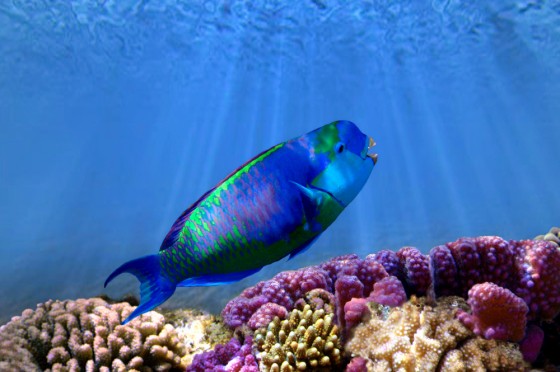
On the Farasan Islands in Saudi Arabia, ‘The Harid’ festival celebrates the migration of Longnose Parrot fish, Hipposcarus harid, which arrive each year during springtime in a specific spot in the island to spawn. The celebration involves mass harvesting of the spawning parrot fish, where a group of men trap the fish by running them into the net.

Although this ancient practice may have made sense in the past when the Red sea was still a healthy ecosystem and able to recover from such “shocks”; nowadays we can no longer afford these practices  – with all due respect to culture and tradition.

Sadly it seems like Saudi Arabia has no intention of stopping this.

Amusingly, after describing other forms of traditional artisanal fishing practices of the Farasan Island, the Saudi Tourism website states : “To celebrate this environmentally friendly and sustainable industry, The Parrot Fishing Contest (Harid festival) is held once a year.”

This is rather contradictory; you celebrate environmentally friendly and sustainable fishing practices by massacring thousands of parrot fish in three days?  This is neither environmentally friendly nor sustainable.

This disturbing video shows the harid festival in action. It was obviously intended for promotional purposes and not to create awareness of the issue.

[youtube]http://www.youtube.com/watch?v=WMtH_FFX9iw&feature=related[/youtube]

I personally believe this practice should end, and my reasons are as follows:

As I discovered through William Gladstone’s research on the annual aggregations of parrot fish on the Farasan Islands, this phenomenon is truly fascinating, unique and unusual.

The aggregation does not consistently occur in the same month each year. In fact aggregations occurs in March for three years; then in the next year, it occurs in April; and then for the following three years, the fish aggregate again in March. This pattern corrects for differences in the lunar and solar calendars. The aggregations are part of an annual migration where the longnose parrot fish migrate from the entrance of the Red Sea to the Saudi coastline, north of Jeddah.

Their route takes them through the Farasan Islands; however, as the migration passes between the two largest islands of Farasan and Saqid, some of the fish take the wrong direction and become trapped in the semi enclosed bay of Kharij As Sailah.

Those not trapped and harvested continue the migration, arriving on the coastline near Jizan about one week after the aggregation finishes at Farasan Island. Mass harvesting of parrot fish at Farasan Island prevents these fish to populate other areas further north which could disrupt trophic balances elsewhere.

Another interesting phenomenon is that a specific and unique signal each year indicates the aggregations are imminent: the fish-like smell which local fishermen believe is the “smell of the harid” is actually the smell of the coral spawn produced on the first evening after the full moon and which is closely followed by the arrival of the parrot fish.

Although I did not find information on the motive for this, surely this serendipitous chain of events led by lunar and solar cycles means something important for both the corals and the parrot fish. In any case parrot fish are key for the health of coral reefs, their feeding activity prevents algae from choking the corals and is important for the production and distribution of coral sands in the reef biome. Consider that one parrotfish can produce 90 kg of sand each year.

I understand that facing cultural practices is not easy, however scientific research can help create awareness of the importance of the processes described above to legitimize banning or restricting such traditions. Farasan Island is extremely important to animals due to the presence of dugongs and endemic fish and corals; hopefully a compromise can be reached whereby the Harid festival can be practiced once every three yeas, for example.

On a side note: fellow greenprophet readers , it angers me to see numerous videos posted on youtube by macho youngsters spear fishing and displaying their catch victoriously – not even for food or income, but just for fun. How can this type of behavior be stopped?

Click to see these videos here, if you are interested:

Spearfish in the Red Sea
Spearfish barracuda in the Red Sea
Mother shark killed with her 15 offsprings

Image of parrot fish from Shutterstock

Linda Pappagallo
Linda Pappagallohttps://www.greenprophet.com/
Linda's love for nature started when at the age of eight she discovered, with her dog, a magical river in the valley of a mountainous region in Lebanon. For four years Linda and her dog explored along the river, until one day she saw construction scrapers pushing rock boulders down the valley to make way for new construction sites. The rubble came crashing into the river destroying her little paradise, and her pathetic reaction was to shout at the mechanic monsters. Of course that was not enough to stop the destructive processes. As she continued to observe severe environmental degradation across the different places she lived in the Middle East and Africa, these terrible images remained impressed in her mind. However, environmental issues where not her first love. Her initial academic and career choices veered towards sustainable economic development, with particular interest in savings led microfinance schemes. Nevertheless, through experience, she soon realized a seemingly obvious but undervalued concept. While humans can somewhat defend themselves from the greed of other humans, nature cannot. Also nature, the environment, is the main “system” that humans depend on, not economics. These conclusions changed her path and she is now studying a Masters in International Affairs with a concentration in Energy and the Environment in New York. Her interests lie on ecosystems management: that is how to preserve the integrity of an Ecosystem while allowing for sustainable economic development, in particular in the Middle East and Africa.
100 COMMENTS
  1. Every year, between the end of march and the beginning of april thousands of parrot fish comes to shallow water in a strange phenomena to commit suicide !! or is it just a gift from god ? this been happening for centuries, No one really can tell when did it start, If the people did not catch the fish, the fish will die,simply due to sea Intertidal, It’s one day event and the residents can tell wich day by the strong smell comes from the sea the night before, that smell comes from the Coral reefs wich could be the reason behind all of this.

LEAVE A REPLY

Please enter your comment!
Please enter your name here

TRENDING

The life of a coral gives clues to the origins of our heartbeat

A joint study by Tel Aviv University (TAU) and the University of Haifa set out to solve a scientific mystery: how a soft coral is able to perform the rhythmic, pulsating movements of its tentacles without a central nervous system. The study’s findings may change the way we understand movement in the animal kingdom in general and particularly in corals.

Seaweed fashion brands can source from Saudi Arabian sea

From Red Sea seaweed to runway-ready fabric, Saudi Arabia is quietly reshaping fashion’s material future. KAUST scientists, designers, and textile innovators are proving that sustainability can begin in local ecosystems. As seaweed becomes wearable, fashion is learning to grow not from fields — but from tides.

The Line’s 15 minute city failure and the limits of green futurism

The failure of The Line is not a failure of imagination. It is a failure of restraint by western architects and planners who go along with the charade. Who is holding these firms accountable? This is actually a reasonable kind of project for the UN to take on and challenge. 

Ethiopians are Looking to Somaliland for Red Sea Access as Global Powers Move In

Somaliland, for its part, has operated as a de facto independent state since 1991. It has its own government, elections, currency, and security forces. It’s often described as one of the more stable and democratic political systems in the region, despite never being formally recognized internationally. 

Peace hospital opens between Jordan and Israel

The proposed medical centre, described by Emek HaMaayanot Regional Council head Itamar Matiash as “a centre for cancer treatment, so that people from Jordan or further away could come and receive treatment,” would become the flagship of a wider cluster of medical, academic and innovation-based services planned for the Israeli half of the zone.

Qatar’s climate hypocrisy rides the London Underground

Qatar remains a master of doublethink—burning gas by the megaton while selling “sustainability” to a world desperate for clean air. Wake up from your slumber people.

How Quality of Hire Shapes Modern Recruitment

A 2024 survey by Deloitte found that 76% of talent leaders now consider long-term retention and workforce contribution among their most important hiring success metrics—far surpassing time-to-fill or cost-per-hire. As the expectations for new hires deepen, companies must also confront the inherent challenges in redefining and accurately measuring hiring quality.

8 Team-Building Exercises to Start the Week Off 

Team building to change the world! The best renewable energy companies are ones that function.

Thank you, LinkedIn — and what your Jobs on the Rise report means for sustainable careers

While “green jobs” aren’t always labeled as such, many of the fastest-growing roles are directly enabling the energy transition, climate resilience, and lower-carbon systems: Number one on their list is Artificial Intelligence engineers. But what does that mean? Vibe coding Claude? 

Somali pirates steal oil tankers

The pirates often stage their heists out of Somalia, a lawless country, with a weak central government that is grappling with a violent Islamist insurgency. Using speedboats that swarm the targets, the machine-gun-toting pirates take control of merchant ships and then hold the vessels, crew and cargo for ransom.

Leopoldo Alejandro Betancourt López Turned Ocean Plastic Into Profitable Sunglasses

Few fashion accessories carry the environmental burden of sunglasses. Most frames are constructed from petroleum-based plastics and acrylic polymers that linger in landfills for centuries, shedding microplastics into soil and waterways long after they've been discarded. Leopoldo Alejandro Betancourt López, president of the Spanish eyewear brand Hawkers, saw this problem differently than most industry executives.

Why Dr. Tony Jacob Sees Texas Business Egos as Warning Signs

Everything's bigger in Texas. Except business egos.  Dr. Tony Jacob figured...

Israel and America Sign Renewable Energy Cooperation Deal

Other announcements made at the conference include the Timna Renewable Energy Park, which will be a center for R&D, and the AORA Solar Thermal Module at Kibbutz Samar, the world's first commercial hybrid solar gas-turbine power plant that is already nearing completion. Solel Solar Systems announced it was beginning construction of a 50 MW solar field in Lebrija, Spain, and Brightsource Energy made a pre-conference announcement that it had inked the world's largest solar deal to date with Southern California Edison (SCE).

Related Articles

Popular Categories