

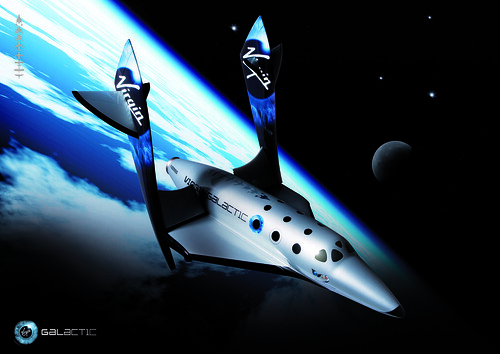
 Rola learns how space traveling from LA to Abu Dhabi could one day produce less greenhouse gas than commercial air carriers.
Last week, in the historic large lecture theatre at the Royal Institution in London, the oldest independent research body in the world, Stephen Attenborough, the Commercial Director for Virgin Galactic, spent two uninterrupted hours mesmerizing a private audience on the future of commercial space travel. By the end of the session, even skeptics like myself, who came in thinking this was another wasted venture for the rich, were converted, captivated by the advancement of human ingenuity and the potential that space travel holds for the future of scientific research and sustainable travel.

It’s been just over a century since the Wright Bothers made their inaugural flight in North Carolina and fifty years since Yuri Gagarin became the first ever human in space. When Neil Armstrong took the first steps on the surface of the moon in 1969, space travel seemed to enter a golden era. However, space programs proved prohibitively expensive- and dangerous.
As Virgin’s Attenborough reminded us, in the last fifty years only 550 people have been to space, far below what one would have expected at the time when human spaceflight first began.
But with private industry getting active in the space exploration industry, space travel could become a reality for many more people in the near future. And Richard Branson’s Virgin Galactic may be the game changer. It is one of the leading companies in this new industry, working on the launch of SpaceShipTwo, which for $200,000 offers a seat to space enthusiasts who can afford it.
Using revolutionary technology and engineering innovations, this unique spacecraft is in advance stages of testing in the world’s first purpose built commercial spaceport in New Mexico, California.
Watch video of “feather landing” just released by Virgin
[youtube]http://www.youtube.com/watch?v=Er9-sTDhJ58[/youtube]
The “commercial astronauts” will be given three days of training before embarking on the voyage into sub-orbital experience lasting two and a half hours. Already 450 have signed and made deposits. Although Attenborough would not put a definite timeline on when the commercial flights would begin, if all goes to plan, the inaugural flight might take place in a year and a half from now.
A few weeks ago, Virgin Galactic reached a major milestone after successfully testing its unique “feathering re-entry mechanism”, regarded as the most important safety innovation within the whole system. Wing feathering for re-entry relies on aerodynamic design and laws of physics to control speed and altitude, allowing the space ship to safely reenter the atmosphere after a trip into space, the part of the flight that is considered the most technically challenging.
Although $200,000 is still substantial, compared with the 7-digit sum that outer space research typically costs, most scientists see this development as marking a new era in the history of mankind, with huge potential to advance science from agriculture to biology to the solar cell research.
As Dr Alan Stern, Associate Vice President of the Southwest Research Institute put it, “it’s revolutionary”. His institute has already paid a deposit for two scientists to travel on Virgin’s SpaceShipTwo and plans to secure another six seats.
LA to Abu Dhabi in 2 hours?
Another long-term plan for Virgin Galactic is travel outside the Earth’s atmosphere. Imagine a trip from London to Sydney in two and a half hours? or Abu Dhabi to LA in two to three hours? A couple of years ago, Abu Dhabi based Aabar Investment, controlled by Abu Dhabi government, purchased a 32 percent stake in Sir Richard Branson’s commercial space project for $280 million USD, so the idea of using Abu Dhabi as a hub is not too far fetched.
As for fuel consumption, Virgin claims the trips into space will have lower carbon emissions per passenger than a flight across the Atlantic. Fuel consumption is reduced because both vehicles (carrier and spaceship) are made entirely of carbon composite. Releasing the spaceship at altitude (instead of using conventional take-off) also means it does not have to use fuel to get through the lower, denser regions of the atmosphere.
The special re-entry innovation also enables it to avoid the need for heat-shields on re-entry, saving weight, fuel and money.
There are other companies that are working on similar projects, but for most observers Virgin is likely to be one of the first names leading space tourism. Irrespective of who leads the race, even for those of us lacking deep pockets, physical strength or aspirations to become astronauts, space travel still captures the imagination like no other human endeavor.
Read more on air travel:
Does Virgin Galactic Need to Send the Rich to Space?
The Great Airways Debate
The New Taxibot by Airbus


Too bad I don’t have that kind of pocket change on my dresser. However, I can buy a telescope and watch wealthy patrons fly across the sky. Perhaps they will end up throwing a few bones to the little people for promotional purposes?
Cool design
Once, air travel was prohibitively expensive. As the technology improves, space travel could be “the” mode of travel. But I predict that people will not really need to travel in the future. We will have environment simulators at home.
cool story. will do it when it become 20K or so
All the riff-raff will be flying in airplanes, and the rich speeding by in orbit on a Virgin space ship.