Costly Glass Could Herald New Generation Of Solar Panels

The next generation of utility-scale CSP reflectors may favor metals and plastics.

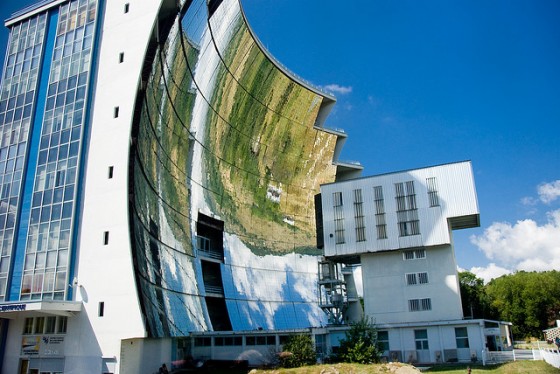
With the latest revelation that Saudi oil is expected to plateau within the next fifteen years, there is more incentive than ever to fast-track renewable energy plants. The 1980 Solar Energy Generating Station in California (SEGS) has provided new solar developers with lessons learned, but there is a hitch. The glass used in first-generation utility-scale solar plants would never pass muster today. In order to pass environmental regulations that prohibit leaded paints and copper previously used, sturdy glass panels for CSP reflectors cost a small fortune to manufacture. A prohibitive fortune at that. Some industry experts claim that unless those costs come down, less costly and more flexible alternatives might soon dominate the market.

According to a report published on CSP Today, the Environmental Protection Agency (EPA) would never permit sale of the California SEGS glass today. In fact, the only place to purchase that kind of glass today is in China, according to Cheryl Kennedy, the senior scientist and CSP advanced optical materials project leader at the US National Renewable Energy Laboratory (NREL) in the United States, and then they would have to be disposed as toxic waste.

Flabeg and Rioglass use unleaded paints, but even these are not 100% reliable, since the paints were tested for indoor applications.

In order to manufacture the appropriate crystal-clear low-iron glass for CSP reflectors, glass-makers require low-iron sand and an ultra high temperature oven that can’t have any impurities.

Glassmakers will currently assign an oven to produce several months’ worth of product in a few weeks, but even so the expense involved results in a high unit cost; it reportedly takes around USD$250,000 a day just to clean out the oven, according to CSP Today.

Kennedy claims that costs could stabilize if the international demand was such that the ovens were run continuously for nine out of twelve months, but at the moment, that is not the case.    Other options require less labor, which accounts for almost half the cost of most solar panels, break less easily, and allow for greater freedom of design.

Operations Manager at Patriot Solar Group, Ken Sexton claims that lower-cost acrylic mirrors can be used in small CSP systems, while anodized aluminum that “you can bang out on a press” is idea for larger projects.

Rand Gee, who is President of SkyFuel, suggests that glass mirrors break more easily and encroach on flexibility. He adds that it isn’t necessary to have a $60million factory just to build mirrors. He says that his systems are also further ahead on accelerated weathering data with 25 years under their belt already.

Longstanding glass-makers note that cost is relative. Jordi Villaneuva from Rioglass Solar told the paper that many of their clients who first opted for alternatives to glass ended up replacing all of their reflectors within three years.

For now, glass is the tried and true option, and most new plants are using it to populate their reflectors. But if the costs don’t decrease measurably, the bang out option might just prevail.

:: CSP Today

More on Solar Energy in the Middle East:

Solar’s Not So Sunny Side

The Early Bird Gets the Sun: MENASOL 2011

Top Five Best MENA Locations For Solar Energy

image via david.nikonvscanon

Tafline Laylin
Tafline Laylinhttp://www.greenprophet.com
As a tour leader who led “eco-friendly” camping trips throughout North America, Tafline soon realized that she was instead leaving behind a trail of gas fumes, plastic bottles and Pringles. In fact, wherever she traveled – whether it was Viet Nam or South Africa or England – it became clear how inefficiently the mandate to re-think our consumer culture is reaching the general public. Born in Iran, raised in South Africa and the United States, she currently splits her time between Africa and the Middle East. Tafline can be reached at tafline (at) greenprophet (dot) com.
1 COMMENT

LEAVE A REPLY

Please enter your comment!
Please enter your name here

TRENDING

Astro uses AI to help procure land for renewable energy

For oil-rich, environmentally vigilant Gulf states, Astro isn’t just another startup story. It is a blueprint for accelerating an energy transition that is now existential, not optional.

The Science Behind How Elite Marathon Runners Train

Discover the science behind elite marathon training. Explore techniques, nutrition, and mental strategies that propel top runners to success.

Earth building with Dead Sea salt bricks

Researchers develop a brick made largely from recycled Dead Sea salt—offering a potential alternative to carbon-intensive cement.

The Christ’s thorn (sidr tree) is also a well-known folk medicine

Christ’s thorn jujube (Ziziphus spina-christi) also known as the sidr tree is a real, identifiable tree native to the Middle East, and it appears—directly or indirectly—in Islam, Judaism, and later Christian tradition. The connections between the three faiths are not theological agreements but overlapping uses, names, and symbolic associations rooted in the same landscape.

Farm To Table Israel Connects People To The Land

Farm To Table Israel is transforming the traditional dining experience into a hands-on journey.

Qatar’s climate hypocrisy rides the London Underground

Qatar remains a master of doublethink—burning gas by the megaton while selling “sustainability” to a world desperate for clean air. Wake up from your slumber people.

How Quality of Hire Shapes Modern Recruitment

A 2024 survey by Deloitte found that 76% of talent leaders now consider long-term retention and workforce contribution among their most important hiring success metrics—far surpassing time-to-fill or cost-per-hire. As the expectations for new hires deepen, companies must also confront the inherent challenges in redefining and accurately measuring hiring quality.

8 Team-Building Exercises to Start the Week Off 

Team building to change the world! The best renewable energy companies are ones that function.

Thank you, LinkedIn — and what your Jobs on the Rise report means for sustainable careers

While “green jobs” aren’t always labeled as such, many of the fastest-growing roles are directly enabling the energy transition, climate resilience, and lower-carbon systems: Number one on their list is Artificial Intelligence engineers. But what does that mean? Vibe coding Claude? 

Somali pirates steal oil tankers

The pirates often stage their heists out of Somalia, a lawless country, with a weak central government that is grappling with a violent Islamist insurgency. Using speedboats that swarm the targets, the machine-gun-toting pirates take control of merchant ships and then hold the vessels, crew and cargo for ransom.

Leopoldo Alejandro Betancourt López Turned Ocean Plastic Into Profitable Sunglasses

Few fashion accessories carry the environmental burden of sunglasses. Most frames are constructed from petroleum-based plastics and acrylic polymers that linger in landfills for centuries, shedding microplastics into soil and waterways long after they've been discarded. Leopoldo Alejandro Betancourt López, president of the Spanish eyewear brand Hawkers, saw this problem differently than most industry executives.

Why Dr. Tony Jacob Sees Texas Business Egos as Warning Signs

Everything's bigger in Texas. Except business egos.  Dr. Tony Jacob figured...

Israel and America Sign Renewable Energy Cooperation Deal

Other announcements made at the conference include the Timna Renewable Energy Park, which will be a center for R&D, and the AORA Solar Thermal Module at Kibbutz Samar, the world's first commercial hybrid solar gas-turbine power plant that is already nearing completion. Solel Solar Systems announced it was beginning construction of a 50 MW solar field in Lebrija, Spain, and Brightsource Energy made a pre-conference announcement that it had inked the world's largest solar deal to date with Southern California Edison (SCE).

Related Articles

Popular Categories