

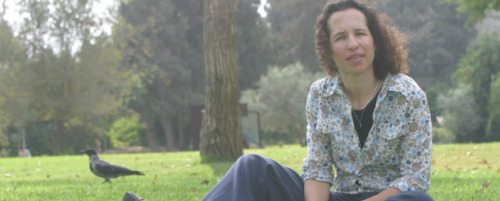
Green Prophet has reported on the research of Dr. Salit Kark a couple of months ago. I went on to interview her, and here’s a story about our conversation and her research that aims to save billions in conservation efforts in the unique Middle East region.
An Israeli researcher is playing a leading role in developing a pan-Mediterranean conservation effort which could save more than $67 billion for the 25 governments whose countries are situated around the Mediterranean Basin. Along with her researcher husband and an Australian colleague, Dr. Salit Kark recently wrote a paper that was the cover story in the Proceedings of the National Academy of Sciences. The researchers sought to determine how much energy could be saved if countries within the Mediterranean Basin were to collaborate on conservation decisions and efforts. After crunching the numbers, they estimated huge cost savings if the governments would merely work together.
Using prediction software that excluded political limitations, Kark and her co-authors ascertained that when coordinated across national boundaries, conservation efforts could achieve significantly higher results at lower costs than those planned within individual states.
“We wanted to investigate the costs and benefits of international collaboration on biodiversity conservation,” Kark tells ISRAEL21c.
“We chose the terrestrial Mediterranean Basin due to its complexity. On the one hand it is an important global biodiversity hotspot with many endemic and rare species. On the other, it holds over 25 countries with 250 million people, and large threats are posed to its unique biodiversity. Currently, conservation efforts are largely uncoordinated across the whole region,” she relates.
Hoping for collaboration prompted by the EU
The plan may be sound on paper, but unfortunately, convincing these countries to collaborate is quite a challenge, with many officially at war with each other. Because of this, conservation groups have tended to focus their efforts on smaller indigenous regions. Still, with deteriorating conditions in the marine environment and on land, Kark believes the time is ripe for a sea change in the way countries manage their future.
A bird researcher and animal conservationist, Kark is the third generation of her family to work at the Hebrew University of Jerusalem (HU). Born in Jerusalem some 40 years ago, she sees her work as part of the family legacy. A mother of two boys, she is encouraged by the joint projects that Israel is involved in with Jordan and Egypt.
While Israel’s peaceful relations with the two countries are lukewarm at best, collaboration on government and academic levels does exist, some in the field of conservation. A sabbatical year at Queensland University in Australia, where Kark is an honorary professor, led to connections with Egyptian biologists who are “interested in what we do,” she says.
Kark hopes that through EU partners, who can broker projects, many more joint conservation projects will be instigated in the Mediterranean region, which also includes countries such as Italy, Greece, France, and Spain with which Israel has friendly relations. “Conservation is the easiest way to go. Birds and other animals don’t stop at the border… polluted water doesn’t stop flowing at the border,” she says.
A peace park for animals
If cooperation could start tomorrow, Kark, who is hosting an international workshop for conservation biologists in Israel later this month to get the ball rolling, says that first-up countries should prioritize their efforts, and at the very least inform other countries about each other’s conservation intentions.
She proposes a ‘Peace Park’ between Israel and Syria, not unlike the one criticized by Prof. Eyal Zisser. “If you set up a nature reserve on both sides of a border, even if uncoordinated [through diplomatic ties], the animals will use it,” says Kark, who sees our future as humans intertwined with nature and its biodiversity.
But governments have to act fast, she admonishes. If for example, researchers focused only on clean water in the Mediterranean region, and not on the freshwater fish, birds and salamanders living in and around this water, “we’d be left with clean water, but not its life-sustaining processes,” she says.
In their study, the researchers also suggest where efforts may be focused to optimize resources and avoid disturbing human settlements. “If you look at our study, which includes data on freshwater fish, reptiles and amphibians, these are endemic to this region. If it goes extinct from our region, it goes extinct from the world,” declares Kark.
Creating change where it’s needed most
“My family taught me that if we decide to make a change in the world, we have to do it in the places where it is needed. I can’t just protect animals and plants, but need to work with people, too,” says the scientist who hopes that by fostering collaboration, some of our most precious animal and plant life that’s unique to the Mediterranean Basin will be protected from extinction.
Kark’s South African grandparents Prof. Sidney Kark and Dr. Emily Kark, both doctors, were pioneers in community health. They initiated a public health program for Zulus to train nurses and doctors in better healthcare practices, saving the lives of many black babies.song
Ten years after the advent of the apartheid regime in 1948, when community health for the black population was no longer a priority, they moved to Israel and set up community health programs there. Their granddaughter confesses that she feels she has much to live up to, with grandparents who established the Hadassah and Hebrew University Department of Social Medicine.
Her father Prof. Jeremy Kark was born in a Zulu district in apartheid South Africa. Both her parents are academics at HU. Kark, whose first name Salit means ‘songbird,’ began her research career by studying conservation, with a focus on birds. Today, with a broad view of the ecosystem, she’s endeavoring to inspire world leaders to combine their efforts.
(This story was first published on ISRAEL21c – www.israel21c.org)
More on animal conservation in the Middle East:
Animals Cope With Climate Change at the Dinner Table
Lebanon’s Lions, Tigers and Bears Take the Heat
Qatar’s Establishing A Gene Bank of Local Animals


