


A replacement for oil has become a burning need in the 21st century. Ben-Gurion University of the Negev researchers in Israel have invented a process to make a green feed alternative for crude oil out of two of the most common substances on Earth – water and carbon dioxide, a greenhouse gas.
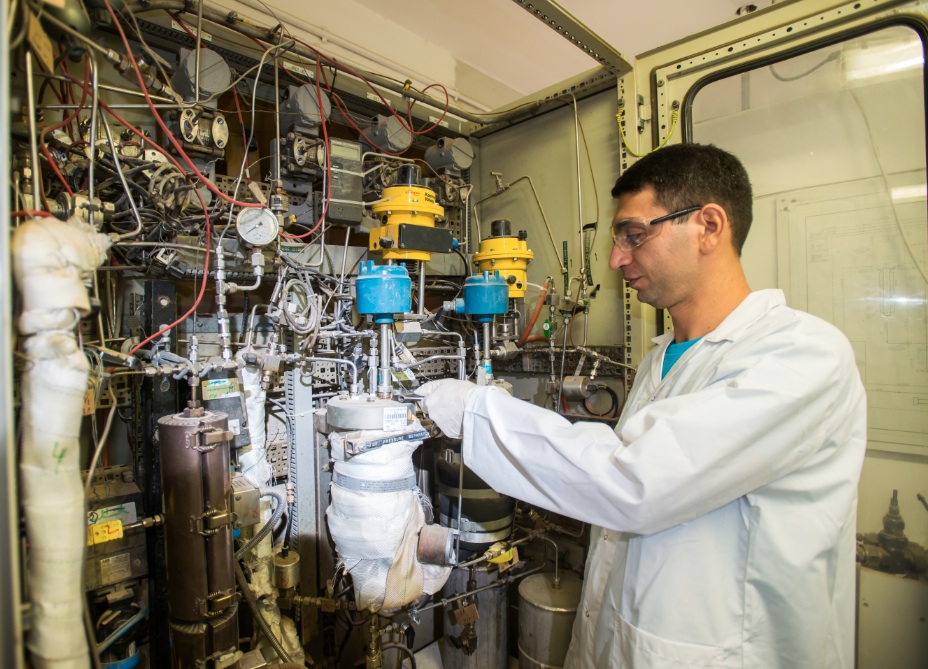
Profs. Moti Herskowitz (above), Miron Landau, Dr. Roxana Vidruk and their team have developed a green feed that can be converted using well-established technologies into liquid fuel and delivered using existing infrastructure to gas stations, Herskowitz tells Green Prophet.
“There is nothing magical about this. The problem here there are many solutions and we will go over that. We are discussing a time frame of 10 to 20 years down the road and the market will decide and the governments will decide which fuels and which kind of transportation modes will be viable,” he tells Green Prophet.
The process Herskowitz has developed operates under low pressure (not dangerous), using standard off the shelf reactor equipment, while the limiting factor is the production of hydrogen. His IP is the catalyst and process in the way that hydrogen and CO2 are reacted to produce hydrocarbons and a water byproduct.
As opposed to other alternative fuel sources, such as electric cars, which require additional infrastructure, this green feed made from water and CO2 would merely replace oil as the input for refineries, he says. Essentially, it could scrub CO2 as a fuel source directly from a power plant.
The process is patent pending, “and we are ready to take off,” demonstrate and commercialize it, asserts Herskowitz. Bench experiments have been conducted and scale-up should be relatively simple, he is sure.
Electrolysis is currently the only method for near-term commercial water splitting, the researchers note. The electricity required for the electrolysis could be produced from renewable sources such as solar or wind energy. Solar-energy based technologies for water splitting are being developed and could become technologically and economically viable on a large scale in the long term.
However, the cost of hydrogen produced by water splitting is still significantly higher than that produced from natural gas.
The researchers turn to ATR (auto-thermal reforming) and gasification technologies that combine other renewable or alternative sources with the oxygen produced from the water splitting. In such technologies, renewable feedstocks, such as bio-gas or biomass, are reacted with oxygen and water to produce a gas mixture containing carbon monoxide, carbon dioxide and hydrogen, known as syngas.
In the near term, the syngas could be replaced by natural gas, which is readily available at many locations at low cost.
In the BGU process, hydrogen produced from water is mixed with carbon dioxide captured from external sources and syngas. This gas mixture is fed into a reactor packed with a nano-structured solid catalyst – also developed at BGU – to produce the green feed, an organic liquid and a gas that contain reactive hydrocarbons.
The catalyst is based on iron, an abundant and low-cost material, but its structure differs from that of the iron catalyst used for the FTS process for conversion of syngas to hydrocarbons. The BGU process, which is designed specifically to facilitate high conversion of CO2, is operated at 300-340°C and 10-20 bars.
It yields over 1 kg of hydrocarbons / kg catalyst/ h, with over 90% CO2 conversion. No deactivation was recorded in runs that were conducted for over 500 h. The selectivity to active hydrocarbons that are converted to liquid fuels exceeded 80%. A patent application has been filed for both the catalyst and the process.
Herskowitz unveiled his revolutionary breakthrough at the Bloomberg Fuel Choices Summit in Tel Aviv in November.
“It is an extraordinary challenge to convert carbon dioxide and hydrogen to green feed,” says Herskowitz, “The technology is based on novel specially tailored catalysts and catalytic processes. Well-established, commercially available technology can be directly applied to the process developed at BGU.
“It is envisaged that the short-term implementation of the process will combine synthetic gas produced from various renewable and alternative sources with carbon dioxide and hydrogen. Since there are no foreseen technological barriers, the new process should become a reality within five to ten years,” he says.
Regarding other alternative fuels, Herskowitz maintains that his invention represents a game-changer. “The liquids that have been used over the past decade are ethanol (alcohol), biodiesel and/or blends of these fuels with conventional fuels, as will continue to be done in the foreseeable future.
“These alternatives are, however, far from ideal, and there is a pressing need for a game-changing approach to produce alternative drop-in liquid transportation fuels by sustainable, technologically viable and environmentally acceptable (in terms of GHG emission) processes from abundant, low-cost, renewable materials,” he says.




[…] Israeli Researchers Make Oil from Greenhouse Gas […]
[…] Israeli Researchers Make Oil from Greenhouse Gas (greenprophet.com) […]