

Green Prophet looks to ancient Iran for some current alternative ideas to electricity-powered air con. Catch the wind with the bagdir wind tower!
The concept of “green building” has taken off in the Middle East over the last few years. The need for ecologically efficient housing and offices is becoming more urgent as the cost of heating and cooling skyrockets and water becomes ever more scarce.

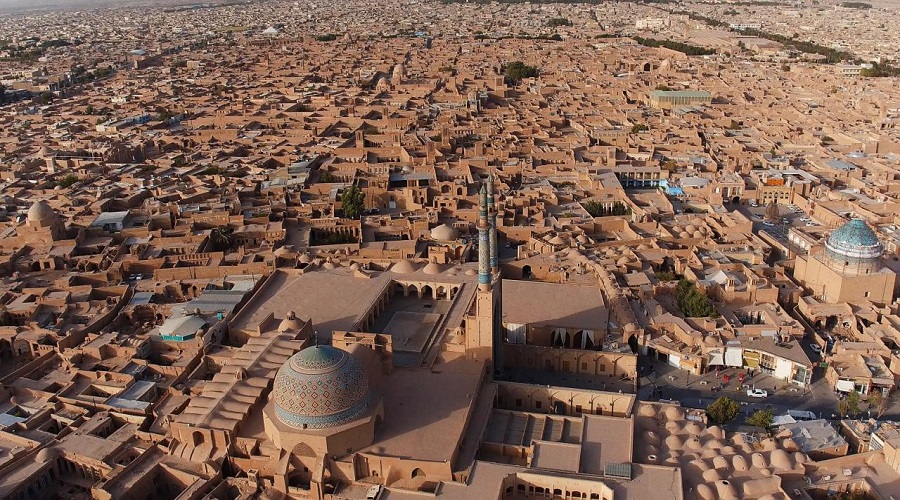
But environmentally-conscious buildings have been around much longer than the modern environmental crisis. Outdating gas-guzzling air con units by generations, bagdirs – or windcatchers – have been cooling down the people of Yazd, Iran, since before the 19th century. These towers spike the skyline of the Iranian desert city like antiquated skyscrapers.

The stone structures channel wind down into a shaft which in turn cools or heats the rooms below, allowing them to remain comfortable all year with zero carbon impact.

As well as using smart technology, the windcatchers of Yazd’s success depends on effort from the building’s inhabitants too. People can reduce their energy use by occupant behaviour strategies, for instance, moving to warmer or cooler rooms throughout the day.

This contrasts to the approach of modern Western design where “the individual chooses the climate for a room:
While nomads in Iran migrate from summer climates, for those who remain in Yazd replace the long migration by a short intra mural migration, within the walls of a single house.

In the summer, when temperatures soar to over 40 degrees C, this means using the ground floor in morning and evening, while escaping to the roof at night – a popular pastime in cities like Tel Aviv. Other strategies include watering floors, wearing lighter or warmer clothes, or – my favourite – taking an afternoon nap in the heat of the day. In Morocco, men are known to sleep on the roofs of the apartments at night to catch the breeze.
How the wind catchers work
Iran is an extreme hot/cold and arid climate. It can get very hot in the daytime sun and then cool down completely at night. Before we had electric sockets and Iran was called Persia, people engineered windcatchers.
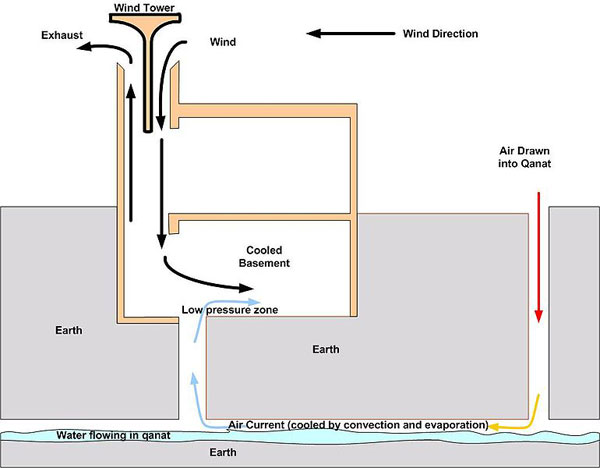
Windcatchers are very much a traditional Persian architectural design that creates natural or passive ventilation in buildings. The basic design illustrated below consists of a tower that emerges from the building below, with openings at the top.
Yazd, one of the largest cities in Iran, and which is home to hundreds of these windcatchers is also known as the City of Windcatchers. Yazd is located between the largest deserts of Iran: Dasht-e-Kavir and Dasht-e-Lut.

Today the tower of Dolat Abad is the tallest existing windcatcher in Iran.
But windcatchers weren’t built by themselves: the city of Yazd has a long network of qanats, or underground channels that bring well water to the surface. When you have a cool breeze running over water you can amplify the cooling effect. My friends in Beersheva, Israel, cool their home with a desert air conditioner which is borrowed from this idea: hot desert air that flows over water to cool the home, not refrigerate it. The modern air conditioners and the stark difference between inside and outside is sometimes unbearable.
How wind catchers work
Windcatchers work in a few ways: The first and most common is to cool the inside of a building. The tower has openings that are facing the wind and trap it inside creating a nice breeze inside the building, much like the way you feel in a wind tunnel between skyscrapers. When used with the qanat, air is pulled down, reaches the water and is drawn up the windcatcher to be dispersed in the building.
When there is no wind, the windcatchers are like a chimney, letting the hot air rise and escape. Ever spend some time in a camper fun in the heat of the summer sun? When the hot air can rise, flow is created and it escapes out of the chimney. Not so much in a camper van.
When built into adobe structures, low level spaces can remain very chill in the hottest parts of the day. And you can still find windcatchers in use in Iran, the Middle East and Persian Gulf.

One of the world’s greatest adobe cities: Yazd.
But the bagdirs of Yazd do have their dark side. Though partly funded by the silk trade, most of the windcatchers owe their existence to local merchants who made their fortunes from the British opium trade to China during the Opium Wars.
More on green Iran:
Iran Creates Biofuel from Algae
Iran and Qatar Align to Help the Environment

Author: Michael Green
Born into a family of auto mechanics and engineers in east London’s urban sprawl, Michael bucked the trend and chose a bicycle instead of a car. A relative newcomer to Jerusalem, he works as a freelance journalist writing for the Jerusalem Post and other publications. Before moving to Israel, he worked for an environmental NGO in England where he developed a healthy obsession with organic vegetables and an aversion to pesticides and GMOs. Michael’s surname is pure coincidence. Michael can be reached at michael (at) greenprophet (dot) com.


Please do something about these argumentative, angry individuals who leave rude-toned messages–as above. Repeated, continuous arguments posted as information by such people are a waste of time for the rest of us. Their mean tone takes away from the information good people exchange worldwide. Simply block them from posting, please. Thank you.
Enjoyed this technology post very much. Thank you.
I’ve seen a few wind catchers built into earthen homes here in the US, but was unaware of their use town-wide. The Iranian 19th century buildings are not only useful but so very beautiful. Here in New Mexico, where the climate is similar to that of the Middle East (dry, desert, sand and little moisture/rain) wind catcher technology would work well. Even though adobe was the mode of construction for centuries, I’ve never seen a single one incorporated into the any building. Like most homes using up energy is today’s choice, ugh. The swamp cooler is the technology most people use, as noted in an earlier post. It works on the same principle of evaporation but is such a waste when the Earth could provide the same solution. Oh well…
You try and write and article without learning the name of the thing you are trying to learn. Switched off at title. Shoddy
This is really amazing. I used to live near Joshua Tree out in the California desert where swamp(evaporative) coolers and air conditioning were most common, this ancient technology if used properly out there would work well, I bet, especially in very windy areas like the village of Morongo Valley where I also had a house.
I knew someone who said his electric bill was around $500 US a month with a/c, I remember using my swamp cooler, paying around $60 US, just imagine if I had an adobe or rammed earth type house with a bagdir built in! Probably close to zero 😉
My apologies if I misspelled that.
Thanks very much for this post!
The Yazdi shul in Jerusalem is very beautiful, and I wouldn’t be surprised if it has elements of this architecture in it. It’s quite famous in Israel…
4000 B.C. is correct.
“cooling down the people of Yadz, Iran, since the 19th Century” ?!!
Badgir (not bagdir)has long history. In 1969 Masouda found old cooling systems in north of Shahroud in north-east of Iran, which showed that some old types of Badgir was used in 4000 years ago in that region. But the Badgirs of Yazd (not Yadz, Rouben is right)are also quite old. There are existing Badgirs in Yazd that are built in 14th century and are still working.
There are Badgirs, which are built by Persian immigrants to Dubai and Bahrain in those lands in 19th and 20th centuries.
it is famous no famouse. hope you got it F A M O U S.
thanks for the correction, you can save the arrogance for elsewhere.
It is YAZD…. not Yadz,……
YAZD, most famous for cats,…. yes most fancy in the world, and the month watering sweets, the most loving population, will never forget, they have loving hearts, will never forget my visits of YAZD, hope you got it, its Y A Z D
sorry, its its “BADGIR” not bagdir, that means …wind catcher, I have done study on those at the city of “YAZD” most famouse for the fancy extra ordinary cats in the world,.. the badgirs work like a natural air conditioners with no cost, they collect the air movement from all sides, as an arch./eng. let me tell you, it works, you can not beleive, unless experience once…. “Badgir” catch the breeze