
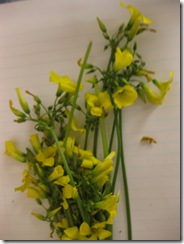
 I’d always admired people who eat wild vegetables. No water gets pumped and no gas is drilled to get those plants to the market. But as an immigrant without a horticultural bent, I needed guidance. Fortunately I had expert teachers: Green Prophet’s own Miriam Kresh, and Sarah Melamed, who writes Foodbridge. Miriam has taught me about both wild and cultivated plants over the years, and I recently went on a nature hike with both Sarah and Miriam.
I finally feel confident enough to identify some plants that I can collect and eat.
Today I’ll share five easily available, edible plants. In Israel, look in any green spot a lawnmower won’t reach.
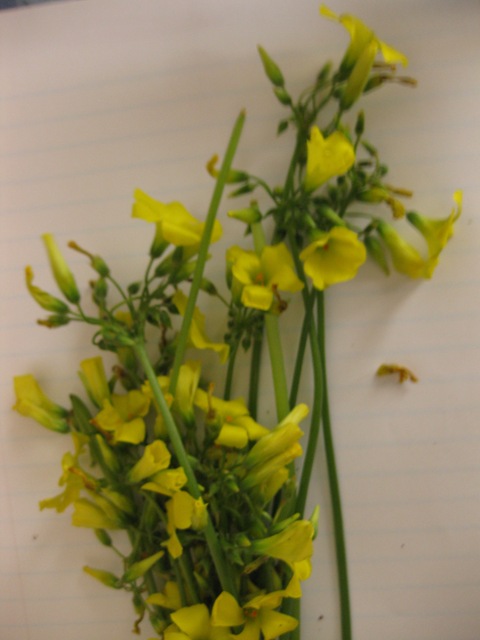
My children, being natives, have known about the one above for a long time. It’s called a chamtzutz or a chamtzitz, and the long stems are tangy and juicy. In English it’s known as cape sorrel.

Hubeiza, or Mallows
This dark green one on the right is called hibeza, or mallow in English. My first-grader learned in school to describe it as “palm-shaped.” Chop it, stems and all, for soup, or if you want, stuff large leaves with meat or rice. It has a mild flavor.
All wild plants need to be washed and examined carefully for dirt and insects.
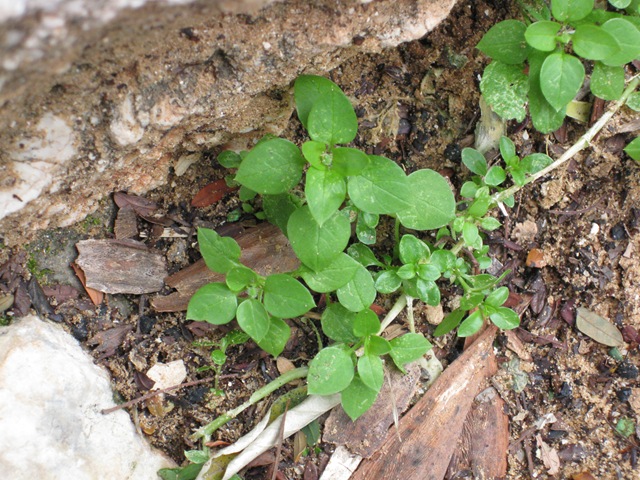
The small, spade-shaped leaves on the left are chickweed. They add a salty flavor to salad. Here Miriam explains how to cultivate and use chickweed.
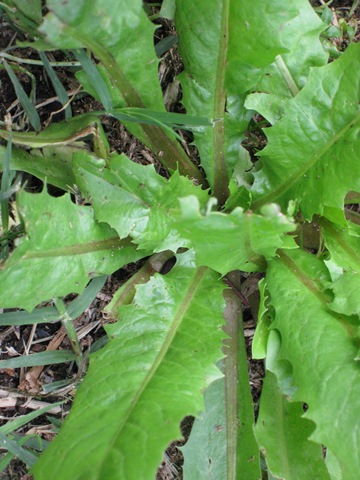
The long, spindly leaves on the right are olesh, or chicory. There are many similar plants so it’s hard to be sure, but Miriam ssured me I won’t get poisoned if I pick the wrong one (at least in this case). They taste slightly bitter raw. Check out her recipe for chicory sauteed with onions.
This last one is my favorite: Sirpad, or nettle. Its thin thorns make it hard to handle so I protected my hands with a bag. The ones in the picture below are full of insect holes, so I left them alone. In the center, you can see the early buds. Pick nettles before the flowers are brown and dry. At home, use gloves to separate the leaves from the thick center stem. After soaking and checking for bugs nettles are a tasty addition to a vegetable or meaty broth, and my kids agreed. You can also chop them to add to any recipe including soup, casseroles, or grains.
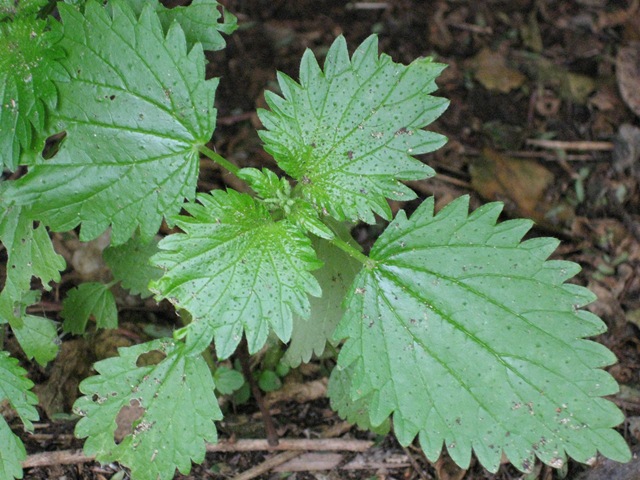
Wild Nettles
See more great posts on Green Prophet by Hannah Katsman:
Twelve Tips for Saving Water in the Kitchen.
Ten Common Misconceptions about Breastfeeding Your Baby
Hannah’s website on frugal cooking can be found at CookingManager.Com

Author: Hannah Katsman
Hannah learned environmentalism from her mother, a conservationist before it was in style. Once a burglar tried to enter their home in Cincinnati after noticing the darkened windows (covered with blankets for insulation) and the snow-covered car in the driveway. Mom always set the thermostat for 62 degrees Fahrenheit (17 Celsius) — 3 degrees lower than recommended by President Nixon — because “the thermostat is in the dining room, but the stove’s pilot light keeps the kitchen warmer.” Her mother would still have preferred today’s gas-saving pilotless stoves. Hannah studied English in college and education in graduate school, and arrived in Petach Tikva in 1990 with her husband and oldest child. Her mother died suddenly six weeks after Hannah arrived and six weeks before the first Gulf War, and Hannah stayed anyway. She has taught English but her passion is parental education and support, especially breastfeeding. She recently began a new blog about energy- and time-efficient meal preparation called CookingManager.Com. You can find her thoughts on parenting, breastfeeding, Israeli living and women in Judaism at A Mother in Israel. Hannah can be reached at hannahk (at) greenprophet (dot) com.
I really like eating stuffs like these….very healthy and best of all it's natural.
Thanks, Nola!
I'm so excited to find this Website. I just arrived in Israel (again). Previously in the summertime, I had been picking edible “weeds” out of my backyard in Iowa and eating them. I left some books about wild edibles in Iowa because I wasn't sure they would be applicable here. This Website will help, I'm sure. Thank you!
Thanks, Yael. You'll get there eventually, one plant at a time.
Thanks, Yael. You'll get there eventually, one plant at a time.
Edible weeds are wonderful, pity they aren't around all year long. I especially love hubeiza and nettle,with the other ones I am never really sure if it's the right one. Yes,Miriam does have a wonderul knowledge of edible wild weeds and so does Sarah.