Make Mansaf, a Bedouin rice dish

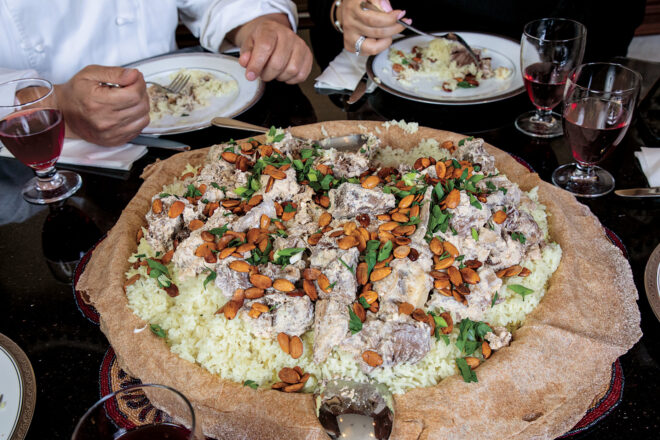
mansaf recipe, plate of Jordanian national dish

Our continued investigation into  sustainable Middle Eastern food focuses on Mansaf, the Jordanian national dish.

Regional cuisines evolve from foods that are available locally and in season. Eating this way implies sustainability from the very source, in addition to fair conditions for workers and mindful stewardship of natural resources.

When it comes to the delicious cuisines of Arabic countries, sustainable food often goes back to lamb. Hardy enough to thrive in the Middle Eastern climate, sheep were probably first domesticated here.

The taste for lamb remains a lively element in Arabic cuisine, although today many Arab countries import much of their lamb and mutton. See our post on fat-tailed sheep and their importance to Arabic cuisine. Another sustainable factor in sheep’s meat is the relatively small size of the animal, which makes a feast with no leftover waste.

Mansaf, which many consider the Jordanian national dish, perfected by Bedouin, traditionally nomadic people, is lamb cooked in jameed, or dried labneh (see our labneh recipe here).

Jameed is another example of using natural resources wisely. When there’s a surplus of milk, labneh is made, dehydrated by salting and straining it, hand-rolled into balls and allowed to dry until hard. It’s used to thicken sauces and flavor foods by re-hydrating. However, the recipe below uses fresh yogurt instead of jameed.

Mansaf, Jordanian Lamb Stew Recipe

serves 8-10

Ingredients

2 kilos lamb, preferably with bones, cut into thick pieces

2 cups yogurt

1 large onion, chopped

1 egg white, beaten with a fork until frothy

2 teaspoons corn flour

¼ cup clarified butter

¼ cup pine nuts

¼ cup slivered almonds

water

salt

freshly ground pepper

1½ teaspoons turmeric

½ teaspoon allspice

1 small piece cinnamon bark

3 cups basmati rice, rinsed

Method for making mansaf

Place yogurt in a heavy-based pan.

Add yogurt, frothy egg white, corn flour and 2-teaspoon salt to pan and stir gently just enough to blend.  It is very important to use a wooden ladle and to stir in the same direction.  So, if you stir to the left, you must continue stirring the yogurt mixture to the left throughout the whole cooking process.  Otherwise, the yogurt will curdle.

Place pan over medium heat and stir constantly with wooden ladle.  Heat the yogurt mixture until it begins to boil, stirring continuously in the same direction.  Lower the heat and leave to boil gently, uncovered, for 3-5 minutes until thick.

Place lamb in a pan and cover with cold water. Bring slowly to boil. Skim the surface to remove particles. When well skimmed and boiling, add salt and paper to taste. Cover and boil gently for 30 minutes.

Heat butter in frying pan and add pine nuts and almonds. Fry until golden and remove pine nuts to a plate, draining butter back into the pan.

Add onion to pan and fry gently until transparent. Stir in turmeric, allspice and cinnamon bark and cook for another 2 minutes. Add this mixture to the boiling lamb.

After lamb has been cooking for 1 hour, remove lid and let liquid reduce until it only half-covers lamb.

When reduced, add yogurt sauce, shaking pan to blend it with liquid. Let the mixture boil gently on low heat until lamb is tender and sauce is thick.

In the meantime, prepare the rice as directed on package.

Once rice is cooked, remove it from pot and place it in a large round serving platter, then spread half of the nuts on top of rice.

When lamb is done, remove the meat chunks with a slotted spoon and place on top of rice and nuts platter.  Then sprinkle the remaining nuts over entire platter.

Place the cooked yogurt in a large serving bowl.

Serve, and enjoy!

More on sustainable Middle Eastern foods:

Saudi Arabian Recipe: Chicken and Rice Kabsa

Eat The Whole Animal: Lamb’s Testicles

Classic Kibbeh

Camel’s Milk

Above image via the NY Times

Miriam Kresh
Miriam Kreshhttps://www.greenprophet.com/
Miriam Kresh is an American ex-pat living in Israel. Her love of Middle Eastern food evolved from close friendships with enthusiastic Moroccan, Tunisian and Turkish home cooks. She owns too many cookbooks and is always planning the next meal. Miriam can be reached at miriam (at) greenprophet (dot) com.

Read More

1 COMMENT

TRENDING

What’s in season in June – plus recipes and forager’s notes

Middle Eastern markets are bursting with the color and aromas of summer's soft fruits. This is the guide to getting the most out of June. 

Jailhouse Booze For Home Bootleggers

You don’t have to languish in jail to make Jailhouse Booze. It’s an easy, fun project you can make in your own kitchen, with fruit juice. Old-time jailbirds used to call it Pruno. We also have another, no-waste, alternative wine recipe: Pea Pod Wine.

Make Guarapo De Piña (it’s fermented pineapple juice)

In Cuba, guarapo is simply freshly-pressed sugar cane juice, and is drunk on the spot, without waiting for it to ferment. But in Colombia, Venezuela, Peru and Mexico, they homebrew guarapo from pineapples or oranges, and the fragrant fluid sits on the kitchen counter top to ferment until it's bubbly.

Bake a New York Cheesecake for Shavuot

This light, creamy cheesecake fits into your green Shavuot, especially if you make it with organic cheese and eggs. It's also light on sugar.

Baby teeth read like tree rings paint a picture of toxins in early life

A new study from the Icahn School of Medicine at Mount Sinai in New York offers a striking insight into how the environments we are born into can quietly shape our brains years later. By analyzing naturally shed baby teeth, the ones tucked under pillows for the tooth fairy, researchers have reconstructed a detailed timeline of exposure to environmental metals during pregnancy and early infancy.

Locals From Rishon Fight IKEA

Big Box stores are a pretty new concept in Israel, and thank God that not every Israeli city wants them in their backyard. A word from someone who has see the beautiful farmland around her hometown Newmarket, Ontario stripped and converted into vulgar strip malls of big box shops: they have no place in a healthy and sustainable town or city.

The Jewish National Fund Meets An Inconvenient Truth

According to the JNF, it has transformed thousands of acres of barren land into green forests in Israel. They state that each person emits about 23 tons of carbon per year, estimating that each tree planted can absorb one ton of carbon in its lifetime. That's a whole lot of trees you'd need to be planting. Could so many fit in Israel?

How to quiet noise from construction in your office

Streets need to be resurfaced in New York but the humming and grinding noise is unsettling. Noise is environmental pollution. 

EarthX and a blueprint for sustainable investing

Trammell S. Crow, a Dallas-based businessman and father of four, is focusing his efforts on impact investing, and media that focuses on saving the planet through EarthX.

Mining Afghanistan’s Mineral Discoveries Similar to Avatar

Now that American forces in Afghanistan are commemorating the longest period of any war that America has been involved in, including the 1965-73 Vietnam War, the recent discoveries of large and extremely valuable mineral and metal deposits may finally bring to light a reason to continue the presence of US fighting forces in this war torn and backward country.

From Pilot Plant to Global Stage: How Aduro Clean Technologies’ 2026 Expansion Signals a Turning Point for Chemical Recycling Investors Like Yazan Al Homsi

The company's Next Generation Process (NGP) Pilot Plant in London, Ontario, has officially moved into initial operating campaigns, generating the kind of structured, repeatable data that separates laboratory promise from commercial viability.

Nobul’s Regan McGee on Shareholder Value: “Complacency Is the Silent Killer” 

Why the governance framework designed to protect shareholders so...

Should You Invest in the Private Market?

startustartup Unlike public stock exchanges, which offer daily trading, strict...

Popular Categories