Bureaucracy Slows Israel’s Solar Energy Progress

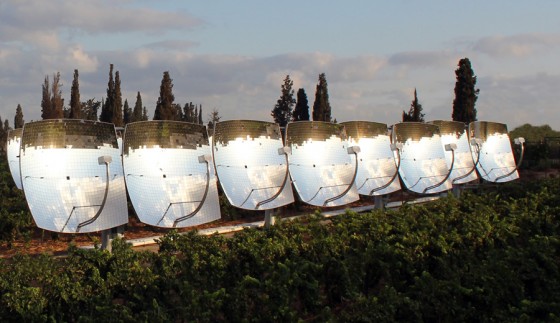
israel solar panel mirrors

Israel’s research labs such as National Solar Energy Center,  Grand Technion Energy Program (GTEP) and companies such as Zenith Solar and Arava Power Systems are developing advanced solar energy technology which is nearly cost-competitive with fossil fuels.  Israel’s solar technology has been used in places as far away as Australia and China.   Combine this with the fact that about 60 percent of Israel is a desert averaging more than 9 hours of sunshine per day and Israel’s solar energy industry should have a bright future.  But as of 2011 Israel had only installed 190 Megawatts of peak photovoltaic power generation capacity.  This is about 3 photovoltaic watts per person.  This places Israel at the top of the MENA countries, well ahead of Turkey which only has 0.1 peak photovoltaic watts installed per capita.  But outside of MENA, 19 countries exceed Israel’s photovoltaic generating capacity.  This surprising list includes such cloudy northern places as Canada with twice and Germany with 60 times Israel’s per capita photovoltaic capacity.

So what’s the problem?

Some solar power advocates claim that the reason for Israeli solar’s failure to thrive is that Israel’s government doesn’t do enough to encourage solar energy or that government bureaucracy actually discourages photovoltaic installations.  Israel’s Public Utility Authority (PUA) introduced feed-in tariffs in 2008 in an effort to encourage solar energy deployments.  Feed-in tariffs are intended to compensate for high start-up and KWh production costs so that solar can compete with legacy energy generation technologies.  Feed-in tariffs have allowed green alternative energy systems to compete with legacy technology in Israel and elsewhere.

But the tariffs introduce a level of bureaucratic complexity to solar installations.  Solar utilities can’t afford to ignore the tariffs that their competitors are benefiting from.  PUA’s scheme limits residential feed-in tariffs to 15KWp and commercial feed-in tariffs to 50KWp with a 50MW total installation limit for the first 7 years.  Residential and large scale commercial solar companies are competing for licenses which entitle them to a slice of this pie.

But now that photovoltaics have dropped as low as $1/Watt, PUE is considering  reducing feed-in tariffs by up to 34% from last year to 65 agorot per kilowatt hour.  This move is intended to save ratepayers NIS 2 billion which would otherwise become windfall profits for solar utilities.

In a Jerusalem Post article published early last month, Arava Power Company CEO Jon Cohen said that such low feed-in tariffs would cause Israel’s green energy possibilities to “slip between our fingers.”  He went on to say that  because of this policy, Eliat’s generators would continue to burn diesel during times of peak demand at a cost that exceeds the feed-in tariff.

Photo of solar energy collectors from Zenith Solar

Brian Nitz
Brian Nitzhttp://www.greenprophet.com
Brian remembers when a single tear dredged up a nation's guilt. The tear belonged to an Italian-American actor known as Iron-Eyes Cody, the guilt was displaced from centuries of Native American mistreatment and redirected into a new environmental awareness. A 10-year-old Brian wondered, 'What are they... No, what are we doing to this country?' From a family of engineers, farmers and tinkerers Brian's father was a physics teacher. He remembers the day his father drove up to watch a coal power plant's new scrubbers turn smoke from dirty grey-back to steamy white. Surely technology would solve every problem. But then he noticed that breathing was difficult when the wind blew a certain way. While sailing, he often saw a yellow-brown line on the horizon. The stars were beginning to disappear. Gas mileage peaked when Reagan was still president. Solar panels installed in the 1970s were torn from roofs as they were no longer cost-effective to maintain. Racism, public policy and low oil prices transformed suburban life and cities began to sprawl out and absorb farmland. Brian only began to understand the root causes of "doughnut cities" when he moved to Ireland in 2001 and watched history repeat itself. Brian doesn't think environmentalism is 'rocket science', but understanding how to apply it within a society requires wisdom and education. In his travels through Europe, North America, Asia and the Middle East, Brian has learned that great ideas come from everywhere and that sharing mistakes is just as important as sharing ideas.

Read More

TRENDING

Dan Zaslavsky’s energy tower dream is rising again in Iran and China

The Energy Tower idea never made the leap from drawings and engineering studies to full-scale construction. But nearly two decades after most people stopped talking about it, the concept is quietly evolving in two unexpected places: China and Iran. The concept let dreamers dream and doers do - figuring out more pleasing designs and engineering.

A visit to Amirim, Israel’s first all-vegetarian village in the Galilee

Just 15 kilometers from Tzfat there is a moshav that was founded in the late 50s that was ideologically influenced by organic, vegetarian and vegan principles. My hostess at Ohn-Bar, the tzimmer where I stayed, explained that the people of Amirim were among the pioneers of Israel’s strong vegetarian movement.

Israeli Hydrogen Startup H2Pro Are Trying to Solve Clean Energy’s Hardest Problem

The company has attracted backing from major investors including Breakthrough Energy Ventures, the climate fund founded by Bill Gates, along with industrial partners such as Sumitomo, ArcelorMittal, and Temasek, a multi-billion dollar company that owns Singapore airlines. H2Pro has raised more than $100 million USD and is moving from pilot projects toward commercial-scale deployments.

Desalination experts debunk Aqua Solaire, the floating desalination barge

AI makes it easy to dream, develop, and create images of what could be world-changing ideas, until the reality sets in. A new project making the rounds is Aqua Solaire, an allged French concept for a solar-powered desalination vessel designed to bring drinking water to coastal communities facing drought, storms, and infrastructure failures.

AI data centers are triggering panic, instead of cleantech opportunities

AI may unintentionally become the economic engine that finally modernizes America’s aging grid. California is experiencing a massive AI data center boom, ranking 3rd in the U.S. with 227 operating centers and 54 more in development as of April 2026, according to Stanford.

Locals From Rishon Fight IKEA

Big Box stores are a pretty new concept in Israel, and thank God that not every Israeli city wants them in their backyard. A word from someone who has see the beautiful farmland around her hometown Newmarket, Ontario stripped and converted into vulgar strip malls of big box shops: they have no place in a healthy and sustainable town or city.

The Jewish National Fund Meets An Inconvenient Truth

According to the JNF, it has transformed thousands of acres of barren land into green forests in Israel. They state that each person emits about 23 tons of carbon per year, estimating that each tree planted can absorb one ton of carbon in its lifetime. That's a whole lot of trees you'd need to be planting. Could so many fit in Israel?

How to quiet noise from construction in your office

Streets need to be resurfaced in New York but the humming and grinding noise is unsettling. Noise is environmental pollution. 

EarthX and a blueprint for sustainable investing

Trammell S. Crow, a Dallas-based businessman and father of four, is focusing his efforts on impact investing, and media that focuses on saving the planet through EarthX.

Mining Afghanistan’s Mineral Discoveries Similar to Avatar

Now that American forces in Afghanistan are commemorating the longest period of any war that America has been involved in, including the 1965-73 Vietnam War, the recent discoveries of large and extremely valuable mineral and metal deposits may finally bring to light a reason to continue the presence of US fighting forces in this war torn and backward country.

From Pilot Plant to Global Stage: How Aduro Clean Technologies’ 2026 Expansion Signals a Turning Point for Chemical Recycling Investors Like Yazan Al Homsi

The company's Next Generation Process (NGP) Pilot Plant in London, Ontario, has officially moved into initial operating campaigns, generating the kind of structured, repeatable data that separates laboratory promise from commercial viability.

Nobul’s Regan McGee on Shareholder Value: “Complacency Is the Silent Killer” 

Why the governance framework designed to protect shareholders so...

Should You Invest in the Private Market?

startustartup Unlike public stock exchanges, which offer daily trading, strict...

Popular Categories