
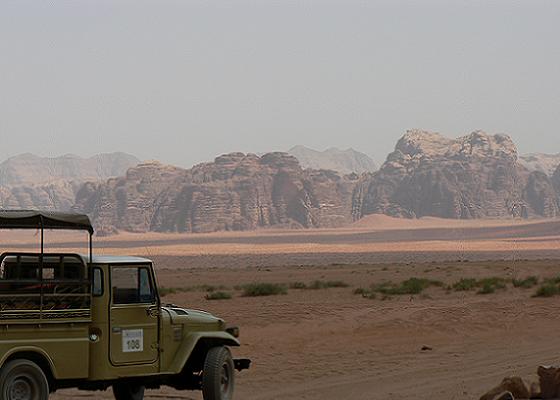
 Can Wadi Rum cope with a predicted influx of tourists attracted by its World Heritage status?
In June, the Jordanian desert valley of Wadi Rum joined the UNESCO World Heritage List, with a decision which has been much predicted since the end of 2010. According to Green Prophet’s Tafline Laylin, writing in September 2010, UNESCO certification would “ease the task to sustainably manage both the cultural and natural beauty that makes this site such a strong candidate for the United Nations’ esteemed recognition”.
With the certification finally announced in summer 2011, Jordanian Minister of Tourism and Antiquities, Haifa Abu Ghazaleh told The Jordan Times newspaper that “This win is considered as a recognition for Jordan and its heritage, and will have a great impact on the country’s tourism sector”.
Wadi Rum is Jordan’s fourth UNESCO World Heritage listed site, along with the spectacular pink stone city of Petra, built by the Nabateans; the Byzantine site of Um Rasas, and the Umayyad-era desert palace at Quseir Amra. Abu Ghazaleh also told The Jordan Times that Jordan would be campaigning for the Dead Sea to be named as one of the New Seven Wonders of Nature.
Ibrahim Osta, head of the USAID-funded tourism development project Sihaya, added that ““This ranking will further raise the profile of Wadi Rum globally which will attract higher value visitors and improve the livelihoods of local residents”.
But some concerns have been raised over the possible impacts of the UNESCO certification on Wadi Rum’s natural beauty, local Bedouin communities, wildlife, which includes the rare Arabian Oryx, and archaeological remains which date back to prehistoric times.
In a guest post on the website of Matthew Teller, a British journalist who specialises in the tourism of Jordan and the wider Middle East, author Tony Howard of Nomads Travel noted that Wadi Rum’s World Heritage status was well-deserved and “a long time coming”.
But, continued Howard, many in Jordan are concerned that the potential rise in tourist figures that the certification might bring about could overwhelm the existing facilities. Indeed, commented Howard and many of those who joined the discussion on Teller’s website, local Bedouin villages have already mushroomed, with tourist camps also springing up around the valley, some of them not run by local Bedouin at all.
Numbers of well-informed local guides were said already to be insufficient to meet demand, and existing tourism facilities in the valley were said to have been poorly designed and not in keeping with the way in which local Bedouin who worked with tourists had previously operated. Other commentators familiar with Wadi Rum also noted that even at current tourism levels, environmental impacts such as litter were not being kept under control.
“Let us hope that those who undertake this task will work fully with the local people to understand their needs – and the needs of all types of tourists”, Howard concluded.
Read more about eco-tourism in Jordan
Jordan Gets A New UNESCO-Protected Pit Stop
Trees In Jordan’s Ajloun Forest Still At Risk
Jordan Dana Biosphere Reserve Kicks Out Kerosene

Author: Sarah Irving
Sarah Irving has spent much of the last decade writing about environmental and social issues, travel, and the Middle East, as a staffer at Ethical Consumer magazine and more recently as a freelancer. Her work has appeared in New Internationalist, Guardian Online, The Big Issue and many other publications, and she is a correspondent for Electronic Intifada. Her first book, Gaza: Beneath the Bombs, was published by Pluto Press in 2010 and her new version of the Bradt travel guide to Palestine will be out in late 2011. She can be reached at [email protected]


“which will attract higher value visitors”??? not sure what they meant and honestly hope it s a not so well translated arabic to english situation.well if you want Wadi Rum to remain a wonder and top of the tourist attraction but still maintain it s pristine beauty and feel then one needs to make sure no luxury hotels ,malls or anything alike of the fancy industrial tourism gets in there . it s a pure contrast to the idea of a desert and if anyone s looking for luxury under the stars they can do that just 5 km away from Aqaba . i ve had better conditions in Wadi rum than in some hostels in Petra /Wadi Musa .So really do not really understand what type of tourists and their expectations we re discussing here. I ve just been in the Moroccan Sahara recently and can tell you that facilities there arent necessarily a joy , at least the part i ve seen but again … it s the desert .Marketing campaingns and security in the region is what will keep tourist coming to enjoy the experience of overnight camping in the desert .Of course , tourist education is also needed. i ve seen locals do the cleaning for the not so environmentally educated tourists out there which is a shame .it s the bedouin s home. maybe the local police should fine anyone for being caught leaving their rubbish behind eg plastic bags and pets ..just as your re asked to pick you re asked to pick your dog s poop in the city , i dont see why it should be different . and in all honesty the dog poop is not such a big threat to the environment ..and just as other countries did – just ban plastic bags and bottles altogether and introduce better prices for mobile refrigerators. the plastic bottles can be replaced with a lot of things – even paper ones – it works for coffee doesnt it ?.
Elaine: I’m hoping to have just that experience in a couple of months! Any pointers?
One of my most memorable expertinces in my life was sleeping out in the desert at Wadi Rum. Not at a touristy place but out on the sand at the foot of one of those big mountains. In the morning the sun coming up was unbelievably beautiful. And prior at night we could see more stars than we had ever seen before. Love loved it!!!