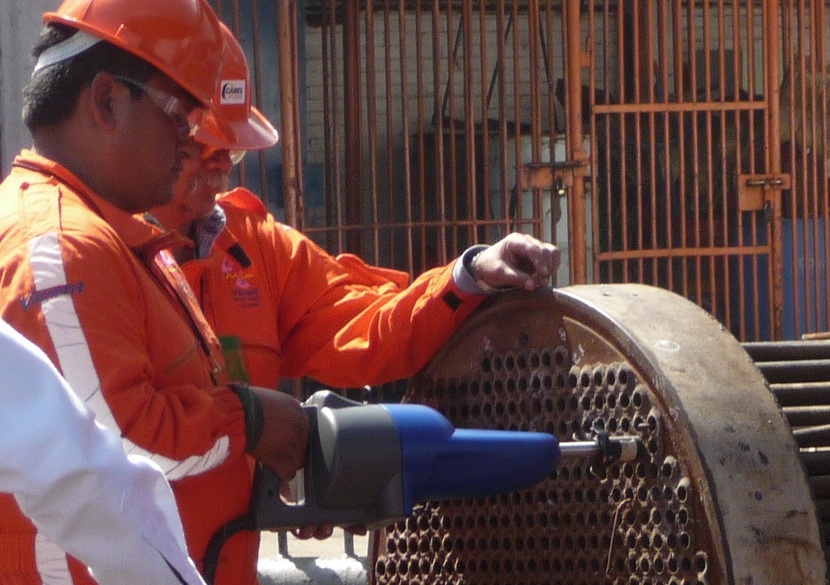
 Rusted, blocked or leaky pipes? An AcousticEye can see inside pipes for swift repair.
What drives an engineer to spend sleepless nights devising solutions to life’s twisted problems? Engineer Tal Pechter, CEO at AcousticEye, transformed his kitchen into a laboratory and his body into a test specimen in his quest for a method to detect holes and blockages in pipes. His obsession evolved from his work at two seemingly unrelated places – Israel Aircraft Industries and prior to that, a sleep apnea startup.
Focused on ‘tubes’ in both jobs, Pechter was convinced that there had to be better methods to locate leaks and blockages in airplane pipes and blockages in a person’s airways, than those currently in use. In fact, there are far more similarities between Pechter’s two jobs than one might think. For example, systems within an aircraft, built with tubes and pipes, parallel the respiratory tract, circulatory and digestive systems in the human body.
[youtube]http://www.youtube.com/watch?v=QceFZl-9d2c&feature=player_embedded[/youtube]
If something goes wrong in an aircraft’s hydraulics system, fuel system or air pressure chambers (all of which involve pipes and tubes), aircraft technicians need to cut through and operate on the whole system. “There is a huge problem in finding the exact location without traversing all the tubes, so the attitude is: If it works don’t touch it. We don’t want to open panels and dig through the entire aircraft,” Pechter explains to ISRAEL21c.
Finding the source of a problem is thus a daunting task that can cost incredible amounts of man-hours and money. It’s also very frustrating for engineers when it is so difficult to diagnose problems which may need only minor repairs.
The same type of frustration is associated with attempting to locate the underlying causes of sleep apnea. With a person already suffering from interrupted sleep, here, too, ‘technicians’ are searching for non-invasive ways to detect the source of a problem. In sleep apnea – a phenomenon that disturbs a person’s sleep up to hundreds of times a night, and which is also associated with snoring – sleep physiologists need to locate the blockage in the ‘pipes’ and fix it, to help a person to sleep easy.
Sleepless nights produce a tube inspection technology
These problems kept Pechter plugging away in his night kitchen lab. He combed the research to discover how holes and blockages in pipes might be ‘seen’ in a non-invasive way. No solution he found seemed to fit until, in 2005, he came across the research of Noam Amir, a young Israeli working on his PhD. Their collaboration led to the creation of AcousticEye, a company that’s seen a $7 million investment, and whose clients include General Electric in the US.
Based in Holland, with its R&D located in Israel, AcousticEye has developed the AcousticEye Eyesight, a tube inspection technology that non-invasively peers into tubes large and small and diagnoses blockages, pinholes, corrosion and irregularities that company engineers should be aware of. And according to Pechter, it does this faster than any solution on the market. Already in use in power plants and in the chemical industry, the company (which plans to break even by 2011) offers a tailor-made testing device that uses optical waves to find problems in any kind of pipe or tube.
The tube inspection device resembles a large hand drill shaped like a dolphin’s head. The optical sensor is a metal tube, protruding from the dolphin’s ‘mouth.’ The sensor sends optical waves coupled with special algorithms in a software solution that quickly detects and diagnoses irregularities in the pipes.
It is so difficult to locate the source of a problem in the twists and turns of the systems in power plants that operators tend to forego routine inspection and repair, Pechter claims. They spend time cleaning, but few resources are allotted to diagnosing deposits in the system, a major factor contributing to efficiency loss.
Scale, marine algae, sea life, you name it – “Everything can get deposited inside these tubes,” says Pechter, adding that according to what he’s seen, not one of the existing technologies can tell you whether or not the pipes are clean.
A core technology based on sound waves
AcousticEye’s core technology is called Acoustic Pulse Reflectometry (APR). It sends out sound waves and measures the Doppler Effect that reflects back to the inspection device. It can work on tiny pipes, large ones, those that are curved, bent, straight, made from plastic, metal, or virtually any material, says Pechter.
He tells ISRAEL21c about a recent job at a power plant, where with AcousticEye the operator learned how 15 percent of the energy that the plant was losing could be saved, simply by performing a routine inspection.
“Other technologies are subjective,” says Pechter. “You need to be an expert to understand them. Ours is easy to use, creates results faster – in about nine seconds per tube.” He estimates this is about 10 to 20 times faster than ultrasound, water jet solutions, magnetic field measurement-based devices and endoscopes, none of which are viable solutions in many situations.
With 20 employees, AcousticEye currently has contracts with GE Energy and Hydrochem in the US, and with IST, a Canadian firm that welds pipes for the power plant industry. Other clients worldwide include Rico in the UK and HiTech, in India. In Israel, they include the geothermal clean tech giant Ormat, with headquarters in the US, and the Israel Electric Corporation.
A boon for the world’s GNP
With a current special focus on heat exchangers, Pechter boasts that the solution is ‘green’ and could potentially affect the world’s GNP. Explaining this seemingly grandiose claim, he says that power plants, oil refineries and chemical industries all use heat exchangers and that, “Good maintenance of the heat exchanger adds to greening the world.
“Chemical and thermal exchangers are the heart of the power industry, and are in each and every power plant,” says Pechter, who holds a first and second degree in engineering, as well as an MBA. One side of the heat exchanger is the hot side with the boiler, while on the other side there’s a condenser that turns hot vapor into water to create a pressure drop. The efficiency of these boilers and condensers affects the price of the energy that is transported to our homes. Every percentage point of energy lost jacks up the prices we pay for power and increases the number of greenhouse gases in the atmosphere.
“People don’t invest money in cleaning heat exchangers and the tests are too expensive,” says Pechter. He relates that other solutions require highly trained individuals using probes such as endoscopes, magnetism, or ultrasound detection – all techniques that are both more time-consuming and expensive. The AcousticEye, says Pechter can be used by an untrained welder or maintenance worker, who can not only diagnose problems in operating systems, but also on the fly, as tubes and pipes are being welded together.
“This is the only tool on the market that can measure deposits in the heat exchangers. And the efficiency problem in heat exchangers affects one-quarter of one percent of the worldwide Gross National Product. Good maintenance of heat conductors can save money,” he asserts.
Pechter forecasts additional applications in avoiding potentially disastrous chemical leaks and in the field of medical diagnostics, but stresses that here and now the focus is on saving energy.
(This story first appeared on ISRAEL21c – www.israel21c.org)