

Dubai’s mega developmental projects, including several artificial islands complexes, are beginning to cause a number of environmental concerns.
The artificial islands, which when completed will contain large numbers of residential and commercial properties (including vacation resorts) are already having their effect on marine life in the Persian Gulf.
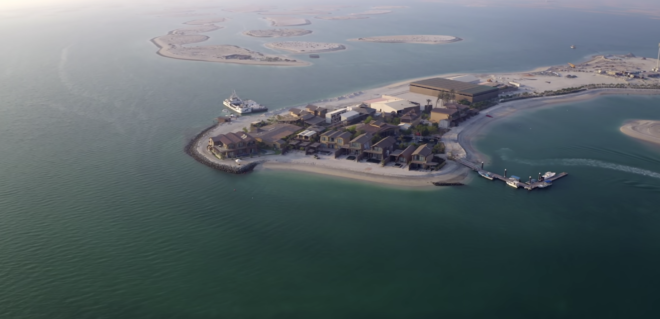
One particular project, The World, encompasses three palm shaped artificial islands which are nearing completion. Shaped to resemble a miniature of the world’s major land masses, the islands range in size from 5 to 20 acres (2 to 8 hectares), and many of the islands are only separated by 50 – 100 meters of water.
Notwithstanding the damage done during the actual construction process (when millions of tons of rock and other debris were used to create them) the man-made, unnatural islands are a serious threat to natural coral formations as well as beds of kelp and other sea weed where aquatic life would normally live and feed.
The construction process has literally buried many of these habitants under layers of silt, severely clouding the normally crystal clear Gulf waters.
Developers of the projects plan to construct a number of artificial reefs to attract marine life, including bringing a number of old ships and sinking them. While this method has proven to be successful in other places, many environmentalists fear that creating artificial sea beds will discourage native marine life and result in the introduction of foreign species that may take over and even be destructive.
Video of empty manmade islands
The Gulf’s coral reefs, especially in the area of the Emirate states, have been in a steady decline during the past 50 years, and were certainly not helped in the 1991 Gulf War, when millions of gallons of crude oil leaked into the waters when many Kuwaiti oil wells were set afire by departing Iraqi military forces.
The delicate eco-system of coral reefs, mangrove coastal areas and sea grass habitats, have been depleted by more than 35%. The Gulf’s sea water’s salinity has also increased, affecting sea life.
Island project promoters plan to import a number of dolphins from the Solomon Islands to add an extra attraction to the project’s marine leisure activities, which will include a special scuba diving park, Snorkler’s Cove, in which a 1 kilogram gold bar will be hidden daily as a “treasure” to be found by a lucky diver.
Gold bars, man-made islands, or dolphins, won’t help to preserve what’s left of the area’s marine life unless a more concerted effort by the UAE and other Persian countries is undertaken to save what’s left of the Persian’s Gulf’s ecosystem.
What’s worse, developers are planning to bring the idea to the Mediterranean Sea, off the coast of Lebanon, imperilling the health of aquatic systems closer to the western world.

Author: Maurice Picow
Maurice Picow grew up in Oklahoma City, U.S.A., where he received a B.S. Degree in Business Administration. Following graduation, Maurice embarked on a career as a real estate broker before making the decision to move to Israel. After arriving in Israel, he came involved in the insurance agency business and later in the moving and international relocation fields. Maurice became interested in writing news and commentary articles in the late 1990’s, and now writes feature articles for the The Jerusalem Post as well as being a regular contributor to Green Prophet. He has also written a non-fiction study on Islam, a two volume adventure novel, and is completing a romance novel about a forbidden love affair. Writing topics of particular interest for Green Prophet are those dealing with global warming and climate change, as well as clean technology - particularly electric cars.
We do know that the original marine life can be restored. Yes, it is possible.
Coral growth can be accelerated. A lot of things can happen. The only thing necessary is will.
Of course the changes that have been made will have side effects. Some people will have to figure out how to make to water as clear as possible. The shoreline problem that Jad Aoud mentioned is also another issue that will have to be taken care of. This is called geoengineering. Of course careful planning is CHEAPER!
The whole concept needs to be reversed.
Rather than build artificial islands, EXCAVATE SHORELINE and create artificial lagoons.
This way the coastline would be relatively untouched, while the barren land is reshaped as needed, and it would also end dredging.
YOU ARE DESTROYING THE WORLD, NOT CREAT IT. THIS IS REALY PREPOSTEROUS
WHY DOD YUO DO THIS?!!!!!!!!
I cant believe that people are actually buying property in these projects in the middle of a global property decline. I guess that jackass prince of Dubai is going to flush billions of dollars of national wealth down this toilet. I hope a good hurricane or tidal wave hits this abomination.
Global sea rise is going to drive these things underwater. What about erosion. Nature will have its revenge.
i really dont understand when dubai asks people to think blue while they keep on distoying the marine life…it makes not sense..!!!
I am wandering, what do they gain to make this great bad idea of world artificial islands without thinking the damage to the nature…! Afterall, it is just the islands that home the rich folks..
Karin: that would certainly be the first time that they have bothered to go to so much trouble!
Wealthy entrepenuers and developers can hire all the PR people they want; but it won’t gloss over the reality of what is really happening there.
It just amounts to one thing – greed!
It sounds to me like a bunch of jealous people in here masquerading as pious individuals who would rather tell everyone else how they should spend their money and on what. Given the suggestions that perhaps you had worked hard enough with a creative idea to afford one of these islands, you too may have decided to purchase one.
I will likely never have enough money to afford something like this, nor can I imagine wanting to buy into this. However, who am I to tell someone else what they can or can’t do with their money, so long as they aren’t killing, or bringing injury and harm to other people in the process.
I’m just wondering, are you the same folks who also want to tell the rest of us to use CFL light bulbs which require HAZMAT clearance for removing broken bulbs in our homes? Are you also the same people who tell us we shouldn’t kill a cow, chicken or fish for dinner? Are you also the same group who has absolutely no problem with killing a baby, so long as the child is still at rest and in development inside the mothers womb?
The reality it that nature will adapt to the changes over time. Any disruption, disturbance, or potential destruction to the current reef will be accommodated by adjustments made in nature to it’s surroundings.
Apparently Dubai has trans-located 500 tons of coral, and they are “thriving.” Is this faked news?
Dubai , Jun 2 In a unique transportation, a Dubai developer has claimed to have moved more than 500 tonnes of coral from one site to another over a period of seven weeks.
Nakheel, the company behind&aposThe Palm&aposand other iconic projects in Dubai, claims it used a method, never tried anywhere in the world before.
The technique was developed by the company&aposs environmental team aimed to minimise the damage to corals caused by traditional removal methods including the typical use of crow-bars, underwater drills and cranes.
The transportation happened — between April and June 2008 during which 1,129 rocks with an average weight of five tonnes were relocated from Dubai Dry Docks to The World breakwaters.
http://www.indopia.in/India-usa-uk-news/latest-news/588972/International/2/20/2
Oh, yes – you mentioned the Solomon Islands dolphins. They are in Dubai – keeping company with a whale shark that was supposedly captured because it was injured, but now that it is healthy there are no plans for its release.
Just search for “Atlantis whale shark” and you’ll get the picture.
Most of what you have written has been raised over the past 4-5 years by various concerned parties, with little to no comment from the construction companies that are doing the damage – i.e. the Dubai companies owned by the royal family. They usually bring in “consultants” paid by them to truck out some tripe like how the coral is growing back so successfully etc etc etc and get the local papers to publish their press releases as if they were real news items.
I lived in Dubai for a few years during the height of the construction period. What we witnessed is pretty much a complete disregard for the environment – especially the marine ecosystem. As we are divers, we could see the deterioration pretty much each time we dived. The water went murky, the sandy bottom turned to mud with a mix of concrete sludge, and on some days it was dangerous to enter the water because of the dredges that were sucking up the seafloor sand to build the artificial islands.
One day, we were diving on a wreck and heard one of the dredges getting closer and closer. We all did a quick ascent from about 15m to find the dredge about 300m from our dive boat with the driver waving furiously at them to get them to turn away. Luckily they did, otherwise we would have ended up as part of the islands!
Just to give you some examples of the stupidity:
– the Palm Jebel Ali is being built on an area that was once pristine coral reef, fish and turtle breeding ground and a nature reserve. The protection for the area was vetoed in order to build the island, and the entire area was wiped out.
– the Dubai beaches are also a breeding and nesting ground for the green turtle. Islands for the turtles were promised to be built, but then I guess that no one told the turtles as they started to disappear. When walking along a beach one day, we came across a baby turtle with so much growth in it (barnacles) that it couldn’t swim properly and would have died. We took it to our dive shop where it was put into fresh water (the barnacles fell off) and then taken to the marine rescue centre which was established to help wounded marine creatures being harmed because of the construction and the damage happening to their habitats.
– we assume that the barnacles were able to attach themselves to the turtle because the currents in the waters off the beaches have been changed so drastically that there is a lot of slack water where there used to be a lot of tidal and current movement around the coast.
Back in 2006, I wrote a blog piece on air pollution in Dubai and touched briefly on the marine damage too.
You can read it here: if you wish to do so!
Reports are also going around the sea bed has been dredged ‘dry’. They are running out of dredge-able sand and may not be able to complete all the projects.
Also, as a resident of Dubai, you can notice that the shoreline along the mainland is retreating due to the massive changes on the shoreline.